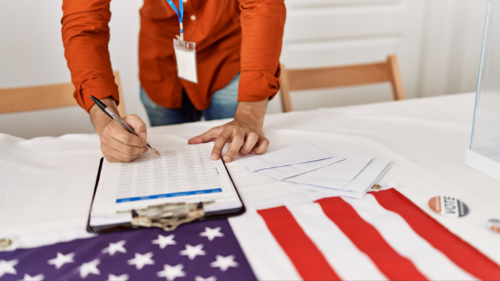
As Veterans Day approaches, many Americans reflect on those who have served our country and honor their continued contributions to our communities. For veterans, a central question is what comes next and how to continue their path of service. Vet the Vote — a nonpartisan coalition dedicated to mobilizing trusted, mission-focused individuals from the military community — helps answer that call by providing a renewed sense of purpose. Through their efforts, thousands of veterans and military family members step up every election cycle to fulfill a vital civic duty by serving as poll workers, strengthening local election administration nationwide.
Ahead of this Veterans Day, the Ash Center connected with the leadership team behind Vet the Vote to explore our shared commitment to democratic innovation, including nonpartisan civic engagement and the intersection of sports and voting. We discussed their mission, the spirit of nonpartisan service, their partnerships across professional sports, and their hopes for the future of American democracy.
Our conversation features Co-Founder and Executive Director Ellen Gustafson, a Navy spouse of nearly 15 years; Chief of Staff and Director of Programs Ingrid Sundlee, the daughter of an Army Corps of Engineers veteran; and Director of Operations Julie Hendricks, a former Navy helicopter pilot, military spouse, and active poll worker who brings firsthand experience from both sides.
This content has been edited for clarity and length.
Q: What inspired you to start Vet the Vote?
Ellen Gustafson: The origin story is that during the summer of 2020 at the height of the pandemic, as a military spouse, I saw so much misinformation flying around that was given more credibility when elevated by members of the military or veteran community. … Seeing how much our community was being used as a vector for questioning elections, I realized it’s really hard to push back on that … We are far more apt as a community to see it to believe it, be in the experience itself, and then be a great mouthpiece for truth.
… hearing that there was a real need for poll workers in 2022 in that midterm election, we put out a call to say, “Hey, why don’t we invite the veteran and military family community to be the solution that America needs to fill these poll worker roles?”
We asked the VA to pass this out to the entire VA mailing list as an opportunity to get involved in your community and make money. Amazingly, in that first year, we were in the VA newsletter. Within 12 hours, 36,000 veterans signed up to serve again as workers. By the end of that first campaign year in 2022, we had 63,000 veterans sign up. So, we knew we were onto something.
Then, we surveyed people after, and they were like, “It was amazing. It was one of the most patriotic things I’ve ever done. I feel better about understanding how elections work because I was there.” Now, in 2026, going into these midterms, we’re at 176,000 veteran and military family poll workers.
Q: How has the landscape for poll worker recruitment shifted since 2022, and what are your main recruitment challenges today?
Gustafson: Well, this year we’re actually not facing a universal shortage. In 2022, because of COVID and threats to election workers, the typical older population of poll workers did not want to go and serve. But when we put this call out in 2022, we got such an incredible updraft of new poll workers of all different ages coming from the veteran and military family community. We filled half of America’s 120,000-person deficit that year with 63,000 people.
Now those new poll workers—now 176,000—are continuing to serve and getting called as needed by their county. … Poll working is not a national thing; it is a state or county thing across over 10,000 election jurisdictions. … They recruit consistently, but we’re not facing a universal national shortage today.
Q: Why do you feel the military-connected community is uniquely equipped to serve as poll workers, and what drives the immense response you’ve received?
Julie Hendricks: I think there are two things. One is when we leave the military, a lot of people are looking for a way to plug into their local community to continue serving. It’s in our nature. I’ll tell people, when I was 17, I didn’t know what I was getting into. But when I got out of the Navy 12 years later, I knew that it was about service—service to your community and your fellow Americans, and understanding that not every country has this right to vote. Having a desire to provide that for your fellow Americans is a call that continues.
Secondly, we’re really well suited physically and mentally to do the job because we are trained and have the ability to put the mission first. You enter a room and you don’t necessarily care who someone’s voting for. You just understand that you’re all going to come together and you’re going to help the people vote … We are able to take the temperature down pretty easily. I joke sometimes—not trying to be hyperbolic, but it is not life or death. You’re in a polling station; there is a solution. We’re able to deal with a certain type of pressure that not the entire public can.
Q: How does placing military community members at polling places reinforce voter confidence in the democratic process?
Gustafson: Poll workers are the official people trained by their state and local jurisdictions to support the on-staff election management team. These volunteers surge into the system to do specific jobs and then go back to their day jobs.
This is again why the military community is so great: we know how to do things that we’re trained to do. We fly helicopters, take nuclear submarines underwater for weeks at a time. This community can figure out exactly how to manage a safe, secure, and accurate election system. Having disciplined, trained people executing the mechanics of an election reassures voters that the system is working as intended.
Q: How do you navigate training volunteers across thousands of distinct jurisdictions?
Gustafson: It’s all done by the states. We recruit, we talk about what this opportunity is, we tell people America needs them, and then we pass them right on to their local jurisdiction by ZIP code, and they get trained locally by the people in their state who do the training.
Q: What led Vet the Vote to partner with major sports leagues like the NFL, NBA, and NASCAR to promote civic engagement?
Gustafson: We saw an opportunity because the NFL was running NFL Votes, using stadiums as polling locations. … The NFL is not talking about parties or who to vote for; they’re just encouraging voting. That’s the same normalizing and depoliticizing of the concept of elections that we wanted to bring to the table.
Plus, the sports leagues are very patriotic and supportive of the military. There is a great parallel: two teams play in a sport, and then you go home and the game’s over. That’s the same norming we wanted to remind Americans that elections should be: there’s rules of the game, referees, people that run the fields, you play the game, you go home, and the winner is the winner. That’s how we see the job of poll workers. They set up the field, make sure everything’s ready to go, the teams play the game, people vote, and then go home.
We started with the NFL, then moved on to the NBA and NASCAR. What we found is they have an incredible platform to speak to a wide array of Americans about honoring poll workers—clapping for them to come out on the field and flipping the script from skepticism and questioning to thanking and expressing gratitude to the people making this happen.
Q: How have these partnerships translated into increased visibility and actual campaigns?
Gustafson: We’ve done a lot of honoring veterans who have served again as poll workers in a lot of different contexts: bringing people to games and races, having them go on the field, court, or racetrack to be thanked. We’ve worked specifically with the NFL to make video content showing the parallel between prepping for a football game day and pep-talking poll workers for election day.
More recently, we launched the Unsung Heroes Campaign this year, where we’re highlighting veterans who are not the athletes, but who work behind the scenes in the sports leagues to make those games and races happen. Then we’re paralleling those people to veterans who are making elections happen. We’re talking about the fact that there are unsung heroes of sports who work in the locker rooms, prep the field, are trainers—and many are veterans. … Veterans are this common thread behind the scenes making both of these big public events happen.
Q: Beyond your athletic partnerships, what other major initiatives or campaigns has Vet the Vote launched recently?
Ingrid Sundlee: We expanded Vet the Vote in three ways in 2026. First, we started the Vet the Vote Awards to give election jurisdictions the opportunity to win an award. We suggested they survey their poll workers, and if more than 10% of their staff was veteran or military family members, we would give them a Vet the Vote Award. … we estimate that 30% of our poll workers are veterans and military family members. So, America as a whole would get a Gold Vet the Vote Award, which is very cool.
Second, we started a campaign called Thank Them Twice. We set up a really simple online system at thankthemtwice.org where you fill out a quick form to thank your election officials. … election officials are under a lot of stress and duress this time of year, and one of the most patriotic, important things we can do is show them that their community supports them.
The final way we’ve bolstered election official support is running an event series called Come Hell or High Water. We had two virtual events and four in-person ones looking at how elections are held no matter what, come hell or high water, across the country. Our first session dealt with the COVID-19 pandemic, and we had election officials from Arizona, Missouri, and Pennsylvania talking about the different challenges posed by COVID. We then went to Asheville, Houston, and Tampa, Florida, where all of these states encountered severe hurricanes right before elections. Election administrators shared their stories about what they did to get around those challenges.
So, Karen Brinson Bell, who ran North Carolina elections after Hurricane Helene, talked about how voter turnout actually increased in the wake of this massive hurricane when many people didn’t have running water or electricity. Florida election officials talked about being locked down in their offices for 50 days after back-to-back hurricanes in 2024 and still administering elections … the real meta-message is that our elections in America happen no matter what, despite massive disaster and disruption. If people are feeling negative or saying a great single event is going to cancel elections, that’s simply not borne out by historical evidence or our Constitution.
Gustafson: One clarifying note is that so many election workers, poll workers, and election officials themselves are veterans. That’s the genesis of the “Thank Them Twice” concept: these are people that already served and are literally serving again.
Ash: What a fantastic message of hope when a lot of people are feeling anxious.
Hendricks: Exactly. If you go on there, it is so inspiring reading the messages. If you need a pick-me-up, just go on there and read them.
Ash: Looking ahead, how can we transform election service from a periodic duty into a enduring culture of civic engagement nationwide?
Gustafson: We want to make it a norm that when people leave the military, this is one of the things they look to get into. They continue to serve America in this way that is different but along the same lines: protecting our right to self-government and our institutions, and you’re making it so that the thing you literally fought for is maintained year in and year out. There’s a powerful message there that military-connected people see. We joke about the fact that when you’re a military-connected person, when you hear the national anthem or see the flag, you get these patriotic feelings. You get that as a poll worker again—that earnest, solemn commitment to the oath, to the Constitution, to continuing this American experiment.
Hendricks: Not exaggerating, the first time I went to poll worker training, I was almost in awe of these other folks coming together to do this thing … It is extremely similar to how you feel on deployment, on the 4th of July, looking at the carrier—it’s a unique feeling, and it’s a good feeling.
Sundlee: The only thing I would add is that people don’t realize they are invited to do this form of civic service. … we’re trying to open the door and make sure people know they are invited and welcomed to these public spaces. That’s been a really important part of what we’re doing.
Dana Guterman is a content strategist, writer, and editor with the Ash Center for Democratic Governance and Innovation.