Video  

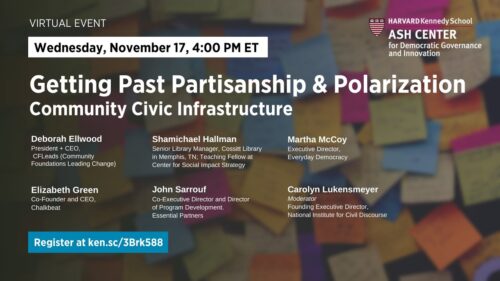
Getting Past Partisanship and Polarization: Community Civic Infrastructure

In this panel discussion, community organizers, leaders, and democracy advocates explored examples from communities all over the country where this is working today. Then, they discussed the challenge of replicating and expanding community civic infrastructure initiatives across the country.

Related Resources

Terms of Engagement – Matthew Baum on What Voters Fear, What They Don’t Know and Where They Look
Terms of Engagement main graphic with picture of Matthew Baum.

Podcast

Terms of Engagement – Matthew Baum on What Voters Fear, What They Don’t Know and Where They Look

As the 2026 midterm elections approach, new research raises an urgent question: are Americans operating within fundamentally different information realities? In this episode, Professor Matthew Baum examines what voters know about election rules, where they get their information, and how partisan divides shape perceptions of the voting process.

In Appearance Before Congress, Stephen Richer Testifies at House Hearing on Alleged Noncitizen Voting in New Jersey
Stephen Richer testifying before Congress.

Feature

In Appearance Before Congress, Stephen Richer Testifies at House Hearing on Alleged Noncitizen Voting in New Jersey

On Tuesday, September 15, 2026, the House Judiciary Subcommittee on Oversight held a hearing featuring testimony from Stephen Richer, a former Maricopa County, Arizona, Recorder, election administration expert and Ash Senior Fellow.

The hearing examined allegations that approximately 6,600 noncitizens were improperly registered to vote in New Jersey between June 2023 and June 2024.


More on this Issue

Allen Lab Fellow Spotlight: City Charters Are Deliberative Democracy’s Friends

Commentary

Allen Lab Fellow Spotlight: City Charters Are Deliberative Democracy’s Friends

Allen Lab Fellow Tyler Fisher examines the untapped potential of city charters as a vehicle for deliberative democracy, arguing that advocates should work to embed tools like citizen assemblies, participatory budgeting, and town meetings directly into the governing architecture of cities, institutionalizing deliberative democracy one municipality at a time.