The Allen Lab for Democracy Renovation’s Technology and Democracy workstream aims to ensure that emerging technologies are developed and governed in support of the public benefit.
The Allen Lab for Democracy Renovation’s Technology and Democracy workstream is focused on developing democracy-supportive technology policies, harnessing the opportunities for emerging technologies to improve governance, fostering professional norms that lead to technology development supportive of human pluralism, and building a robust pipeline of experts who can bridge ethical and technical considerations within policy and industry spaces. We pursue this work through foundational analysis and theory, field-building, and policy development.
The Landscape of Digital Civic Infrastructure in Massachusetts
Allen Lab for Democracy Renovation authors offer the first comprehensive analysis of how Massachusetts municipalities are using technology to support civic engagement, government decision-making, and public service delivery.
Crocodile tears: Can the ethical-moral intelligence of AI models be trusted?
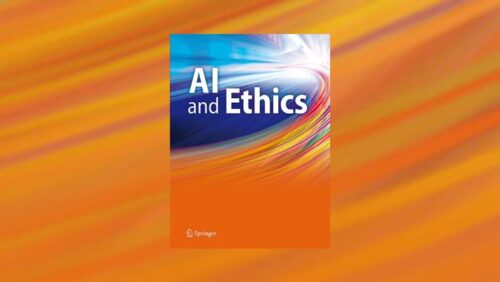
Allen Lab authors Sarah Hubbard, David Kidd, and Andrei Stupu introduce an ethical-moral intelligence framework for evaluating AI models across dimensions of moral expertise, sensitivity, coherence, and transparency in their recently published paper, Crocodile Tears: Can the Ethical-Moral Intelligence of AI Models Be Trusted? in Springer AI & Ethics.
Earlier this year, the Allen Lab for Democracy Renovation hosted a convening on the Political Economy of AI. This collection of essays from leading scholars and experts raise critical questions surrounding power, governance, and democracy as they consider how technology can better serve the public interest.
This policy primer from the Allen Lab for Democracy Renovation is intended to introduce the ideas and conversations around how public AI alternatives could foster an ecosystem that prioritizes the public interest while offering a counterbalance to corporate concentration.
This policy primer from the Allen Lab for Democracy Renovation is intended to introduce the ideas and conversations around reform of Section 230 of the Communications Decency Act and how it could remake the social media ecosystem.
A Roadmap for Governing AI: Technology Governance and Power-Sharing Liberalism
This paper aims to provide a roadmap for governing AI. In contrast to the reigning paradigms, we argue that AI governance should be not merely a reactive, punitive, status-quo-defending enterprise, but rather the expression of an expansive, proactive vision for technology—to advance human flourishing.
GETTING-Plurality Research Network
At the center of our work is our multidisciplinary research network. The Governance of Emerging Technology and Tech Innovations for Next-Gen Governance (GETTING-Plurality) is a research network linking philosophers, social scientists, computer scientists, legal scholars, and technologists. This unique collaborative unites tech ethics initiatives at Harvard University with external impact partners across higher education and the tech industry, bringing philosophers and ethicists to the table for every project.
Our network seeks to advance understanding of how to shape, guide, govern, and deploy technological development in support of democracy, collective intelligence, and other public goods. Our focus is on how to do so, given the plural nature of human intelligence. We connect theory with practice to ensure that academic insights inform real-world policy and industry standards.
Transparency is Insufficient: Lessons From Civic Technology for Anticorruption
Allen Lab Researcher David Riveros Garcia draws on his experience building civic technology to fight corruption in Paraguay to make the case that effective civic technology must include power and collective action in its design.
The Ecosystem of Deliberative Technologies for Public Input
Ensuring public opinion and policy preferences are reflected in policy outcomes is essential to a functional democracy. A growing ecosystem of deliberative technologies aims to improve the input-to-action loop between people and their governments.
In a new working paper, Crocodile Tears: Can the Ethical-Moral Intelligence of AI Models Be Trusted?, Sarah Hubbard, Associate Director for Technology & Democracy, David Kidd, an Allen Lab member, and Andrei Stupu, a former Allen Lab fellow, introduce a framework for evaluating the ethical-moral intelligence of AI models across dimensions of moral expertise, sensitivity, coherence, and transparency.
Sunset Section 230 and Unleash the First Amendment
Allen Lab for Democracy Renovation Senior Fellow Allison Stanger, in collaboration with Jaron Lanier and Audrey Tang, envision a post-Section 230 landscape that fosters innovation in digital public spaces using models optimized for public interest rather than attention metrics.
Digital Civic Infrastructure for Massachusetts Workshop
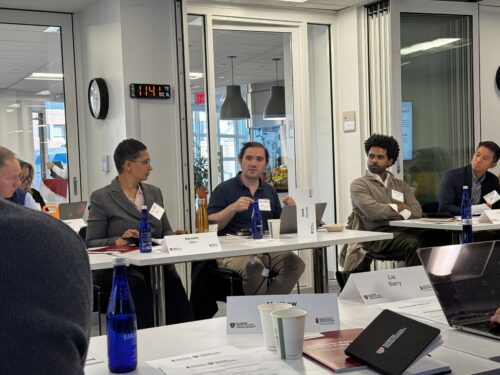
The Allen Lab for Democracy Renovation and Bloomberg Center for Cities brought together civic technologists, researchers, as well as municipal and state leaders across Massachusetts for a workshop on digital civic infrastructure.
Creating a healthy digital civic infrastructure ecosystem means not just deploying technology for the sake of efficiency, but thoughtfully designing tools built to enhance democratic engagement from connection to action.
Governing with AI – Learning the How-To’s of AI-Enhanced Public Engagement
Public engagement has long been too time-consuming and costly for governments to sustain, but AI offers tools to make participation more systematic and impactful. Our new Reboot Democracy Workshop Series replaces lectures with hands-on sessions that teach the practical “how-to’s” of AI-enhanced engagement. Together with leading practitioners and partners at InnovateUS and the Allen Lab at Harvard, we’ll explore how AI can help institutions tap the collective intelligence of our communities more efficiently and effectively.
Technology and Democracy: What to Read This Summer
This list of resources, curated by the GETTING-Plurality Research Network at the Allen Lab for Democracy Renovation, highlights emerging ideas at the intersection of technology and democracy.
The bipartisan Utah Digital Choice Act aims to reform the social media ecosystem by giving users more choice and ownership over their personal data, while encouraging platform innovation and competition.
Weaponized AI: A New Era of Threats and How We Can Counter It
Allen Lab for Democracy Renovation Fellow Dr. Shlomit Wagman lays out a framework to address the threats artificial intelligence poses to global security and democratic institutions.
In a recent piece for Tech Policy Press, Allen Lab Senior Fellow Alex Pascal and Nathan Sanders outline how US states are well-positioned to lead the development of Public AI. State governments can act as “laboratories of twenty-first century democracy” to experiment with AI applications that directly benefit citizens.
Over the past several weeks, the Department of Government Efficiency (DOGE) within the Trump Administration has been embedding staff in a range of United States federal agencies. These staff have gained access to data maintained by the federal government. This guide explains what is in the data, what DOGE is doing with it, and why it matters to all Americans.