Organizing and Mobilization during Democratic Backsliding
In this webinar, panelists drew upon lessons from around the world about how civil society groups can protect and promote democracy and the rule of law during episodes of democratic backsliding.
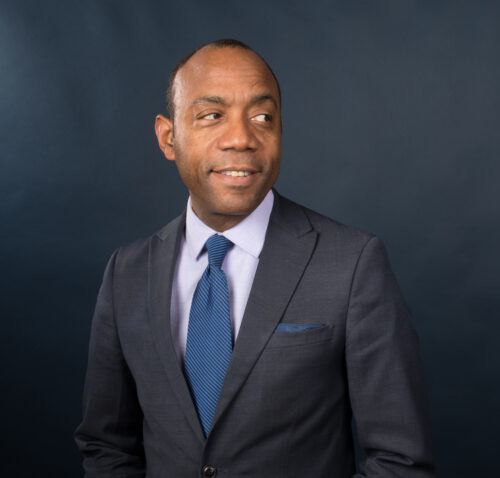
Cornell Brooks is the Hauser Professor of the Practice of Nonprofit Organizations and Professor of the Practice of Public Leadership and Social Justice at the Harvard Kennedy School and the Director of The William Monroe Trotter Collaborative for Social Justice at the School’s Center for Public Leadership.
Erica Chenoweth is the Frank Stanton Professor of the First Amendment at Harvard Kennedy School and Director of the Nonviolent Action Lab.
Marshall Ganz is the Rita E. Hauser Senior Lecturer in Leadership, Organizing and Civil Society at the Kennedy School of Government.
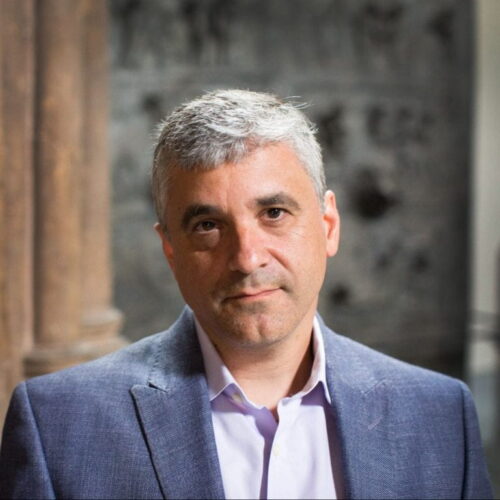
Steve Levitsky is the David Rockefeller Professor of Latin American Studies and Professor of Government and Director of the David Rockefeller Center for Latin American Studies at Harvard University.
The views expressed in this article are those of the author(s) alone and do not necessarily represent the positions of the Ash Center or its affiliates.
Terms of Engagement – How did the Democrats Lose Silicon Valley? Should They Try to Get it Back?
The relationship between Silicon Valley and the Democratic Party has undergone a dramatic shift over the past decade, with many tech leaders moving away from their once-strong political alignment. This special episode of Terms of Engagement explores what drove that change and what it means for the future of democracy, political power, and the influence of technology elites.
Terms of Engagement – Sedition, Partisanship, and the Future of American Justice
Former Assistant U.S. Attorney Troy Edwards, who was a leading prosecutor in the case of the January 6 attack on the U.S. Capitol, joins Terms of Engagement to discuss the Trump Administration’s move to vacate the seditious conspiracy convictions of the Oath Keepers and Proud Boys and what it means for the future of the Department of Justice and the rule of law.
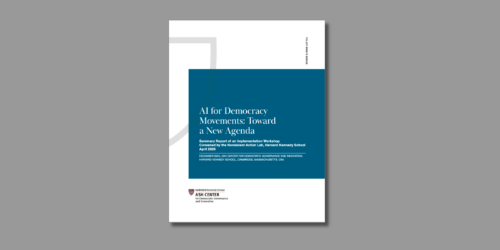
A new report summarizes key insights from the Nonviolent Action Lab’s December 2025 convening on how artificial intelligence can empower pro-democracy movements.
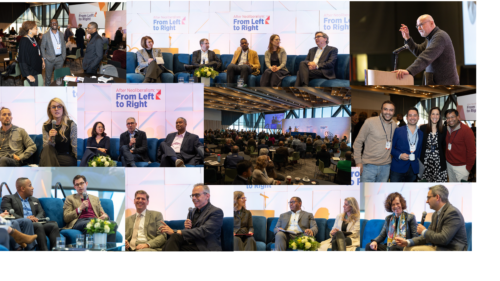
After Neoliberalism: From Left to Right brought together hundreds of leading economists, political scientists, journalists, writers and thinkers from across the political spectrum to explore and debate emerging visions for the future of the political economy.
Watch Roadtrip Nation’s Living Civics documentary and hear from leading universal civic learning experts on the power of narrative for civic engagement.
The Present — and Future — of Alternatives to Police
Allen Lab Affiliate Benjamin A. Barsky examines alternative emergency response programs — arguing for a democratic model of public safety governance in which responses to nonviolent incidents are shared across government and civil society rather than dominated by police.