Voiceover:
You’re listening to Terms of Engagement, a weekly show from the Ash Center for Democratic Governance and Innovation at Harvard Kennedy School, featuring Ash Center director Archon Fung and senior practice fellow in American democracy, Stephen Richer. Now let’s get to the show.
Archon Fung:
Hey everyone. Welcome to Terms of Engagement. I’m Archon Fung, a professor at the Harvard Kennedy School and faculty director of the Ash Center for Democratic Governance and Innovation.
Stephen Richer:
And I’m Stephen Richer. I’m the former elected Maricopa County recorder from Phoenix, Arizona. And I’m now a fellow at the Ash Center. And apologies for starting a few minutes late today. I was still wiping away the tears from last night’s U.S. World Cup Game. And please forgive me for the casual attire today. I am currently traveling in Seaside, Oregon where I’m doing an adult run camp.
Archon Fung:
That’s excellent. And so you’re in the sporting mood. So we had a little exchange about this in the show prep. I got to ask you, you’ve been watching the World Cup, you’ve actually been to a couple of games. I’ve been watching a little on TV. So do you think two wrongs make a right in the game with Bosnia and Herzegovina, the U.S. striker or the star of the team, Balogun, I think, I don’t know how to pronounce his name exactly, gets a red card. A lot of people, myself included, not that I’m a soccer expert, think that that red card was undeserved. The red card would’ve prevented him from playing in last night’s game with Belgium. But evidently, according to journalism reports, the President of the United States calls up the president of FIFA and asked him maybe to rethink the red card so that Balogun has to play. So maybe President Trump in that magical phone call, maybe that was the best call ever, the most perfect call, got the red card reversed. Do you think two wrongs make a right?
Stephen Richer:
I think that probably a lot of people were appreciative of President Trump taking an interest in something that was so meaningful to so many Americans. That being said, I found it a little distasteful. I don’t think it’s the role of the president. And it seemed like some sort of shady backroom dealings in order to give the United States an advantage. With the benefit of hindsight, knowing that even with our starting striker in play, we lost 4-1. I would’ve said, “No, this is a moment to show that Americans are people of principle. We respect the rules of the sport and we’re going to sit our starting striker.” And you know what? We might’ve lost 5-1. But again, all this-
Archon Fung:
But it would’ve been an…
Stephen Richer:
If you told me he scored the winning goal last night or something, then I might’ve been able…
Archon Fung:
Yeah. So that would’ve been an incredible moral victory on a Ted Lasso kind of level, but alas.
Stephen Richer:
One of my colleagues said to me that the manager of a World Cup soccer team is there to win and you got to play the best team that you have available. And there was all this scrutiny and questionability over the red card that was given in the previous game. And so was it appropriate? I don’t know, but it didn’t feel right. And certainly it didn’t make the United States any more popular among the international community.
Archon Fung:
Yeah, absolutely. And maybe we’ll revisit this on a subsequent show. Our friend and colleague, yours and mine, Tova Wang, is doing a project on sports and civic life and democracy. And one of the themes there is I think everybody who plays a sport at any level understands that the rules make the sport possible and you really, really want to win and you get lots of bad calls, but the rule set is out there and it’s part of what makes the game good. And how is it that in politics so many people, the idea of winning has overshadowed or superseded this idea that the rules make the whole thing possible. And can we get to a more sports-like version of politics?
Stephen Richer:
Yeah.
Archon Fung:
Rules really, really matter.
Stephen Richer:
And then it’s interesting because you have the written rules of sports and then you have the unwritten rules too. Sort of, even if the referee doesn’t see it, what is acceptable, what is not acceptable? So for instance, if the referee doesn’t see it, pulling on somebody’s jersey, totally within the social parameters of acceptable sports behavior, quickly kicking somebody to the groin if the referee doesn’t see it, I think that you would suffer social opprobrium. And so it’s interesting to me, but I guess it’s not going to matter. We’re not going to have an asterisk on our win because we did not win.
Archon Fung:
We did not win.
Stephen Richer:
My enjoyment of the World Cup has diminished as a result, but I’ll still be following it to the end. And it’s still exciting that it’s here in the United States as all the final games are here in the United States.
Archon Fung:
It is. And well, I mean, the U.S. men’s team made it to the round of 16. That’s not nothing. So that’s really good.
Stephen Richer:
Yeah. Well, okay. Ralph is texting us that we need to get to our topic at hand and we certainly should, especially considering we started a little bit late. But we are talking about the topic that everyone is talking about, which is artificial intelligence, except for we’re going to be talking about it a little bit in the context of democracy especially. I’m sure that everyone is probably sick of all the commercials about how you can integrate artificial intelligence into your workplace. And it evokes probably a lot of rolling eyes at this point, which is not necessarily where it started. And that trajectory, that arc is very interesting because I think that we’re a country that has really historically embraced new technologies and what they can bring to the workforce. And that’s especially true of young Americans. I think if we think of something like the Hardy Boys, which I grew up reading-
Archon Fung:
The Hardy Boys.
Stephen Richer:
Was young Americans adopting the technical wonder that was the automobile before everyone else and they could do amazing things with it. Or if we think of Matthew Broderick’s character in WarGames, understanding how computers work before the average person in society does allowed him to do wondrous things and exciting things. And maybe that’s where we were at the beginning, but in Arizona where I’m from, Eric Schmidt, the former CEO of Google spoke at the commencement of University of Arizona and he was largely booed when he was talking about artificial intelligence. And that reflects a broader sentiment. We were looking at some Pew Research statistics and only about 23% of the American public thinks that AI will have a positive impact on their jobs. And only about a quarter of Americans also think that AI will have a positive impact on society today. So we’re going to bring in our guest who’s going to talk with us about this position of AI, but then also is AI compatible with our democracy? So Archon’s going to introduce our wonderful guests.
Archon Fung:
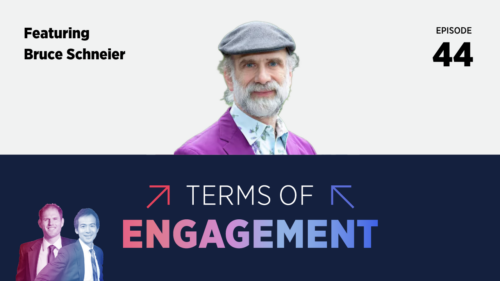
Great. And our wonderful guest is Bruce Schneier who is a lecturer at the Kennedy School and a member of the faculty community, the Ash Center. He is one of the most widely read voices in security and technology. Much of his career still, he focuses on security. The economist once called him, “A security guru.” He’s written many, many books, including the bestseller, A Hacker’s Mind.
Most recently he’s written with Nathan Sanders, the book that we’ll be focusing on, which is Rewiring Democracy: How AI Will Transform Our Politics, Government and Citizenship. He’s got a live Bluesky presence where he toots, I guess, Bluesky about security. So his blog is Schneier on Security. And my own bias as an MIT kid is a lot of people around the Kennedy School and in these kind of social science circles talk about AI and technology and policy. I listen more to people who have a deep technical background. That’s just my bias. I feel like if you have a nose and a feel for the phenomenon, it’s more interesting to me to hear what your views about it are. And Bruce is a real expert in both the technology and the politics and policy of it. So welcome, Bruce.
Bruce Schneier:
Yeah, thanks for having me. I don’t know where you got that Bluesky fact. I’m on no social media at all.
Archon Fung:
I follow you on Bluesky. You post stuff on it.
Bruce Schneier:
I think there might be something that republishes my blog. I’m on no social media. It makes me a freak, but highly productive.
Archon Fung:
So I’m following an AI, a bot that follows you. That’s what’s happening.
Stephen Richer:
Or it’s a hacked impersonator. Because the first question I was going to ask as a technology enthusiast, what it’s actually called to write on Bluesky. What did you call it, Archon?
Archon Fung:
I think I missed… I called it-
Bruce Schneier:
No, no, I’m on Mastodon. Yeah. Mastodon is, because they’re an Elephantidae-
Archon Fung:
Yeah, yeah.
Bruce Schneier:
… tooting. Now I can look it up while you people talk about the World Cup.
Archon Fung:
So Bruce, what I want to know, just to begin to get into the topic a little bit, is your relationship to AI and how you’re using it, if at all. And do you use it, first of all? And why or why not and what for?
Bruce Schneier:
I largely don’t. I always feel like I should, but I have not found a useful case for me. I’m writing a piece right now on what I tell my students and it’s difference between the work and the gym. So this is my spiel. If you are at work and your job is to move a bunch of heavy things from here to there, use any assistive tech you like. A hand truck, a forklift, or an AI Android. But at the gym, it makes no sense for an Android robot to lift weights for you. Because at the gym, the point is to lift the weights. So what you would think I might use it for would be writing. But for me, writing is the gym. It is how I think, it is how I organize. It is how I make sense of things. Outsourcing that, it wouldn’t work because the process is the weightlifting is the important thing, not the output. The output is almost ancillary to me thinking about it.
Stephen Richer:
Okay. I like that analogy, but it sounds like you’re spending most of your life in the gym then rather than doing the work. And a reminder that please, we’ve already got some comments in the chat. Please feel free to post comments and we’ll work them into the conversation. Archon, you are actually a pretty heavy user of AI. And how do you integrate it into your scholarly work or your work administering, running the Ash Center?
Archon Fung:
Yeah. So I think I have two reasons that I use AI. And one reason is everybody’s talking about it. It feels like it’s going to be a big deal. So I kind of want to get a first person feel for what these things can do and can’t do. And the main way that I’ve been doing that is I’ve been running local large language models so they don’t hit data centers, et cetera. They just hit my laptop and make the fans spin up. And I’ve been vibe coding 1980s video games on them. So I vibe coded a centipede game, lots of snake games, a few others. And so that’s been kind of fun to kind of get a sense of what they can do and what they can’t do in terms of coding.
Stephen Richer:
Both of you, what’s your AI policy for students?
Bruce Schneier:
So it’s interesting. I give them the work versus gym spiel, but I can’t be their parents. I can’t police it. I tell them it’s a waste of their tuition dollars. So funny, and I think about the two different things I think about. One is the students feel pressure to use it because they feel like they’re in a race with their other students. They feel like they don’t, they’re going to do worse. They’re going to produce less good work. So the bar is raised and they feel AI-
Archon Fung:
Because we are measuring them on how much they can lift from one… To use your analogy.
Bruce Schneier:
And the other is that they’re all overworked. I mean they can come into a class with all the good intentions of doing the work and keeping up in the reading and paying attention, but it’s the middle of the semester, they have too much on their plate and they have to cut corners. And even before AI, readings… Archon will know this just as much as I do from teaching. They don’t do the readings. They don’t… Not enough time. So I don’t know. I’ve experimented with things, but I have decided just not to police it.
Stephen Richer:
So is AI the SparkNotes of 30 years ago?
Archon Fung:
Yeah. I mean, it’s at least that. It is at least that, for sure
Bruce Schneier:
That’s a good way of thinking about it. But I just read an article two days ago about employers finding that new grads coming out of college, having had spent four years with ChatGPT or three or whatever it is, don’t have the reasoning skills. I mean, they haven’t spent enough time-
Archon Fung:
Yeah, they didn’t go to the gym, like you say. Right. Yeah.
Bruce Schneier:
But we need to figure this out. How do we as teachers grade in a world where anything done remotely can’t be trusted?
Archon Fung:
So maybe one silver line, it’s hardly a silver lining, but I know I am doing this and colleagues are, is we are shifting our assessments and our interactions to more face-to-face. So I met with every student for about 20 minutes in the spring semester to talk about their final projects face-to-face, just so that I get a sense that they’ve actually gone through some reasoning process and I’m reasoning through with them, which I absolutely didn’t do in years past.
Bruce Schneier:
Right. And in some ways the modern university was built on this notion of mass evaluation. And you go back to Cambridge or Oxford and it’s individual instruction, individual evaluation. Now we can grade students in blocks of 100 and maybe we can’t do that anymore. That’s going to change education.
Archon Fung:
Yeah, read their papers because we don’t know who the-
Bruce Schneier:
A lot of professors use AI to read papers. In a sense, that’s different. I am more sympathetic to that because as professors, we don’t need to read the papers. I mean, that’s work to us, not gym. But I’m sure the students feel like they’re not getting their value if they’re being graded by an AI. But they usually graded by a TA and we just never told them. So how much worse is that?
Archon Fung:
We should move to the democracy topic.
Stephen Richer:
Well, before we get to sort of the doom and gloom that we’re going to talk about in the context of AI in society, what are some of the positive ways in which countries, governments have been using AI to deliver better services, to communicate better with constituents? What have you seen?
Bruce Schneier:
So there’s a lot. And God, I mean the doom and gloom bothers me just as much as the utopia people. AI is a tool. It enhances your power. If you want more democracy, AI will help you. If you want less democracy, AI will help you as well. So in our book, wave around once. So there it is. We talk about a bunch of things going on around the world. I’m going to talk about, we mentioned a few that didn’t make them because they’re too new. So my first one is Japan. And so there’s someone there, Takahiro Anno. 2024, he’s a software engineer, mid-30s, runs for mayor of Tokyo, comes in fifth among 50 something because he uses AI to run the continuous stream answering voter questions. It was all new back then. Super cool. Would’ve been an obscure footnote in history, but last year he won a seat in the upper chamber of Japan’s Diet.
Archon Fung:
Diet. Yeah.
Bruce Schneier:
Right. And so he has a new political party called Team Mirai, which is Team Future. It is neither left nor right. It is pro-tech. And he’s using the funding he got publicly for his party to spend it on AI engineers building civic tech. So he has these deep listening apps where voters participate in interviews and their policy proposals are generated and voters get to talk about them. It’s super interesting. He’s making this stuff available to other parties. His party won more seats a few months ago. So they now have 11 seats in the house, which is not very much, but it’s not nothing. So he’s doing great stuff to try to make the legislator in Japan more responsive to its citizens. That’s one story.
I’ll give another story from Brazil. Brazil is a really litigious society, way more than the U.S. They spend an extraordinary amount of their government dollars defending lawsuits and paying off when they lose lawsuits. The courts are using AI in a big way not to do judging, but to do everything else, to schedule, to assign cases to people, to make the system work better. You could see it in the numbers. They are now much more efficient at dealing with cases. The Brazilian judiciary is more efficient because of AI. This has a revenge effect because now that the attorneys are also using AI, more cases are being filed. But I think this is great for democracy. I think the judicial system and also suing the government is a way for people to get their voices heard. So here’s Brazil using AI in I think a really interesting way.
One more story from California, this group, CalMatters. And they have been around for years. And what they do is they pay attention to California politicians. So every floor speech, campaign, email, tweet, everything that the legislator says is recorded in this system along with who gives them money and their voting record. And you as a citizen can search this to figure out what your politicians are doing. They added an AI feature I think last year called Tip Sheet. And what this does is it looks through that data and looks for anomalies, weird things, but it doesn’t publish it. What it does is it makes its tips available to journalists who register on the platform and the human journalists can follow up on what the AI found and see if a real story is there.
A really good example of getting the best of the human and the best of AI, which is like searching a lot of data, the human doing the investigation to work together to provide better investigative journalism. I could do this all day. There are stories in Germany, in Chile, in France, in Canada, all over of countries using AI, groups within countries, to make democracy work better. I could also do the reverse, ways we’re making democracy worse with AI. So if you want to go down that way, we can have other stories, but it’s a tool. It enhances the power of the people.
Archon Fung:
So interesting. So Stephen, having run for office, what do you think about the first example of using AI maybe first to answer many of your constituents’ questions that you couldn’t answer yourself because there’s only 16 hours that you’re awake in the day? And then also to listen to what they care about and what they want. Would you be excited about that or nervous about that machine interface?
Stephen Richer:
Yeah. Well, so campaigns are what a lot of people have talked to as a possible use for artificial intelligence. And the elections community has certainly paid a lot of attention to campaigns. I think that’s less compelling generally to the average user or average member of society as a benefit. Some people think, “Well, anything that’s going to allow candidates to do more of other stuff isn’t necessarily a pro-social thing, a good thing for society.” Because now it just means that, I don’t know, they’ll be doing more fundraising or something like that. That being said, one of the things that every election office has explored over the past two years is how to use AI to answer voter questions that are commonly phrased. So normally in the past, we would’ve just had through a customer management service system, just stock answers that we would pull down.
So instead what I’ve been working on is training AI models from Arizona statutes, from the elections procedures manual, and from emails that we have sent to constituents previously such that it can give answers without any of the staff having to spend time on it. Now we’re very cautious in the elections space just because it’s a space where if you get one of them wrong, it could disenfranchise somebody and it could lead to a further diminishment in trust.
Archon Fung:
Yeah. So yeah, you got to be risk-averse when you’re providing voting information.
Bruce Schneier:
So I gave a talk to congressional staffers and they talked about this and they said it’s the deluge. It’s not AI versus human, it’s AI versus nobody. And to me, the way to think about AI is helping in campaigning and it is things like polling, it is things like setting up websites, doing get up to vote campaigns. Don’t think Congress, don’t think Senate, think city council, think local. What this does is it lowers the barrier to run to office. You don’t have to be a rich white guy to run for office. So if these assistive tools I think make democracy better because they make it possible for people who couldn’t run for office to do so. Legislate, he was a Harvard fellow. He has an AI that’s helping legislators local write legislation. It’s either nobody or lobbyists before. I think this is great. Hilary Leir, another Ash fellow, she was working on assistive tools for people to run for office. DonorAtlas helps candidates find donors. Again, think local office here where there’s no time, no money, no expertise.
Archon Fung:
That’s a great… Go ahead, Stephen.
Stephen Richer:
I do want to turn to why is it being perceived otherwise? But before we get there, I do want to take a question or two from the chat. Here’s one that I don’t even understand, but I think you will, Bruce, which is your recent tech policy blog post in 2025 might have missed a key concern. Our voices are barely heard when less than 1% of AI-assisted PRs via the bot created by site visitors are actually accepted. I don’t know what a PR is.
Bruce Schneier:
I don’t know what it is. Not a progress report.
Stephen Richer:
No. Maybe…
Bruce Schneier:
I mean the general timber I think is that whose voices are the AIs magnifying matters a lot. I was here in Toronto, someone did some research on when you type into an AI, tell me about a house. It gives an American middle-class house. Draw me a picture of a kitchen. It’s a Western middle-class kitchen. And sort of that training on slightly right of center California, small L libertarian, white male values is what you have. How to make these systems more expansive is hard. So I’m not sure if that’s the question, but-
Stephen Richer:
It’s a GitHub pull request, if that makes sense.
Archon Fung:
Oh, so this is a pretty technical question. So GitHub is a repository for lots and lots of code and a pull request is somebody modifying that code and pulling some part.
Bruce Schneier:
Archon can’t help but teach.
Stephen Richer:
Well, thank you because that’s good because I didn’t know so I appreciate the teaching.
Bruce Schneier:
Right. And you now don’t know more now that you know.
Stephen Richer:
But I can ask AI later.
Bruce Schneier:
That’s right.
Stephen Richer:
So is this a translation problem, Bruce, or a marketing problem that you’re saying all these positive things are happening with the government?
Bruce Schneier:
No, I then like to separate out a couple of things. One is AI is a tool of the humans. So it’s what the humans want. And two, the AI companies are freaking evil. So separate out what is a tech problem, what is a capitalism problem? I think what people… Oh, what’s his name? Ted Chiang, science fiction author. He said it a few years ago in an interview that most people’s fears of AI are misplaced fears of capitalism. I think it’s really insightful. Who is it? It’s power enhancing. Whose power is enhancing, yours or Google’s or Facebook’s?
Archon Fung:
And your stories have all been about enhancing people trying to run for an office who are small, aren’t members of incumbent parties and then-
Bruce Schneier:
But we’re moving into a world where a few companies want to capture all the value. So here’s an example. Let’s imagine an AI is good enough to be a physician’s assistant. It’s good at diagnosis. It could read x-rays, does all of these things and makes it a really good physician’s assistant. So two ways this could go. One, each physician gets one of these and becomes a better doctor and spend more time with the patients, better listening, more empathy, becomes a better doctor. Or the company who owns the medical practice can give that doctor five times the patients and fire the four of the doctors. Same tech. Which do you think will happen in the U.S? Which do you think will happen in France? It’s going to be different and it’s not the tech.
Archon Fung:
Yeah. So to set the stage alert, provide a little bit of information. Ralph, if you could put up the slide from, this is some Pew data about public opinion and expert opinion about AI. And so the blue dots are just like U.S. adults, people answer the survey. And the green dots are people working in AI. That’s what an AI expert is, is somebody working in the industry. And there are huge, huge gaps. People working in the industry, the AI experts are much more enthusiastic about AI improving how people do their jobs, the economy, medical care, education. But it’s interesting, you get down to the bottom and experts and people like-
Bruce Schneier:
No one likes elections.
Archon Fung:
… very skeptical that AI will either improve elections or the news that people get. So that’s one piece of data. And then also another piece of data, I think we know this, is that people in some other countries like China, ordinary people, like you do the general population survey in China and people in China are much more enthusiastic about the eventual effects of AI on the economy and society than people in the United States. So Bruce, I think on that bottom, the news people get and especially elections, you are more positive than either the AI experts or the adults or is that a mischaracterization?
Bruce Schneier:
I’m not sure. I mean, because right now it’s going to be used to manipulate people. And that’s what I think we’re referring to those last two, news people get and elections. It’s manipulative ability. Now manipulation is older than AI. I mean, again, it’s not an AI problem. This is a capitalism problem. This is a problem of TikTok. It’s the business models of those companies. Surveillance and manipulation are legal business models, and that’s what those companies do. If you look at all the misinformation on the election, Kellogg’s does that to market a breakfast cereal. They’ll get an award for good advertising. So I agree, but it’s not the tech. It’s older than the tech.
Archon Fung:
Yeah. Yeah, go ahead.
Stephen Richer:
I want to turn back to that capitalism question and the situation that you presented. I think one, you could respond that, “Well, consumers will choose the hospital that is using Using AI to give the physician more time to spend with each patient.”
Bruce Schneier:
The people who say that have never been sick. You’re in the ambulance. I’m going to choose my hospital. I’m bleeding out. No, let’s not do this. I just don’t want to do this. It’s just too dumb. Sorry.
Stephen Richer:
Well then let’s take it out of a hypothetical and just say in the present world, people have these tools at effectively zero dollar cost to them and that’s something that they didn’t have before. Yes, I know that they’re being sold something in the same way that you’re being sold something with Facebook, but really this is a mass available at no cost to every single person who wants to make a cool [inaudible 00:30:48]
Bruce Schneier:
Dropping democracy is a big cost. I wouldn’t minimize that.
Stephen Richer:
Well, how do you draw the link for me there?
Archon Fung:
Yeah, right, right. Between the mass availability, anybody can-
Bruce Schneier:
So it is a manipulation. Oh God, I forget who wrote the book. Free is not the same as a regular price. Free is psychologically different. And the fact that it moves it into free means people aren’t making that same value decision. So psychology doesn’t work that way. And also you’ve got a lot of monopolies working here effectively. And I mean, nobody’s on Facebook because they want to be on Facebook. They’re on Facebook because they have to be on Facebook. Everyone hates the damn platform. So you have lock-in, you have the incidification, all of this works mess with the ecosystem. So I mean, I’m always often asked, what’s the best thing we can do to help with all these tech problems? Drop the monopolies. I mean, you actually want real competition. And if you can do that, if you have competition, you have reasonable regulation, so you can’t do the makeup stuff. I would definitely get rid of surveillance as a business model. I mean, I think that’s as ethical as setting five-year-olds up chimneys to clean them. I mean, I get it’s a fun business, but sorry, you can’t do it anymore.
Stephen Richer:
And sorry, what company is that? Are you talking like a Palantir as-
Bruce Schneier:
Google. Google spies on you for a living. Google’s profits are based on spying on you and selling that information to advertisers. That’s what they do. These are all weird perturbations of the market. The market’s not allowed to work for a whole bunch of these things. Not where I thought this conversation would go, but here we are. And fixing that would go a long way to fix the tech. In AI, this might fix itself. It turns out that the smaller, cheaper public domain models are almost as good. Using them, few of them in concert are better than the frontier models. China, because they were denied access to the best chips, actually have to do engineering. And in the US, the companies can just have quite a large piles of money. They don’t have to really think about what they’re doing. And my guess is a lot of this data center build out is going to look like Undersea Cables did 20 years ago, that it’s going to be different. And I think that’ll be really good for the tech and good for the market. I mean, fewer OpenAIs and Anthropics seem better for the world.
Archon Fung:
So your thought is that there’s going to be a lot of tech build out in data centers and data transmission capacity and everything else, but that we won’t use it for what we’re thinking about using it for now.
Bruce Schneier:
Apple’s building a model that’s going to work on your phone. So people will be running them on their phone, on their laptops, on their high-end gaming machines. You right now could run DeepSeek locally. You could run DeepSeek on a phone. I know someone’s running on their phone. It’s running slow, but it’s DeepSeek on their phone.
Archon Fung:
Right. Earlier in the chat, Greg asked Archon, “Which local model do you use?” So I use Qwen, which is a 27 billion parameter model, the one I use and Gemma. And those are both open-weight models.
Bruce Schneier:
And you’re running them locally, right?
Archon Fung:
On a laptop.
Bruce Schneier:
Right. So in this world, there kind of isn’t any moat anymore. I mean, these two companies are trying to get public, just ahead I think of the enormous crack. Really interesting to watch this.
Archon Fung:
Yeah. I mean, I think that’s a piece of that’s speculative. I think that’s one possible future in which…
Bruce Schneier:
Are you kidding? I’m giving investment advice.
Archon Fung:
Yeah. Yeah. Yeah. This show is absolutely not any investment advice. So one possible future is that in which all this data center build out is a huge, huge bubble. But I think people should know that the other bet is the bet of Sam Altman and Elon Musk and others that there will be some incredible hockey stick and the bigger data centers, bigger, more compute will result in huge gains in intelligence that’ll swamp everything out. And that’s why we’ve got to spend all this money building the data.
Bruce Schneier:
It’s interesting to watch the finances. I mean, Archon, you know this. And in 12 months, AI and coding, which is probably the success story right now, went from, “Can’t do it reliably,” “Could do small tasks, but loses thread in big things,” “Can do big things, we need to check it,” to “It’s doing big things well. We don’t check it. We just put it out there and we’ll see what happens.” And “We get a market portal who will fix it,” to, “Oh my God, these are too expensive. Don’t use them.”
Archon Fung:
Right. That’s true. That all happened in that last one was the last three weeks or a month or so.
Stephen Richer:
Let’s turn it to how should government respond to answer the AI and democracy, AI and governance. If this is a imperfect marketplace, I think you could, maybe you would even call it more than that. What is the appropriate role for government in regulating, policing, whatever you want to call it, this developing marketplace?
Bruce Schneier:
This tough. I actually want real regulation. I want good regulation. I’m afraid it’s not going to matter because if people are running models locally that are public domain, it’s not going to work.
Archon Fung:
You’re talking about safety regulation, right?
Bruce Schneier:
Yeah. But if I can get the same performance. And we saw this in the few days we had fable in the beginning, people are getting the same performance running three different models with a supervisory model all in concert. The non-AI code matters a lot more than the AI right now. I mean, coming back in a month, we’ll see. So we do this in our book. We talk about four things I want governments to do to deal with AI. First is to reform the ecosystem, to really think about how the AI ecosystem works. I’m a big fan of public AI, of a non-corporate alternative in the mix. Second is to resist harmful uses of AI. And we’ve seen a bunch of those. Elon Musk produced a handful, there are others, but also to use AI where it is responsible. We talk about Modi who uses AI to translate his speeches in real time to the 20 plus Indian languages. That’s a phenomenal use of it. That’s great. I mean, there’s no excuse for any government not to offer all of its services in every language of its citizens.
Archon Fung:
Right now. Yeah, right now.
Bruce Schneier:
Right. And the last thing is to renovate democracy. To me, a lot of the problems of AI and democracy are not AI problems, they’re democracy problems exacerbated by AI. And the solutions are not AI solutions. They’re democracy solutions that we’ve already known. So money and politics, ranked choice voting, multi-member districts, all of these things that make democracy better make democracy better as it’s being stressed by AI. What I don’t know is how much this will matter in a world of everyone’s got their own model. So we saw this in the… If you use a DeepSeek, the Chinese model online, you ask about Tiananmen Square, it wouldn’t talk about it.
Archon Fung:
Absolutely.
Bruce Schneier:
You download it to your laptop, you ask the same question. It knows all about Tiananmen Square. So the guardrails, the propaganda, the biases, the unbiased removals, none of that happens in the AI. It happens in the wrapper. The harness is what we call it. And when people are downloading models, they can remove the harness and replace it with their own. So all of the work doesn’t matter when you’re dealing with people using their own models. And there’s going to be thousands of these, I think. So now what do I do? This is not like nuclear power or chemical weapons where I can control the tech or control the process or the parts. This is widely available. It’s going to be a very different world.
Stephen Richer:
Archon, are those the four areas of government that you think are appropriate to focus on or are there others that you envision?
Archon Fung:
I mean, I think that’s a really good start. I don’t quite know how to deal with the safety problems because I don’t know if on my laptop a year from now, somebody’s going to be able to ask an AI to hack into a hospital or build some virus that is not yet… I just don’t know whether we’ll be able to go there, but if we are, and that’s Bruce’s fear, that’s like super hard to regulate because everybody’s got one. On that first one, the ecosystem of AI, that one’s really hard too because nobody… I mean, Stephen, I think you’d like to see a competitive environment where lots of people are competing to build AI. We are so far away from that world. That’s not the United States, that’s not China. China’s got a different issue, authoritarian control of AI. And Europe has a different issue still, which is no compute and no data scientists.
Bruce Schneier:
Can we talk about Switzerland now?
Archon Fung:
Oh, with their public AI.
Bruce Schneier:
So we write this book, we talk about public AI, how great it would be. And-
Archon Fung:
Why don’t you talk to people about public AI and why you like that as an alternative?
Bruce Schneier:
So it would be a model that isn’t built under the profit motive. So either an NGO or a government or a university. And it would be something in the mix that isn’t, doesn’t have those same incentives, different incentives. No to replace corporate AI, but to be something that could be broadly available, perhaps more democratic, perhaps more responsive. So we write about this and we’re aspirational in this book. Last October, somebody did it. Switzerland released a model called Apertus. It is entirely publicly funded, consortium universities funding the Swiss government. No illegally taken copyright material, no poorly paid third world labor, entirely using renewable hydropower, existing data center, so no new rare earth minerals mined. Might be the world’s first fully ethical AI. Not state-of-the-art, but a year behind state-of-the-art.
Archon Fung:
Far from a frontier model, right?
Bruce Schneier:
Yeah. But they didn’t intend to do that. They wanted to be broadly useful and it’s meant as a public utility so that anybody can build on top of it, sure that it will be there, sure that it’ll be available. They’re working on a new model, probably come out any week now, but they’re not chasing the top. But what’s interesting to watch is I think the top is disappearing. So China, interestingly enough, is working on these smaller models. And it turns out when you hire expertise, you don’t want the world’s best human at everything. You want a good travel agent, a good research assistant, a good nurse. You want targeted expertise. And I think the future of AI is going to be more that. And here, China, because they’re not competing on the frontier, is producing smaller, cheaper, more agile, useful models. I think that’s the way the world is going to go most of the time. And sometimes you need the best AI. You’re trying to win a Nobel Prize in protein folding or something. Most of the time you need an investment counselor and a regular sized technology-
Archon Fung:
Understand your home mortgage contract or something like that.
Bruce Schneier:
Right. A negotiator, a litigator, whatever you need. Even a physician’s assistant.
Stephen Richer:
So President Trump has proposed taking partial ownership in some of the more prominent American-based AI companies. Senator Sanders has said that ownership should not just be 10%, but should be 50%. Does that get us down the road towards becoming that Switzerland model? Or are those proposals fundamentally flawed and whether it’s 10 or 50, it won’t convert it into a model that you find?
Bruce Schneier:
So if I go on Claude, it is amusing to see Trump. It’s amusing to see Trump actually recommend actual communism, like let the government take over the companies. So we could be amusement. I want the government to be in the for-profit business. We want the government to be in the government business. So I don’t like the taking ownership. There’s a good cautionary tale from Norway where the government did take ownership in energy production. That didn’t turn out well. Actually, what I like is Senator Warren’s proposal better. And that is an excise tax on these AI companies.
You can either tax energy use or you can tax token use. I think that is a better way to share the revenue. I do think we need to do it. I mean, these companies are making profits on all of our collective output. They are profiting off all of us. It’d be good to return some of that revenue, especially if they end up running like a bulldozer through a lot of our jobs. But I don’t like the ownership model. I think that is a mistake. I think there’s a reason we reject government ownership of companies. And I think it’s a bad idea. I like the taxation.
Archon Fung:
You think it goes down a corrupt path. It’s like government owning oil companies, doesn’t end well, right?
Bruce Schneier:
Right. And it’s not the way a market economy works. A market economy lets companies be companies and government be government. I do want more regulation and I do want a better taxation. But even something as simple as-
Archon Fung:
But the Warren’s proposal is just extracting revenue, right? It’s like, “Okay, well, there might be a social cost. At least we should get some tax revenue-”
Bruce Schneier:
It’s a taxation. I mean, even something as simple as reframing the tax codes. So right now labor is taxed at a higher rate than capital, which means a company will make money replacing a human by an AI even if they cost the same because of the beneficial taxation. So fixing those kind of things I think would be really useful. And yet think about this, that no company ever wants to hire humans. It is a necessary evil that a corporation has to have employees. They can get rid of them, they would do it in a second. So how do we build society even though that is true?
Archon Fung:
Right. Stephen, you raised the issue of are Bruce’s categories, would I add anything to that? And I think I would add one thing to it, which is I think maybe the biggest democratic decision here that’s at stake with AI, and you said this, Bruce, is what kind of AI we want to build? And already there are different propositions on the table. So right now I think that the main U.S. trajectory of AI, setting Apple aside, is some super intelligence goal. That’s what Sam Altman is after, that’s what Elon Musk is after. They’ve said so. That’s what a bunch of the Google folks explicitly want to build. For some reason, that’s the American version of artificial intelligence is something that’s 1,000 times smarter than any human being. And it’s a little bit not quite right. But I think to a first approximation in China, it’s like AI to deliver a pizza 10 minutes faster or it’s very, very pragmatic.
It’s not a super intelligence kind of goal. And so I think that’s a huge democracy question. If this big, huge transformative technology is coming, who gets voiceover what that looks like? And the first thing you have to get rid of is the idea that there’s an inevitable form of that, that it’s going to be How 2,000 or whatever it is. No, we have a lot of choice over that. And then the question is what are those choices and who gets to make them? And right now I don’t think it’s a huge democracy problem in China, it’s a huge democracy problem in the United States, is there’s not really public popular direction over that fundamental choice.
Bruce Schneier:
And that’s not an AI problem, that’s a money and politics problem. That’s a community quality problem. That’s a structural problem.
Archon Fung:
I think it’s an imagination problem. I think it’s pretty deep. There’s a lot of sides to it, but to me that’s pretty fundamental is I would like AI to be a technology that helps every individual do what they want to do better, like a bicycle or stilts or a car or whatever. But that’s kind of not really the main direction that the build is going toward.
Bruce Schneier:
I am a little intrigued that you think a car and stilts are the same.
Archon Fung:
I don’t know. We’re on a live stream, so I couldn’t think of better examples.
Stephen Richer:
Bruce, my last question to you will be, what do you say in response to somebody who says, “Well, there’s always been concerns with every new technology that the workforce will be completely revolutionized and a lot of people will lose out and we might have just 90% unemployment, the Industrial Revolution, internet, computers, whatever it is?” And those haven’t manifested in the ways that maybe it was most feared. Sure, they have changed the labor force and they have disrupted the labor force. They haven’t fundamentally blown it up. What do you say, do you agree with somebody who says that or do you push back and say, “This is anomalous?”
Bruce Schneier:
I think we do both. I mean, certainly you may be right. So the couple things that are different here, the Industrial Revolution was the first time that we as a species were able to consume calories outside our body at scale. And that made possible, pretty much everything I can see was made possible by the ability to do work internal to our bodies. AI is the first time we can do that same thing with cognition, with thinking. So I think it’s going to be as radical in that very general sense. I think it will destroy a lot of jobs. I think it’ll create a lot of jobs, but like indus revolution, the jobs created aren’t easily filled by the people whose jobs were destroyed. The jobs created require a different skillset. So it might take a couple of generations for the people who lost jobs to get new jobs.
So even if that happens, it’s very tumultuous during the time. And it’ll be nice if we as society recognize that and figure that out. But it’s possible that because these are cognition jobs, there won’t be as many replacements. And maybe there will. But again, go back to that doctor story I said. Do we have five really good doctors or one overworked doctor and four unemployed doctors? And that’s not the tech, that’s the company managing the medical practice. So I think we need some reforms of our systems of governance, of our system of economics to ensure that we get the right result. I mean, no one knows how this tech will affect employment. Everybody’s freaking guessing.
Right now, these AIs are terrible at everyone’s job. Not because they can’t do it, because they’re so easily fooled. Facebook, what? A month ago was going to replace their customer’s front with AI to do all of those lost accounts and a lot of interactions. They pull it within a week because it was super easy to convince the AI to get you access to somebody else’s account. AI can’t do the job. AI TravelAgent in California sold someone a ticket for a dollar, went to court. The court said, “Too bad, Air Canada, you have to do it.” So I think these things are going to be barriers for a long time. My guess is we overcome them. But what happens next is more a matter of the system than the tech. And it will create a lot of new jobs that we can’t imagine yet, but will it create as many? We don’t know. And the hope is that newfound leisure can be shared by all of us 36-hour work week rather than be entirely co-opted by the 100 richest people in the country.
Archon Fung:
Yeah. And as you say, that’s not a technology problem, that’s a-
Bruce Schneier:
That is a capitalism problem.
Archon Fung:
Yeah.
Stephen Richer:
Archon, does this portend the decline of democracy? Does AI necessarily portend the decline of democracy?
Archon Fung:
Not at all. I mean, super sympathetic to a bunch of Bruce’s positive cases and uses. I think people are doing incredibly creative things with it all over the place.
Stephen Richer:
But what do you make of we already have Gini coefficient problems at a level that we never before imagined and that this is going to simply ramp those up considerably? And that’s going to create the tensions and further stoke some of these populous movements that are maybe less patient with the mechanics of democracy as it currently exists.
Archon Fung:
That might be part of the democratic process in the long run. I mean, there’s a really good book from a couple of years ago, Power in Progress by Daron Acemoglu and Simon Johnson. And they write a little bit about AI at the end, but most of the book is about, not the Industrial Revolution, yeah, the Industrial Revolution and mass production. And their theme like with a lot of tech, I think they want to generalize this, is these big technology changes are bad before they’re good. So with mass production, industrial revolution, lots of people’s limbs get chopped off in the first part of that there’s a lot of child labor, et cetera. But then there’s a kind of social pushback that says, “No, no, we’re much more productive now. Society ought to share the fruits of this productivity.” And then so it begins to get better for society and they’re kind of pausing that as a possible pattern.
And so with AI, will it be kind of Bruce’s branch of the five big companies right now just getting bigger and bigger? Or is there a piece where the rest of society says, “Hey, this has made the society much more productive. We should all benefit from that.” I think that’s maybe the biggest question mark. And that second path to me is more democratic in a long view kind of sense, though it’s pretty messy in between. It’s not tidy elections every four years.
Bruce Schneier:
And that’s a problem because… And I don’t know how much messiness we can handle at this point. We’ve got a lot of messiness right now.
Archon Fung:
Stephen, so I think worry.
Bruce Schneier:
Right.
Stephen Richer:
Okay. Well, we are already over our time. As our intelligent listeners could probably glean, this is not a topic that I know all that much about. I did enjoy doing a bit of prep reading in advance and reading some of the pieces that Bruce has written. If you want to see more of his work, he has, as we mentioned, a blog as well as a number of published books on this topic. And I dare say, because he is not wasting time on social media, he will have more that is coming out soon as this scene continues to unfold. I do think that the democracy and AI question will be lurking in the background, if not the foreground for at least the coming years until this technology becomes a little more, I guess, understood and its role in society becomes better known. Thank you all for indulging me in sort of my learning here and thank you for your questions and comments. And thank you to the production team, Ralph, Colette, Courtney and Evelyn for helping us get this going as always. And Archon, final thoughts.
Archon Fung:
Huge thanks to Bruce for joining us from Toronto.
Bruce Schneier:
Thank you.
Archon Fung:
And thanks to everyone. It was a super lively chat this time and thanks for opening up the aperture. Oftentimes we’re more squarely focused on pretty narrow democracy issues, but this time we talked about a lot of stuff because AI is a huge topic.
Stephen Richer:
Okay. And we will see you next Tuesday, 12:15 p.m. Eastern Time live chat. If you didn’t listen live, you can of course watch this on YouTube or any podcasting platform. So thank you very much for being here. Have a great week.
Archon Fung:
Have a great week. Bye all.
Voiceover:
Thank you for listening to Terms of Engagement. Email us your questions, suggestions, or thoughts for future episodes. You can find an email address in the show notes below. See you next time.