Voiceover: You’re listening to Terms of Engagement, a weekly show from the Ash Center for Democratic Governance and Innovation at Harvard Kennedy School, featuring Ash Center director, Archon Fung and senior practice fellow in American democracy, Stephen Richer. Now let’s get to the show.
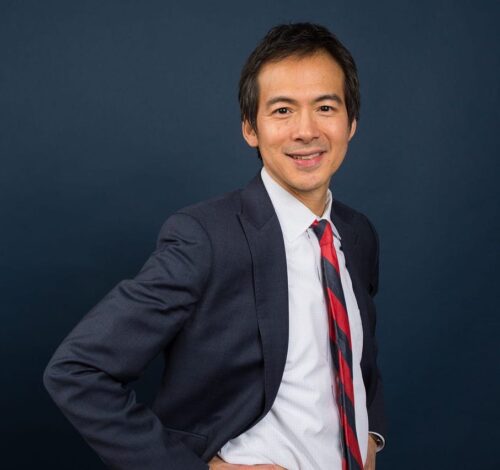
Archon Fung: Hey, welcome to Terms of Engagement, everyone. I’m Archon Fung, a professor at the Harvard Kennedy School and director of the Ash Center for Democratic Governance and Innovation.
Stephen Richer: And I’m Stephen Richer. I’m the former elected Maricopa County recorder, and now I’m a fellow at the Ash Center.
Archon Fung: Hey, so we’re recording the show live. So if you’re joining from YouTube or LinkedIn or the X account that Stephen’s broadcasting from, join us in the conversation, type in your comments and questions and we’ll try to get to it.
Yeah, we are always monitoring those and we do appreciate those. Today’s topic is a very live topic, and so it’s undoubtedly one that probably some of our guests have opinions on, have thoughts on, have questions on, and we certainly welcome that. But as always, Archon and I are speaking on behalf of ourselves and only on behalf of ourselves. We are not speaking on behalf of the Ash Center, on behalf of the Harvard Kennedy School, or, of course, on behalf of Harvard University.
Archon Fung: Great. And so before we get into the Election Assistance Commission, which is today’s topic, there’s an exciting primary tonight in Michigan, the rumble in Michigan, the Democratic primary. Are you following that? And so Haley Stevens is outspending Abdul El-Sayed by about 9:1, but Polymarket evidently has Sayed at 98%. There’s no election at 98%, even uncontested ones. I don’t believe that statistic. But are you following the primary?
Stephen Richer: Just a little bit. Just what I see on social media. I’m just following mostly the administration. I think we’ve got primaries today in Washington, Virginia, Kansas, Michigan, as you mentioned. And so just hoping that those all go smoothly. That’s where my primary concerns are right now. But I know that it’s like a hotly contested, hotly discussed. And I dare say it will be the key line, the keynote of today’s nightly news, national news.
Archon Fung: Yeah. And tomorrow people will probably be reading more into it than they should, but it is exciting from the spectator point of view. So what are we talking about today, Stephen?
Stephen Richer: Yeah. Well, commenters should let us know if they’re taking the under, if they’re taking that 2% bet, if they’re going to take the big payout from Polymarket or Kalshi.
Archon Fung: 50-1 payout.
Stephen Richer: Yeah. Which we should do a program on that one time, sort of the gamification, the prediction markets in the public space, in election administration. But that is not what we’re going to talk about today. Instead, we’re going to talk about another very hot topic, which is the United States Election Assistance Commission, which is an independent bipartisan commission that was created by Congress with the Help America Vote Act in 2002. It is, as mentioned, a bipartisan commission that has four commissioners. It is charged with developing guidance to meet Help America Vote Act requirements, adopting Voluntary Voting System Guidelines, and serving as a national clearinghouse of information about election administration.
On Thursday, July 9th, President Trump took the number of commissioners down from three to zero. So there were four commissioners just a few months ago. One had left and pursued another career opportunity. One resigned I think that very day, and then two were dismissed from their terms of service. So we have gone in a matter of months from four commissioners now to zero commissioners. And we’re going to talk with one of those commissioners whose last day was that day, July 9th. And we’re going to talk about what the Election Assistance Commission does, what this means for the future of the commission, and what this means for the administration of the upcoming midterm elections and beyond.
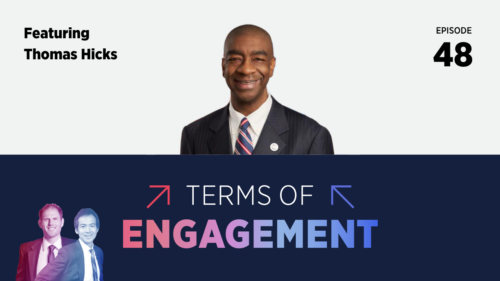
Archon Fung: Yeah. And both Stephen and I are very fortunate to know Tom Hicks, who was one of the commissioners who was let go. Tom has spent more than a decade as one of the four people responsible for the federal government’s role as an EAC commissioner. He was nominated by President Obama, and he was confirmed unanimously by the Senate in 2014. I think not too many people have been confirmed unanimously by the Senate in any capacity in recent years. He was sworn in as a commissioner of the EAC in January 2015. Now, interestingly, his swearing in ended part of a four-year stretch in which the agency had no commissioners at all. Tom then went on to chair the EAC three separate times, including in the run up to the 2020 election, and then again beginning in February of this year.
Before the EAC, Tom was a senior elections council on the Committee on House Administration where he worked on campaign finance, election reform, contested elections, and the oversight of the EAC and the FEC, the Federal Election Commission. Before that, he was at Common Cause. He’s a graduate of Clark University and Catholic University’s Columbus School of Law. So welcome, Tom Hicks.
Thomas Hicks: Thank you for having me. It’s good to see you both.
Stephen Richer: Yes. And Tom is of course a friend of both of ours, and so we’re very excited to have him on the show. We’re not excited about the circumstances. But before we get any further, Tom, thank you for your many years of dedicated federal government service. I know that it’s not always appreciated by everyone, and sometimes it’s a little inglorious in the ways that it ends, as somebody who was removed from my office on terms that I didn’t necessarily imagine or envision. So I can somewhat empathize. But thank you very much.
Tom, so for those of our guests who maybe aren’t working in election administration, which is the vast majority of them, or aren’t following the daily ebbs and flows of election administration conversation, tell us a little bit about what the Elections Assistance Commission actually does when it does have a quorum. Those of us who are election administrators, we largely knew it because of the certification of different election equipment and the role that it played in that. And then we also knew the educational component. So for a lot of us, the EAC was Tom, was Ben, was Don Palmer coming out and talking about the different resources that they had available or the different educational initiatives that they had launched. But why don’t you tell us in your words so that we better understand the EAC?
Thomas Hicks: Well, I think of it as a great organization and one that many people don’t know, but should know more about. The EAC, one of the small functions we have is the National Voter Registration Form, which most folks know as Motor Voter. Basically a form that people can sign up to to be able to vote. But as you mentioned earlier, the certification piece of voting equipment is actually huge for the agency to do. Those are folks who are going to go vote later on in their primaries may want to look behind, if they can do so-
Stephen Richer: Legally.
Thomas Hicks: … don’t get yourself in trouble, but if you can look behind the machine, there is a sticker behind most of the machines in the country that have EAC certification and says EAC on it because we certify those voting machines, similar to cars in terms of being certified by the federal transportation boards and things like that, of making sure they’re safe, they’re accurate, and that they’re supposed to function the way that they’re programmed to do.
Another piece that you mentioned was serving as a national clearinghouse, of gathering information and distributing that out to election officials and to voters. One thing that people don’t really realize is that most of the country has 8,000 jurisdictions, and the people running those elections in those jurisdictions are usually one or two people. It’s usually a 55-year-old white woman who has about two years of college education. But she’s doing other things, maybe doing payroll or driving the school bus or there are other things as that. But she doesn’t have that same sort of ability to go to national conferences and get information. So we would provide information to her on how to better run her elections processes.
Another huge piece that people got away from and didn’t understand it until it stopped happening was actually HAVA funding of giving money out to the states. And people don’t realize it until it’s gone. And so we were giving out billions of dollars to the states to improve the process, buy new voting equipment, hire some of the cybersecurity experts that they had in their offices and so forth and other things. But another small piece that we do, we would amplify things. For example, on July 26th was the anniversary of the Americans with Disabilities Act. And we would amplify things like that because I believe that with the Help America Vote Act, which was the first time that Congress said that those people who have disabilities can also vote independently and privately, so we tied that to the Americans with Disabilities Act and would amplify that during that time to let people know.
Stephen Richer: So I want to put a fine point, sorry, on a few of these things just real quickly so everyone understands. The EAC came out of the Help America Vote Act 2002, that was not a coincidence. This was following the Bush v. Gore presidential election in which we all learned about hanging chads. And a lot of legislators, federal legislators said, “Maybe our elections need to be in a better place. Maybe we need to invest federal dollars into improving elections across the country.” And so those are those dollars that Tom was talking about pursuant to the Help America Vote Act.
Another component or another thing that Tom mentioned that I think bears repeating is that a lot of people think of a Secretary of State or an elected official or the administrator of a large jurisdiction like Maricopa County or like Los Angeles County or Harris County. But in reality, the profile of your average election administrator, your median election administrator is that profile that Tom mentioned, which is somebody for whom this is not their full-time responsibility, maybe didn’t come up through it with a political class and is somebody who is scrambling to be aware of everything that’s going on, but is mostly just operating the nuts and bolts as one of the many operations that they oversee.
Thomas Hicks: Right.
Archon Fung: And I wanted to ask, Tom, so what do you see as the EAC’s position with respect to the federal role and the state and local role in administering elections? Because of course, right now, one of the huge debates is how big should the federal role be? And for most of the time I’ve been watching elections, the left has thought, “Oh, the federal role should be bigger. Why do we have 8,000 local jurisdictions?” And now with President Trump and executive orders about elections, a lot of people are saying, “Well, no, we need to keep elections state and local, that’s what the Constitution says.” So how much power does the EAC have to alter the character of state and local elections? So for instance, if an election administrator wants to use a machine that’s not been approved by the EAC, a voting machine, can they do it? Or you say, “No, you have to use one of these five kinds of machines”?
Thomas Hicks: So that’s a really good question. And I want to be clear in that states run the elections and the Voluntary Voting System Guidelines that we put out are voluntary. But if a state says, “Hey, we want to be a part of this,” then they have to follow the rules that we put in place for that. Another piece that I think was really well done, and Stephen had talked about this a little bit earlier in terms of being a bipartisan agency, the Congress in their wisdom, when they voted for the Help America Vote Act, it was 357 members of Congress voted for it. And 92 members of the Senate voted for it. You don’t get that kind of bipartisan legislation through anymore for the most part. And President Bush, who played a big role in 2000 because he was elected president, still signed the legislations because he realized there were problems with the election, and hey, this is an opportunity to fix some of those problems, and gave more legitimacy to his election overall with that.
So states run the elections, but our agency would do more of a carrot and stick approach in terms of, “If you accept this money, then you have to do certain things like have a voter registration list that has everyone’s name on it,” or, “This is what you need to do with polling places.” Or with the machines piece of, “If you want to be a part of the certification process, these are the companies that have these machines that are certified,” because we do have two labs that are certified that the manufacturers submit their machines to and then are certified to that sort of standard and then move from there.
But it’s a lot of moving pieces. It’s functioned well. There will be problems. There will be problems today. But I say this all the time. There is no administrator that I know of who wants to be on TV at 10:00 tonight explaining what happened with their election and why those problems occurred. That’s why they do these things. It’s not a one day job. They’re working on this 300 plus days a year. I’m not going to say 365 because people need some time off. But they’ve worked on these elections for a long, long time to prepare for this. And it’s like running up to the Super Bowl for the most part. We’re in the playoffs now with the primaries. And then come November, will be the Super Bowl sort of thing. So these folks are doing their job. They’re doing it well. They need more resources. We’ve been basically trying to run elections with a gum and glue here and sort of thing for a number of years. And I think that it’s time to actually fund these sorts of things.
But to directly answer your question, I don’t know if the president should be playing more of a role in the elections process. That’s for Congress to decide because the president is not named in the Constitution in terms of dealing with elections. It says, “Time, place and manner,” under Article II. And I don’t believe that… Article II or III. Article II, it is Article II. But I don’t believe that he has any role in the function of elections overall. But many presidents have issued executive orders that we’ve looked at. And I do want to say that because Trump is in office, there were things that the agency was looking at that both the left and the right absolutely hated and wanted changed. And so there were some sort of compromises that we were looking at, but those things can’t be done now with no commissioners.
Stephen Richer: Well, let’s dig on this a little bit because I think it’s an interesting question that we keep coming back to, which is what is the role of the federal government? Maybe not the president, because as you clearly noted, the role of the president in administration of elections is very narrowly prescribed. But the role of Congress is a little bit more open-ended. And occasionally they choose to set some minimum standards. Very noteworthily, in 1965, Congress passed the Voting Rights Act because they thought it was unacceptable that some states weren’t allowing full participation from people of certain races.
So is there, in your estimation, a minimum floor that isn’t being addressed that should be brought up by the Congress? So for Republicans right now, they’re saying it is unacceptable that states are not requiring documented proof of citizenship or they’re not requiring photo identification if somebody shows up to vote. Do you find that to be sort of, setting aside sort of the public policy of that, an acceptable place for the Congress to inject itself? Or do you think that that’s something that should be left to the states?
Thomas Hicks: Congress should look at these sorts of things because they are subject to elections overall. I worked at the Committee on House Administration, which oversaw the federal piece of elections in terms of the way that elections were run from a federal level, because there is a federal aspect for elections overall. Congress has played a role and I believe that they will continue to play a role. And so when we look at that, unless they do overall play a role for the entire country, it should be left up to the states to say these sorts of things because there should be certain protections that are put in place to ensure that elections are safe, secure, and accurate to ensure that everyone gets to participate who should be able to participate and have their votes counted accurately.
Stephen Richer: Okay. Well, yeah. I mean, there’s just so much to probe on there. And we probably should at some point maybe revisit the certification component. Archon, what was done in Arizona was that we passed by state mandate a requirement that we had to be federally certified. So we could only use tabulation equipment that was certified by the Elections Assistance Commission, but that wasn’t directed by the EAC. That was our own choice as a state. And so that whole process is fascinating. And obviously there’s been a lot of talk about tabulators over the last six years in particular. And even as recently as two or three weeks ago, the president made tabulation security one of the focal points of his address from the Oval Office.
But I want to turn to your story, Tom, because you were appointed in 2015. And so before we get to the end of it, which I think a lot of people will be very interested in, what were some of the highlights? What were some of the low lights? How did the commission change?
Thomas Hicks: So, I think of it-
Archon Fung: How do you become a commissioner? What kind of people are eligible to serve?
Thomas Hicks: It was a long process. It took me more than four and a half years to get from nominee to actual commissioner.
Archon Fung: Wow.
Thomas Hicks: Before that, it’s a similar sort of piece of a Supreme Court justice in terms of going through the vetting process, meeting with members of Congress and senators, answering their questions, going through confirmation hearings. I had two, one in 2011 and then one in 2013, where members of Congress ask you questions about your policies and so forth or things that you’ve written. And then there’s a committee vote and then a entire vote of the entire chamber. And then you move forward or you don’t. I think of it as it was a huge pain. No one’s getting rich doing it. So it was all love of country for us to do it. And so the four of us who were there decided that we were going to… I think we were functioning well. We did have our disputes. We did battle on some issues. But I do think that it’s like any sort of institution, you get along or you don’t.
And the way that the EAC is set up, it’s set up so that you have to have a vote of three to move anything forward. And so that’s a bipartisan aspect to ensure that not one party takes advantage of the system over another. So being a commissioner I think is a highlight to my career. I don’t think it’s the end of my career. But we’ll see moving forward what other opportunities may be out there. But it is a daunting task to become a commissioner at the agency.
Stephen Richer: So four years is bonkers, I had no idea that the approval process would last that long, because the presidency could have changed in the intervening period. And so that seems extreme to me. But we’ll set that aside for another day.
Thomas Hicks: Well, fun fact, Obama was reelected in 2012 and then had to re-nominate me because the Congress had gone out and come back in.
Stephen Richer: Oh, wow.
Thomas Hicks: So I’ve been renominated. I had been nominated more than once for this position.
Archon Fung: I think only-
Stephen Richer: Your nomination sounds like it wasn’t that controversial. I mean, you had an overwhelming, almost unanimous Senate vote. So why did it take so long?
Thomas Hicks: So I believe, and this is my speculation, that the Republicans hated the overall agency at that time and decided that they didn’t want to put anyone on the commission. And then Harry Reid changed-
Stephen Richer: Oh, so it wasn’t really about you? But yeah…
Thomas Hicks: Yes. It wasn’t personal. I hope not. But Harry Reid had changed the rules for the filibuster at that point. So it was a straight 51 to become a commissioner. And so the Republicans put two nominees up. Another nominee who was waiting with me decided to withdraw her nomination. And so this is why, initially, in 2015, there were three commissioners, as in two Republicans and myself because the other Democrat had withdrawn her nomination. And we functioned well until one commissioner left and then we got two more. And I think for the last seven plus years, we had functioned pretty well. And we were going to do some good things this year as well.
Stephen Richer: Okay. So tell us about a few of those good things. Tell us a bit about that functioning well. When you had three or more commissioners, what were you guys able to achieve that improved the election ecosystem of the United States?
Thomas Hicks: Well, I think one of the best things we did was we changed some of the things to allow for e-pollbooks to be tested, similar to voting machines overall. So we were looking at a certification process, and it’s in place now, for e-pollbooks. And for those of you who don’t know, it’s basically the machines that are used for voter registration. So people come in, their names are called up, they have their license scanned and it pops up with their ballots and so forth. And so we did those sorts of things as well. Election night reporting we were looking at and some other aspects as well.
But some of the smaller things that I think were really good were that, this week I was going to be down in NASA for a voter registration requirement, not requirement, recruitment of poll workers for veterans. We were recruiting veterans to serve as poll workers. That event’s still going to go on, but it’s not going to have the EAC functioning with it as well. But veterans are looked at as someone who is great to serve as a poll worker. And so getting those folks in the system, I think, leads to more confidence of the process and people can say those things are good as well. We’re looking to have a celebration of the 250th anniversary of our nation down in Williamsburg and do some things with the University of William & Mary. And so those things cannot go on now. And also look back on the election. So the election functions in November. What sort of problems occurred that we don’t want to see happening again? So let’s look back and see what sort of things we can change moving forward.
Archon Fung: Yeah. So the structure of the commission is super interesting because there’s two Democrats appointees and two Republican appointees. And you think some things about elections just should be nonpartisan. You want machines that plug in and turn on when you try to turn them on and register whatever people put in the Scantron, et cetera. But then obviously some things about elections have been very partisan, especially lately. Did that balance shift between you and the other commissioners between 2015 and earlier this year? Or was it mostly the same mix of, “Yeah, we can move forward. These are consensus issues,” and, “No, no, these are capital D, capital R issues”? Talk a little bit about the consensus versus the partisan parts of it.
Thomas Hicks: Well, there’s always been some sort of issues that have occurred in terms of partisanship, in terms of these are some of the issues that… And I wouldn’t even necessarily frame it as partisanship of, “These are some of the things I believe in that should be moving forward.” And the other folks would say, “Hey, these are some of the things that we believe in and we’re going to call a vote for it.” And so if you don’t get three votes, then it doesn’t move forward. And so that’s where we stood on some issues. And it’s just the way the things are.
Stephen Richer: What were some of those that would divide the two Republican members from the two Democratic members? Because clearly, as Archon mentioned, it wasn’t whether or not we should test tabulation equipment and whether tabulation equipment should read the ovals as they were filled in. I don’t think that would be a 3-1 or a 2-2 issue. What was the dividing line?
Thomas Hicks: Well, basically the citizenship question, but that’s nothing new for the agency. That’s been going on since before the agency was founded.
Stephen Richer: And I want to be clear, not whether or not you should be a US citizen, but-
Thomas Hicks: Correct.
Stephen Richer: … but proof of citizenship, right?
Thomas Hicks: Correct. Correct. Correct.
Stephen Richer: Okay.
Thomas Hicks: So you have to be a citizen in order to vote. But the question was, how do you prove that sort of citizenship? And we were saying that that should still be left up to the states and let the states determine the eligibility of those folks who are voting in their elections. And there was a question put on the rolls, which can all be found at eac.gov, the annual reports, because all those votes are public information.
Stephen Richer: Yeah, so a reminder to the audience that you can chime in with a question. If you have one, just put it into the chat box. I’m monitoring that. I think that’s important context because the conversation that is happening right now around the Save America Act is not an entirely new conversation. This was addressed by the National Voting Rights Act, Voter Registration Act rather, of 1993. And as Tom mentioned, on the federal form that the EAC oversaw, it had a requirement and an attestation that you are a United States citizen, but that question over whether documented proof of citizenship should be required has so far been left up to the states, not to the federal government.
Thomas Hicks: Right.
Archon Fung: So you mentioned, Tom, one of the really important things that the EAC does is decide who gets and how to distribute federal election dollars. And I’m interested in what those dollars have been over time. So it was kind of low when you came in or low-ish. It popped up hugely during COVID, I think.
Thomas Hicks: Yes.
Archon Fung: And then what happened? How much money in election assistance aid were you distributing? And what was the pattern of that distribution? I’m sure some counties are more well-resourced than others and some jurisdictions are very needy.
Thomas Hicks: Well, the way that it’s distributed is a formulaic process that’s done per state. So the larger your state, the more money you get. With a minimum amount that most states were getting, they would get at least $1 million if those funds were available. So that was really well done, like you said, right around COVID where we gave out millions of dollars for new voting equipment, new tabulation machines, and also to protect election officials and voters who wanted to go to the polls. Because election officials overall were running three basic elections. They were running a vote by mail, they were voting an early voting aspect, and then they were voting a regular, “I’m going to go to the polls and cast my vote election as well.” So they were running three elections during that timeframe and doing really well.
But we also, people don’t remember that we were losing poll workers because COVID was something that was contagious and killing people. But we still had people who came out who wanted to volunteer and serve as poll workers, which was absolutely phenomenal in that aspect. But over time with the Trump administration leaving, the Biden administration coming in, they gave about 75 million for two years and then it dropped down to about 15 million for one year. And then it has shot back up to about 50 million. And if you do the math, divide that by 50 states and the five territories in DC, that does not equal a lot of money for the states to work towards election overall.
Stephen Richer: No. One thing that most election administrators agree on is that the federal government should pay more for election administration. That’s a pretty broad consensus. A lot of us say, “You’re on our darn ballot. We’re putting your candidates on there.” Now, of course, that’s a little bit of a mischaracterization because they are running from your community, but they are federal officers in that these are the people who are going on to serve in Congress. But certainly with the presidential, we had a good case where we could say, “This is you telling us that you want to be on our ballot sort of thing, and you need to pay up accordingly.”
Okay, Tom, I’m mindful of our time. So bring us up to speed. July 9th, tell us what happened that day. Did you see this coming and why now? Why July 9th?
Thomas Hicks: I have no idea why July 9th. It was very traumatic for me overall. And the story that I have is that’s the fifth anniversary of my dad passing was July 9th. And for that to happen basically same day as being fired from the federal government that I’ve worked for for 30 years was very traumatic. But I want to make sure that I let folks know that the agency will continue on and will function well for this election cycle. My question would be what happens after November? So as we move forward to go through the primaries here and then the general election in November, what sort of things can we ensure that Americans can still cast their votes and have their votes counted accurately?
And one thing I say all the time is your vote will not count if you do not cast it. People worry about voter ID. There are about 30 plus states that have some form of ID that is requirement. There’s other aspects, but what works in Maine doesn’t work in Washington state or will not work in Arizona or will not work in Florida. So we want to make sure that individual states who feel that they have the best rules have those rules functioning for their states, but also knowing that other states may have other aspects that allow for them to cast their votes as well.
Stephen Richer: Yeah, I want to press on the dichotomy because you said, “The EAC will function appropriately for this November election, but I’m worried about it after this calendar year.” And it’s sort of to Greg’s question in the chat, which is a little bit, you’ve been saying all along that states run elections, and you just told us that we’re going to be fine for the November elections. But if that’s the case, then what’s the difference moving forward? Where does the EAC come into play and not having a quorum matter that it doesn’t matter currently?
Thomas Hicks: Well, one thing is you can’t change the Voluntary Voting System Guidelines. So if there’s some issue that we discover after this election cycle, those things can’t be changed moving forward. And so I think of that as basically something that is not a great thing. Having a lack of a quorum also basically you can’t do structural changes to the agency. And when I say structural, I mean like when we did the e-pollbooks testing and certification process. So inserting new rules to have those tested and certified.
Stephen Richer: So this would be if there, for instance, is a tabulation failure with a certain software patch that a large number of jurisdictions are using for this November election, heaven forbid that that happens, but then that tabulation manufacturer says, “You know what? We’ve got to update our patch and we want it to be certified by the commission so that people can use it moving forward.” You’re saying the commission as it currently stands would not be in a place to be able to do that?
Thomas Hicks: No. So the patches should still be able to happen.
Stephen Richer: Okay.
Thomas Hicks: But what I’m saying is that if there’s a wholesale rule change for the Voluntary Voting System Guidelines overall, those things can’t be changed. So for instance, when people want to say, “Hey, we should ban barcodes,” that can’t be done without the commissioners.
Archon Fung: So it’s hard to change the policy.
Thomas Hicks: Right.
Archon Fung: Yeah.
Thomas Hicks: So the day-to-day can still function, but the policy aspects of it will not.
Archon Fung: Yeah. So there’s a few questions in the chat about voter ID and whether one of the questions HarvardKennedySchoolGrad91 asks, “What are efforts underway to get bipartisan compromised to get voter ID…” And she says, “law to demonstrate citizenship in appropriate district?” Some stuff has to be done by law, either in Freedom to Vote Act or SAVE Act, right, is congressional. Is there a domain that the EAC has to alter those things and to reach some sort of compromise on the standards level rather than on the actual law and requirement level?
Thomas Hicks: No, we do not. It would be more of a… The EAC would issue guidelines on what would be best for the states to do. So basically, all right, so you have a voter ID, but are there any alternatives that are available for folks who may have a religious exemption? So we would issue guidance to the states on implementing whatever Congress would make into law. So we would not handle that at all. That’s left up to Congress, and the EAC would not play a role in that overall.
Archon Fung: Right. But now the new guidance can’t be issued without commissioners. Is that right? Staff can’t just say, “Hey, here’s the-”
Thoas Hicks: Well, they can’t just come out with it because it would be more of a, in my opinion, policy. That’s a policy question for the agency.
Archon Fung: Yeah.
Stephen Richer: So I guess be a little creative, put on your devilish hat, Tom, and think about what is the worst case scenario for this November election without commissioners? And then what is the worst case scenario sort of moving forward if the body remains without commissioners?
Archon Fung: Yeah. And Will Houser in the chat sharpens up the version of that, he says, “This quote, ‘Elections will be fine,’ seems good but however, with no commissioners to certify voting equipment, what presents a wave of litigation or conspiracy theories from targeting unverified local voting machines?” So that’s one version of it, which would be later. But what are other versions in the midterms and beyond, as Stephen said?
Thomas Hicks: Well, I don’t think he’s wrong with that. I think that those are some of the things that… But that’s what we all learned in law school of the sort of scenarios that may jump out that we would have to try to answer. But I think of it as do your civic duty and serve as a poll worker as well. So if you have issues that you feel that the election will not function well, participate by doing more than just voting. One, you should be voting. But two, participate as a poll worker. Stephen laid out the number of states today that are serving to have their primaries. How many folks on here could be serving as poll workers today? So I know that most of the folks might be up in Massachusetts at the Kennedy School. So there is a primary coming up pretty soon for Massachusetts as well. So sign up, take the training and become a poll worker.
Stephen Richer: Yeah. So we always encourage that. And happily, we have a few people even within the Ash Center who consistently work as election day workers or beyond. And certainly you shouldn’t just think of it as just election day these days. As Tom, Archon and I know, obviously there’s lots of opportunities for early voting, for being at the central tabulation facility, et cetera, et cetera, et cetera. And yes, we absolutely encourage that.
Okay, back to the doom and gloom, because that’s where I want to be.
Archon Fung: And a bunch of the chat too, evidently.
Stephen Richer: Why is President Trump doing this? Is this part of sort of inserting himself more into election administration? Is this because, like the Department of Education, he wants to get rid of departments that he feels are superfluous and this is going to be wrapped up under another department? Or is it because he wants his people and his people will be able to do something that the previous people weren’t or something like that?
Thomas Hicks: Yeah, I-
Archon Fung: Yeah, and on that pass, why did he also let go the Republican commissioner who was serving as well as the… I mean-
Thomas Hicks: Yeah. Yeah, I have no idea. You’ve raised great questions. I say this all the time of I wish that I could read about this 50 years from now in a book as opposed to living it day to day. I have no idea why President Trump is doing this. It might be a little bit of throwing chaos into a scenario for November. But I also think of it as if you want elections to function well, one of the last things you should do is get rid of the agency that has three functioning commissioners to ensure that. So I do think that we were doing our jobs and I think that we were doing them well. And so I don’t see a real reason to have this chaos spread right now.
Stephen Richer: Yeah. I sort of wonder how much of this is about the Elections Assistance Commission quad, the Elections Assistance Commission versus sort of an exercise of the newly understood unitary executive theory, which is that the President has more latitude to hire and fire commissioners at his discretion than maybe was previously understood under Supreme Court jurisprudence. How much of this is just sort of like, “I want to get rid of government departments that I don’t particularly like,” and how much of this is, “I want to have my imprint on election administration”? And I think some of the people in the chat are saying, “Well, there’s a good history there.” So they’re maybe suspect that that’s where this is going. Because if you look at the president’s two executive orders, how much he talks about the Save America Act, his relationship even with the United States Postal System, clearly the president cares a lot about election administration in the United States. And so it’ll be, I guess, interesting to see how he utilizes these new vacancies to effectuate that, if at all.
Thomas Hicks: Well, I will say that, and I want to elaborate a little bit more of, he can’t just hire new commissioners. They have to go through the confirmation process. So this is something that’s going to take some time to do. I talked a little bit earlier about my experience. Common Cause had done a report on stalled nominations under the Obama administration, and it turned out that I was the longest serving nominee in the history of the United States at some point, non-judicial, at that point, which is just absolutely ridiculous. So for President Trump to move forward with new nominees, fine, go for it. But give us qualified people who are going to make the elections process better as opposed to throwing chaos into the system.
Archon Fung: Yeah. And to kind of put your experience in the EAC in the context of federal agencies more broadly, a couple things. One is some people in the chat will have been following executive power and Supreme Court decisions. So Trump v. Slaughter was a decision that the Supreme Court ruled on, I think probably four or five, five or six weeks ago now, that got rid of an older president, Humphrey’s Executor, which said that independent agency heads were serving at the behest of Congress and president could not fire them without some sort of serious cause. That case was about the FTC, but you and your colleagues are the first agency heads to be let go, I think, after Trump v. Slaughter. So that kind of fits Stephen’s exercise of executive power. It’s just agencies. It’s not necessarily the EAC in particular.
But it’s a little bit weird because as federal agencies stand, the EAC is not a particularly muscular agency. You guys don’t make rules, you don’t enforce, you don’t find people. It’s about guidance largely, it’s about support, it’s about certification and standards. So it’s not one of these big bad agencies of the-
Stephen Richer: Yes.
Archon Fung: … jackfruit of the state, right? Or Stephen, pushback.
Stephen Richer: No, no, no. I think that’s a fair assessment, but Tom would of course know better than I, but just everything touching elections right now is a live wire. I mean, when the action was taken on July 9th, Tom, it was a national news story. Every single outlet covered it. I’m sure a million reporters were calling Tom. Would that have been the case 15 years ago when Tom started? I doubt it. But so even if it’s not as muscular as some of those, it certainly has an elevated profile, especially three months prior to what will undoubtedly be a very contentious midterm election.
Archon Fung: Yeah. That’s absolutely true.
Thomas Hicks: Yeah. I agree. I agree with that.
Stephen Richer: So Tom, anything else in your crystal ball as far as what’s going to happen with the EAC? Let’s go with, what were some of the things that you were looking forward to tackling that you would love for whoever helms the EAC next to address?
Thomas Hicks: Well, I think of it as what do election officials need? And one of the big things that we talked about was resources. And what can you do with those resources moving forward? So I think that whoever is slated to be at the EAC next to have those resources allocations to give out to the states. One of the best things that I think that the agency did was starting a new board, the Local Leadership Council, which is 100, two from every state, they were local election officials, to come in and tell us what sort of things to improve upon. And I think that we used their knowledge to improve the process overall. So I do think that elections are better today than they were in 2000 because of the work of the EAC and my fellow commissioners.
Stephen Richer: Okay. So I’ve got one very specific question, which is our friend, Auditor Bill asked, let’s see, “What is the status of the voluntary election auditing standards that the commission was working on?” Do you know where those rested, Tom?
Thomas Hicks: I don’t know.
Stephen Richer: The voluntary election auditing standards. I know that Bill was often interested in setting more standards for post-election audits, as you know-
Thomas Hicks: Oh, okay.
Stephen Richer: … they’re largely on sort of an ad hoc basis right now. And there is no sort of definitive standard that is set by the EAC. And I don’t know if that was something that you guys were reviewing.
Thomas Hicks: We were working on that and those things like that are now stalled and cannot move forward.
Stephen Richer: Because those would require a vote by the quorum?
Thomas Hicks: Mm-hmm. Exactly.
Stephen Richer: Okay.
Archon Fung: Or recommend to a bunch of states a certain post-election auditing protocol. I mean, that seems very nonpartisan, right? I mean, that would increase confidence probably for everybody that it had been done properly.
Stephen Richer: Yeah. And as Bill would attest, and I would certainly remind people, that the states are getting better and better at this because every state now authorizes post-election audits, believe it or not, but if you went back even 15 years ago, not all states even allowed under law to do that. And now more and more states are requiring them. And of course, post-election audits are important for a whole number of reasons, not the least of which is to make sure that those tabulators that were certified by the EAC were in fact not disrupted, not altered in any way, and were reading those paper ballots accurately, as a number of you have heard me say ad nauseum previously
Archon Fung: Yeah. Agree.
Thomas Hicks: Well, another piece of that is this is all done in the public. So go and watch these things happen.
Stephen Richer: Yeah. So Tom, now with our closing up minutes here, where are you on American democracy? And Archon’s going to give you the scale here in a second, but I’m going to throw in a little bit of a wrinkle. Sort of where were you before July 9th and where are you now in terms of how you assess the portrait of American democracy?
Archon Fung: Great. And our numerical scale for the prospects of American democracy is the hot pepper scale. So one is the poblano pepper. Very mild. It’s fine. It’s going to maybe be more mellow even or substantially more… I guess Bush v. Gore 2000 was a two. The totally calm, confident elections are a one. And hair on fire is more like on the Carolina Reaper, five is like, “Oh my gosh, this is really five-alarm fire.” So where are you one to five on American elections, both before July 9th and after July 9th?
Thomas Hicks: Well, I think that before July 9th, I would have been at a two. And then now after July 9th, I would move up to a three. So I think middle of the road. I think there’s going to be some issues. What those are, no one knows just yet. But people need to be vigilant and volunteer and keep their eyes open. And vote.
Archon Fung: Yeah. Excellent. And support the people who make elections work. Thank you so much for this conversation, Tom. My father passed away a few years ago, and when I was growing up, he used to say he thought the most important profession or occupation in society was the farmer because what’s more important than eating food, right? And it’s not that the food just appears at the grocery store or on your table. And when you drive down the street, it’s not like the car just appeared at the dealership. Somebody made all of those things. Many people, right? Thousands, millions of people in some cases. And when you go vote, it’s not just that Stephen or Thomas, they’re running the voting machine, there’s a whole bunch of stuff that had to be set up, years of hard work to make that happen that’s invisible. And we forget about all of that hard work, all of that organization, all of that effort and care.
And so for me, this is a great conversation, Tom, because your many years of service and dedication and resourcefulness, a lot of that is just invisible and people just take it for granted that they can go and fill in that oval. But it takes a lot of effort to make that happen and for all of those ovals to be counted and to be put into machines that are reliable and all the rest of it. So thanks for making that visible, Tom.
Thomas Hicks: Thank you.
Stephen Richer: Well, Tom, we absolutely appreciate it. And again, thank you for your 30 plus years of service on behalf of the federal government. I’m sure not everyone on this chat agrees with every single policy perspective that you might’ve had-
Thomas Hicks: No [inaudible 00:51:48].
Stephen Richer: … but I know that. Yeah. Maybe you don’t even agree anymore with some of your past policy perspectives. I certainly have changed my opinion on a few things.
Thomas Hicks: Yeah. That’s what evolving means. It’s like don’t just go it. I am not the same person I was 20 years ago.
Stephen Richer: Yeah. I had more hair then. But we really appreciate you being here and thank you for serving with a high degree of ethics, certainly something that Archon and the Kennedy School talk a lot about.
So thank you all also for joining us live. As a reminder, of course, we record this and then we post it to YouTube and to all podcasting platforms after. Thank you also to our production team, to Ralph, to Colette, to Evelyn, to Courtney. We appreciate all the work that goes on behind the scenes, speaking of behind the scenes, as Archon just mentioned. And if you have any ideas for future shows or topics that you would like to cover, please write to us. I think the email’s going to come up on the window there, info@ash.harvard.edu. And then we will be back next Tuesday, same time, 12:15 PM Eastern Time. Archon, parting wisdom?
Archon Fung: Just thanks, everyone. Be safe out there. And then also download the podcast. Listen to us again on your run and on Spotify, Apple Podcast, wherever you get your podcasts. And huge thanks to Tom.
Voiceover: Thank you for listening to Terms of Engagement. Email us your questions, suggestions, or thoughts for future episodes. You can find an email address in the show notes below. See you next time.