Archon Fung:
Hey, everyone. Welcome to Terms of Engagement. I’m Archon Fung, a professor at the Harvard Kennedy School, and faculty director of the Ash Center for Democratic Governance and Innovation.
Stephen Richer:
And I’m Stephen Richer. I’m the former elected Maricopa County recorder, and I am now a fellow at the Ash Center and a lecturer at the Harvard Kennedy School.
Archon Fung:
And we’re recording this show live, so if you’d like to join in the comments, just type something into the chat there and then tune in live this time every Tuesday at 12:15. And if you’re not live, email us anytime at info@ash.harvard.edu.
Stephen Richer:
But we are committed to doing the live show, which is why I am in a broom closet right now in Washington, DC. And I think we might’ve just had a little bit of an opening there, so appreciate your patience with me today. But we do like doing it live because we love integrating your comments into the conversation, and so feel free to put those comments into the chat and we’ll work them in and have a good conversation that way.
But as always, Archon and I are speaking on behalf of ourselves and only on behalf of ourselves and not on behalf of any Harvard University entity or the Ash Center.
So we are talking about democratic backsliding, a topic that is near and dear to this show and one that has come up in a number of different contexts if you followed this show for some time.
And in fact, just last week, Archon shared a graphic that spoke to academic freedom at universities throughout the world, but we’ve also presented in the past statistics from popular studies such as the V-Dem Institute or such as the V-Dem study that have suggested that America, the United States of America, is in a moment of democratic backsliding.
And so we’re going to talk about that today, whether or not it’s happening, and then what is the cause? There are a lot of popularly-identified cause, but we’re talking today with somebody who’s going to challenge those presuppositions and really dig in and have us think about it critically.
Archon Fung:
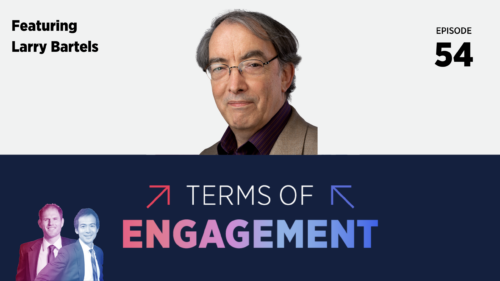
Great. And we are really lucky today to have Larry Bartels, and I’m super excited. Larry is one of the most prolific and accomplished political scientists working today. He’s an American political scientist, but also is working in comparative politics.
Now he is the university distinguished professor of political science and law and the May Werthan Shayne Chair of Public Policy and Social Science at Vanderbilt University. He’s the co-director of the Center for the Study of Democratic Institutions there.
In 2024 he was awarded the National Medal of Science, which is the nation’s highest honor for scientific achievement. He’s written many, many papers. Three of his books, which are directly relevant to today’s topic, is Democracy for Realists, written with Chris Achen in 2016, Unequal Democracy, Princeton University Press, and then most recently, Democracy Erodes from the Top: The Challenge of Populism in Europe, also Princeton University Press, 2023. Welcome, Larry.
Larry Bartels:
Hi, great to be here.
Archon Fung:
Hey. Yeah.
Stephen Richer:
So I would imagine a lot of our listeners don’t challenge this premise, but help spell this premise out for me. I mean, we’re the United States of America. We are the beacon of democracy. Are we saying that democracy’s in recession here, that we’re no longer sort of a true democracy by any definition of the measure?
Larry Bartels:
Well, I think part of the difficulty here is to decide what measure you like. Democracy turns out to be a very complicated concept. There are lots of elements of it, and sometimes they actually contradict each other or at least our intention. And so when people argue about whether democracy is on the rise or backsliding, often they’re not disagreeing so much about the facts on the ground as they are about what the elements of democracy are that we think are most important.
Archon Fung:
And-
Stephen Richer:
And so… Yeah, go ahead. Sorry.
Archon Fung:
Yeah. So we’ve showed versions of this before. Every, I think, working political scientist has seen versions of this graph. Colette, if you could put up the V-Dem time series. So Larry will be very familiar with these lines.
I just pulled this this weekend off of the V-Dem release and their aggregate measure for democracy, the most commonly used measure is the polyarchy measure. And this tracks the polyarchy measure, which adds up a bunch of things. And I just did three lines here. I did Western Europe and North America, the United States, and then Eastern Europe and Central Asia. And I guess I should have pulled North America out of that top line there because it is duplicating the black US line.
But so just a few patterns here. If you look at the Western Europe line, you can see a big dip around 1939, 1940, that World War II was not good for democracy I think almost on any definition of democracy.
And then the orange line here is Eastern Europe and Central Asia. And you’ll see it’s very, very low from the post-war period, 1945, all the way till 1989. And of course that is the Soviet Empire. Also, I think according to almost any measure of democracy, not good by democratic measures.
And then what you see in the US here, this black line is a steady, steady rise with a notable jump after 1965 when Black people in the South were enfranchised. And it just kind of holds steady, high, very, very comparable to Western Europe until you see this. Well, there’s a little tiny dip around 2000, and I attribute that to Bush v. Gore probably, and then a dip after 2020, that’s probably January 6th, and then a huge decline in the most recent series or most recent years of Trump 2. That’s the latest data are 2025. That’s the latest V-Dem release.
Stephen Richer:
So what is this a composite of? Can you give us an example of some of the statistics that might be considered?
Archon Fung:
Yeah. So it’s are there competitive elections? What are the chances that the person who’s elected will govern? Those are some of the measures in the polyarchy measure. And then V-Dem collects tons and tons of measures. So this isn’t like the freedom measures or the liberty measures. These are the electoral democracy measures. Yeah. So Larry, do you believe these lines?
Larry Bartels:
Well, as a general matter, I think they probably have the overall story right. It’s hard to know whether the specific things that they’re measuring are the things that really matter.
Electoral democracy is one part of a broader story. I think the way governments actually work and the way they interact with citizens and reflect the interests of citizens probably is what people are likely to care about. And most people, I think, view elections as a means to that end rather than as an end in themselves.
Archon Fung:
Yeah. Yeah. So does that make you somewhat less concerned about that dip at the end there, if what really matters is the quality of interactions between government and citizens?
Larry Bartels:
Well, no, because I think those have turned for the worse as well.
Archon Fung:
And how would you capture that, those kinds of measures? Or I don’t know, not even measures, just the phenomenon?
Larry Bartels:
Well, I think one of the most important lessons of the last decade or maybe two or three decades of American politics is how important norms are. And political scientists generally spend a lot of time thinking and writing about specific institutions and procedural rules without realizing that most of what’s important is not actually all that well-codified.
The people who are governing us behave in ways that have a lot to do with their inherited notions of what’s right and wrong about running the country. And when those break down, I think they can create substantial problems, and that’s where we are now.
Stephen Richer:
And so, Archon, what do you attribute that to though? I mean, you can’t just say that the Trump administration, because if that’s reflecting sort of a disconnect between, oh, what citizens want and who is governing, nobody disputes or very few people dispute the fact that President Trump won election in 2024. And so why would that, even if you think that some of the things that he is doing are unlawful, why would that-
Archon Fung:
Make the line go down?
Stephen Richer:
… serrate the democracy line?
Archon Fung:
Well, so how V-Dem works is they ask a bunch of political scientists, political observers to rank each country on the measures, and they say, “Okay, well, we want you to generate a ranking on these measures of electoral stability or the chances that whoever wins the election will govern, et cetera.” And my guess is that many of those rankers are looking at some of the…
Well, they’re thinking about January 6th going way back. And then I think they’re also looking at what’s coming out of the White House recently and what’s happening at the state level and reading maybe some electoral fragility there. Maybe we can’t count on elections as much as we were able to five years ago, 10 years ago.
Stephen Richer:
Okay. So that’s not a raw data [inaudible 00:10:53] assessment?
Archon Fung:
No, it’s all expert assessments. That’s right.
Stephen Richer:
Okay.
Archon Fung:
That’s right. That’s how it works.
Stephen Richer:
And I will say that even though it is trajectory down, it’s still high on that map and is still fairly close to Europe on that standard, right?
Archon Fung:
Yes. Although the V-Dem people say it are very concerned, it’s the biggest drop, biggest short-term drop in maybe ever for the United States.
Stephen Richer:
And so, Larry, I guess you think that narrative broadly correctly captures what is going on in the United States right now, correct?
Larry Bartels:
Well, I think there are some important respects in which the American democracy has eroded. In my view, they have less to do with the specific things that this particular measure is trying to capture than with the attitudes of the people who are running the government and their feeling of constraint to behave in ways that are consistent with the traditions and expectations of US democracy.
Archon Fung:
So what kinds of norms do you have in mind that are flashing yellow for you?
Larry Bartels:
Well, much of what President Trump has said about the electoral process I think has been, if not intended, at least had the effect of reducing the confidence of ordinary people in the democratic process.
I think a lot of what’s gone on in government in the last year and a half has flouted with, in some cases, legal restrictions on the power of the presidency, but more often conventional understandings of the appropriate relationship among the branches of government and between the federal government and the states and localities.
Archon Fung:
Yeah. I heard you give a wonderful talk at Notre Dame in the spring, and we talked a little bit after, and one of your central theses in that talk was that President Trump has caused a lot of trouble for political science, and we need to rethink a lot of our projects and how we understand politics to be working.
So on that dimension, is this idea that norms are really important and it turns out elites seem to be able to maybe turn on a dime and disregard many of these norms that have been in place for many decades across parties, was that a recent surprise to you or did you always think, “Oh, these norms, people could just break them”?
Larry Bartels:
Well, I didn’t pay enough attention to these norms, and I think political scientists in general haven’t. I would say that in some ways I think of this as boiling down to the problems with what Chris Achen and I called the folk theory of democracy, which is the idea that somehow everything hinges on the behavior of ordinary citizens in a democratic system.
And in my view, that’s generally not the case. Certainly people have an important role to play, but governing is actually carried on by professional politicians. And much of what they do, I think, is not constrained by the behavior of citizens in the way that we imagine.
So if you think about one of the very first norms that President Trump flouted when he was running the first time for president, for at least 40 or 50 years, presidential candidates had released their tax returns, and Trump said, “I’m not going to do this.”
Most political observers, I think, imagine that any candidate who flouted that norm would be punished at the polls for it. Trump said, “I’m not going to do it.” Turned out the voters didn’t care.
And so that’s an example of a well-established norm that we thought was enforced by public opinion but really wasn’t. And now that politicians have learned that, it’s hard to know how that toothpaste will get stuffed back into the tube.
Archon Fung:
The normative toothpaste.
Larry Bartels:
Yeah. I mean, if future candidates want to release their tax returns, they will, but I think it’s unlikely that anyone will imagine that if they don’t there’ll be some significant electoral punishment.
Stephen Richer:
So can we drill in on this folk theory? Because I think this is the subject of your 2016 book, correct?
Larry Bartels:
Yes.
Archon Fung:
Yes.
Larry Bartels:
One subject of it.
Stephen Richer:
So again, the folk theory of democracy, as you tell it, is that Americans believe that the populace is in control and that democracy sort of rises and falls with the democratic sentiments of that population, right?
Larry Bartels:
Well, in 2016 we were writing mostly about the fact that elections don’t produce responsive government because people are not, as observers and political scientists sometimes imagine, voting on the basis of their issue preferences and compelling politicians to follow the lead of the citizenry in terms of pursuing particular policies.
But I think the application of the same idea in this context is that we imagine that citizens are enforcing the norms of democracy, and if they somehow develop bad attitudes and turn against democracy, that that will precipitate a decline in the quality of democracy.
Archon Fung:
Yeah. So people shouldn’t miss the, Stephen’s trying to highlight it here, I think in a very welcome way, the importance of Larry and Chris’s argument in Democracy for Realists. It is really against the common wisdom. I think both the professional common wisdom, a bunch of it, certainly mine, and then also kind of out there, the common wisdom that a bunch of what happens in American politics is driven by voters at the ballot box, both constraint-wise and outcome-wise.
And if it’s available on open source, we’ll post this in some of the show notes, but a key chapter, one of my favorite chapters in the book is titled Homer Simpson Gets a Tax Cut, which is about how, well, Larry wrote the chapter, you can explain it, but people aren’t getting what they think they’re getting when they’re voting for the tax cuts in the case that you’re kind of looking at. Yeah.
Larry Bartels:
Well, that’s from a different book.
Archon Fung:
Oh, it’s not in-
Larry Bartels:
That was a chapter in Unequal Democracy.
Archon Fung:
Oh, Unequal Democracy. Sorry, yeah.
Larry Bartels:
But it’s a story about the complexity of policy and the difficulty that people have understanding what their interests are in policy debates.
So when President Bush was first elected, he proposed a huge tax cut and people were generally supportive of that, I argue because they misunderstood the contours of the policy and what its implications would be for them. And the title comes from a cartoon that I saw in which Homer’s boss is sitting on a huge pile of money bags and Homer is waving his $5 bill in the air and woo-hooing the fact that he’s getting some payoff from this policy.
Stephen Richer:
So the general idea is that the voters are not in the driver’s seat to the extent that is popularly imagined in that the government, as it exists in the United States, is not as responsive to voters as we might think, but also that voters aren’t as much to blame, say, if we accept this dip in democracy as presented by V-Dem and by other indices as well. V-Dem’s by no means the only outlet that’s saying that.
But we can’t just turn around and say that, “Okay, well, that must mean that the American person has become less democratic because our politics is always a reflection of our people, our voters.” And if I have that right, I guess where’s the break in the linkage?
Larry Bartels:
Well, in this case, I think lots of people voted for President Trump in 2024 for reasons that had nothing to do with their attitudes about democracy or their attachment to democracy as a political system.
If you look through history, I think the evidence is that people are generally less caught up in the importance of democratic norms and procedures in the abstract than political scientists would like them to be. They’re mostly focused on their sense of the wellbeing of the country and their own wellbeing and how things are going.
In Democracy Erodes from the Top, I wrote a chapter about the democratic backsliding in Hungary and Poland, which was generally attributed to anti-democratic attitudes and populism in Eastern Europe.
If you look at the data from the election in which, for example, Viktor Orban first came to power in Hungary in 2010, there was no appetite for dismantling democracy. What people wanted was a country that would be more competently run than it had been by the people who were in charge.
Orban then took advantage of that opportunity. He more or less by accident was elected with a 2/3 majority, which allowed him to fiddle with the Constitution and redraw the electoral boundaries to his own advantage and pressure the independent media and so on.
So he took advantage of the opportunity to try to entrench himself in power. And part of what he did in order to do that was to complain about the European Union and about immigration. And if you look at the attitudes of ordinary Hungarians, they became anti-immigrant and anti-EU mostly after Orban was elected rather than before. So this was an example of a politician who saw an opportunity to try and entrench himself in power, and took advantage of it.
If you look at US local politics through most of our history, the story of the political machines is that some group of people would, for one reason or another, have an electoral advantage and then try to entrench themselves in power. And sometimes, as with Orban, they were successful for a significant period of time, but then eventually the forces of opposition or the conditions in the country or the city turned against them and they were voted out.
Archon Fung:
Yeah.
Stephen Richer:
So Orban was democratic in the sense that he did reflect the priorities of the Hungarian people in that they were prioritizing whatever he was selling at the time, but that didn’t necessarily mean that the people also supported the alleged anti-democratic turn of the Orban administration, because that wasn’t necessarily just a binary thing that was on the ballot?
Larry Bartels:
Right. But then after the backsliding, they continued to support him for some time as long as they thought the country was going well. So they didn’t prioritize democratic norms and procedures in the way that we might’ve wished them to.
Archon Fung:
Yeah. And-
Larry Bartels:
And I would say the same thing in the United States. I don’t think most of the people who support President Trump do so because they’re fans of authoritarianism. They like him for a variety of other reasons and prioritize those reasons rather than their attachment to our particular understanding of democratic norms and procedures.
Archon Fung:
So as a general matter so far in the, I guess, the last 10 years or whatever your period is of democratic backsliding, do you think that we pretty much can’t count on voters in Europe or the United States to defend democracy, whether at the little level of punishing norm violation for not being sufficiently transparent or the big level of tearing up, in Orban’s case, civil society institutions, and in President Trump’s case, maybe electoral institutions?
Larry Bartels:
Well, I think depending upon what the violations of norms look like, citizens may be inspired to try to resist them. I would say it’s rare in history for ordinary citizens either to take the lead in overthrowing democracy or to take the lead in preserving democracy in an environment where the political elites are, for one reason or another, determined to circumvent it.
Archon Fung:
Stephen, you have been a politician, know lots of politicians. Are they afraid that they’ll get punished by voters for violating norms? What’s the-
Stephen Richer:
Violating norms? No, but they’re very attuned to what the populace thinks from their sample size in that they’re very attuned to the loudest voices.
So I think that people consistently underestimate how much sending an email in, how much making a phone call, how much even just posting a social media message, because the world that they see is the one that is created through those messages to them. And I think that they’re attuned to that.
Now, if that doesn’t reflect a prioritization of norm adherence, then I think that that isn’t a priority for them. But it’s more of a sort of a David Mayhew where they are single-minded seekers of reelection who are reading cues from their key constituencies, I would say.
Larry Bartels:
I think one of the problems that democracy has in general is that we’re wrapped up in this idea that the citizens should somehow control things and that things will go well if they do. I think the single-mindedness of seeking reelection is an example of that.
Stephen Richer:
But doesn’t what I just say sort of run against what the argument that you are making? Because here I am saying that these politicians are weather vanes that are blowing every which way depending on what the voters dictate, but you’re saying that actually, yes on some things, but on a lot of other things, it’s completely at the discretion of the elected official or the elite in some other capacity.
Larry Bartels:
Yes, I would say there’s some of both, but I would say that it’s an important amendment to your second phrasing of this that it’s not necessarily the voters they’re paying attention to, but the loudest voices.
In other work that I’ve done, I look a lot at disparities in responsiveness to different people based on their political and economic characteristics, and I think there’s a lot of evidence there that the messages that they’re responding to or the pressure that they’re responding to is often pretty unrepresentative of the voters as a whole.
Archon Fung:
Yeah.
Stephen Richer:
Yeah. I would just say it’s incredibly human to be affected by it, because in a jurisdiction where I was, I had about 2.6 million registered voters in my jurisdiction, but I’ll tell you, even just a few hundred emails, which is statistically very insignificant in the scheme of 2.6 million, well, if you get a few hundred emails and they all start saying the same thing, you have to be, I would say, also a borderline sociopath to be completely unaffected by that onslaught.
Larry Bartels:
Well, I get that, but I guess what I want to say is that representation works better when politicians have other considerations in mind besides what they’re hearing from those hundred people.
Being a single-minded seeker of reelection makes it easy to violate these norms as long as nobody seems to care about them. And so I think having some profiles and courage is helpful to the democratic system as well.
Stephen Richer:
Yeah. But it’s interesting because in some ways those profiles and courage are sort of almost anti-democratic in that they’re not being responsible.
So a lot of people told me, they said, “Look, you’re a Republican. You signed up to represent us and now you’re in a Republican and elections office. You need to give voice to the people who put you in that office.”
And I guess in the abstract, that was never really on the table for me, but in the abstract, I guess there’s something to that if you see yourself as more of a mouthpiece of a constituency than you do as sort of an independent, autonomous, hopefully moral actor.
Larry Bartels:
Well, that’s right. That’s an example of what I said at the beginning that there are these various strands of democracy that are often intention and sometimes in contradiction.
Archon Fung:
Yeah. And you’re arguing against the full responsiveness strand here, especially in Stephen’s case that he just brought up for sure.
William Hauser has a comment in the chat and he said, “Recently, Ty Cobb, Judge Luttig warned, ‘Elites plan to interfere in 2026 midterms.’ Given the top-down backsliding thesis, that is that backsliding is driven from the top down, how can these systems safeguard elections when the institutional gatekeepers themselves, those elites, are the threat? So where does the defense of elections come from if a bunch of the backsliding itself is coming from the top down?”
Larry Bartels:
Well, the story of our constitutional system doesn’t always work perfectly, but the aim is that the various institutions of government will serve as checks on each other.
I think one of the things we’ve seen a lot in the last decade is that elected officials aren’t very good checks because they feel the kind of popular pressure, especially from their primary constituents that Stephen was just talking about.
If you look at the record, although there have been lots of questionable decisions by judges, I would say overall judges have been much better behaved than elected politicians have been in terms of preserving democracy.
I think people who are in other kinds of institutional positions have often been better. If you think about the Joint Chiefs of Staff, for example, professional military officers, I think they’ve generally performed pretty well in terms of trying to protect against violations of important democratic norms. But insofar as these politicians are subject to pressure and feel the desire to be reelected above everything else, then they seem to be pretty unreliable as backstops for the democratic process.
Archon Fung:
Yeah, interesting. So to William Hauser, I think Larry’s appealing to kind of a Madisonian case of, well, you want all kinds of different elites with all kinds of different interests and maybe they can push against one another.
In a piece that you sent in prep for the show, Larry, on the norm enforcement, let me see if I’ve got this right, I think you were arguing that, well, you look around at the norm violation and there’s not a lot of pushback coming from all of these different sectors. And then you said, “Well, yeah, but I do see pushback coming from one in particular, and that’s the financial markets.” So where do you see the pushback coming from in terms of democratic defense in the US case?
Larry Bartels:
Well, I was trying to think about the various actions that President Trump has taken, especially in the first year or so of his second term. And the response of the public to those actions I think was generally pretty mixed and not a real constraint.
But if you looked at the cases in which he seemed to back down significantly from what he had at least talked about doing, they were disproportionately, it seemed to me, cases that involved economic pressure in the case of his attacks on the head of the Fed, for example. There was pushback from the bond market or at least writing about concerns about pushback from the bond market, being concerned about undermining the independence of the Fed. And that seemed to get his attention and to cause him to dance around the idea of trying to fire or pressure the Fed chair, but not to actually go through with it.
So I think what we want to do is to see where norms are holding what it is that seems to be imposing a constraint. And my suggestion was that in these cases it seemed to be those particular economic interests, but obviously they’re not relevant for or active on all kinds of other actions that we might be concerned about.
Archon Fung:
Right. What do you think, Stephen? Do you think that that’s the countervailing force we can count on is the bond market?
Stephen Richer:
Well, I do think that markets have a way of translating potentially highly-corrosive action at the governmental level into sentiment that is more broadly felt. So if we begin with the hypothesis that voters aren’t voting on democracy and that they cared more in 2024 about inflation and in 2026 they care more about, I know, affordability is the word.
Archon Fung:
Affordability, let’s say. Yeah.
Stephen Richer:
And so yes, except for I don’t think that the market is completely attuned to just democratic norms. I think the market likes some things that upholding democratic norms produces such as rule of law, stability.
But I think that you could probably flout lots of democratic norms and maybe even have a positive effect in some instances on the market, and therefore it wouldn’t distribute that pain across the American public. But I do think that there’s at least a little bit of something into it.
I don’t know. I find this all a little sort of de-romanticizing my notions about America-
Archon Fung:
That’s the point of it.
Stephen Richer:
… just because… Larry, do you still believe in American exceptionalism? This is something I’ve grappled with a lot over the last 10 years.
Larry Bartels:
You have to tell me more about what you think that means.
Stephen Richer:
Just the notion that certain steps of governance would never happen in the United States, that we’re a country where it’s so baked into our fiber that we wouldn’t go down an anti-democratic or an authoritarian route. That just it can’t happen here, the post-Cold War phenomenon of that.
I guess just that these stories that we see from throughout the world where authoritarians rise to power are things that happen in other places, often at other times, but certainly in other places, and they don’t happen in the United States because it’s just not in our nature.
And I guess, did we ever have that? Or if we haven’t, then have we just had good luck in the meantime? Or what else has been preventing the United States from ever becoming an authoritarian empire or whatever?
Larry Bartels:
I guess I would say that it seems to me most developed democratic systems have strong norms that tend to that outcome, but those norms can be overwhelmed by particular conditions in all kinds of times and places, and we’re not immune to that.
When I wrote about Europe, there’s a lot of concern about populace in Europe. It seemed to me that none of the Western European countries is in as much danger to the democratic system as the United States is, just because the depth of the passions in the United States I think in the current era are stronger than they are in any of these European countries.
But I also want to say it seems to me that we get into trouble if we simplify the danger here as moving from democracy to not democracy. I think there’s a vast gray area, multidimensional gray area.
The United States is not a particularly well-functioning democracy by a variety of considerations, and that’s true for many other countries as well. What I worry about is not the end of democracy, but a serious long-term erosion of the quality of democracy, which we’ve had at various times in our political history. We generally patch them together and move on.
A terrific book, I think, on this score for people who want to review the history is a book by Suzanne Mettler and Rob Lieberman called Four Threats which looks at various crises of democracy in American history and makes the interesting observation that often the way we get out of them is by disadvantaging some particular disadvantaged group. We paper over the conflict by arranging some negotiated settlement in which some people are winners and others are losers, and that too can be costly to democracy.
Archon Fung:
Yeah. So which elements are you particularly concerned about for the United States now, looking into the next three, four years? Is it the electoral piece? The rule of law piece? I guess the normative underlies, I mean, runs across a bunch of those, but are there particular dimensions of the democratic enterprise that you think, “Oh, this feels different and sharper and I’m more concerned about it”?
Larry Bartels:
Well, there’s been a long-term run-up in political polarization, which I think has encouraged politicians on both sides to press what were understood to be the limits of political conflict and political competition.
And I think especially for people on the right, the perceived stakes are especially high now. I’m not thinking about the next three or four years, but the next 20 years. I think the heart of concern about the state of America for many people on the right goes back to the huge burst of social change that we experienced in the 1960s and ’70s.
My most recent book with Kathy Cramer is called The Politics of Social Change and focuses on that process and its implications for contemporary politics.
But one aspect of it is the threat that some people on the right feel of the perception that we’re moving toward a majority-minority country and that they and people like them are somehow losing their position in America as they understood it.
And I think that fear, that threat is powerful for a significant number of people and probably will be until we cross that demographic threshold and find that nothing substantial has really changed.
Stephen Richer:
So what’s the fix, Larry? What’s the solution here?
Larry Bartels:
Oh, I don’t think there is a solution. I think democracy is always in crisis by some understanding.
Stephen Richer:
Well, that’s heartening. If we’re always in crisis, then it makes this moment perhaps a little slightly less anomalous.
Larry Bartels:
Well, I think that’s right. Although I think the current crisis is in some ways more serious and more costly than previous ones at least in my lifetime have been.
I think what we want is political actors who are constrained, if not by the nice attitudes of their voters, at least by the sense that they’ve developed in the process of political socialization of what democracy is and what the limits of political competition should be.
Stephen Richer:
So should we want elites, should we want them less constrained or more constrained by voters do you think would be productive for preserving those democratic norms?
Larry Bartels:
Well, I don’t think the constraint by voters is particularly relevant to whether the norms survive or not. I mean, it is true that if voters cared single-mindedly about democracy and enforced that priority, that politicians would respond to that. But I don’t think that’s ever been the case or is ever likely to be the case.
Archon Fung:
It’s just too noisy.
Larry Bartels:
So in most of these respects, I think what’s likely to be more important is the sense of right and wrong that political actors themselves develop in the course of their political socialization.
Archon Fung:
Mm-hmm. So what about people in the civic education business who favor, I mean, I think some of them put it this way, but I think most would not, but in our framework of the discussion so far, favor talking about the importance of democratic norms and socializing them more broadly from grade school forward.
And maybe some of them might say, “Well, the mess that we’re in, given this discussion that Larry and Archon and Stephen have been having just shows how important that enterprise was, is people don’t care about democracy as a normative enterprise. And if they did, they would be enforcing that norm on politicians and punishing them for violations more than they are now.” Is that a fruitful direction in your view?
Larry Bartels:
Well, I guess I would say it can’t hurt and unlikely in my view to make a big difference. But insofar as that civic education is effective, I guess I would say it’s more important in my view to educate the people who are actually in positions of political power than it is to educate the citizenry as a whole. And maybe you have to do the latter in order to accomplish the former, but the effect that this has directly on the people who make political choices is, in my view, likely to be more important than the effect on citizens who are somehow going to try to pressure politicians.
Stephen Richer:
Yeah, I guess I just look at some of these people and I don’t think it’s a lack of knowledge about what the norm is.
Archon Fung:
Wait, these people, the politicians or the voters?
Stephen Richer:
The politicians.
Archon Fung:
The politicians.
Stephen Richer:
The elites. I would say either they already have, some of them have access to supposedly the best education in the world on some of these fronts or they have the ability to access it. I guess the education would be more of an education of virtue. So instead they’re all going to be reading Aristotle’s Ethics or Aquinas or something like that instead of Schoolhouse Rock! or something.
Larry Bartels:
Yeah. I think if you think of education as providing information, that’s probably insufficient for what we’re talking about. And it’s really a kind of inculcation of values that’s relevant.
Stephen Richer:
Does this wrinkle you, Archon? Because it’s very sort of like the problem is born out of the elite, but the solution will also be born out of the improvement of the elite, and the general public might just sort of be along for the ride.
Archon Fung:
Yeah. I mean, I find it, both paths, whether it’s elite-led or voter constituency-led, quite hard to get there.
So Larry will remember this book. Many years ago, John Sides wrote a book that was quite kind of skeptical of the democratic enterprise because part of it was, well, people don’t really want to participate. They’d rather have, the term he created, unwieldy, was empathetic, non-self-interested elites. Right? You’d want these kind of a hereditary aristocracy to make the right decisions for people in an empathetic, non-self-interested way.
And I guess my response then and now is like, “Well, show me one. Show me one of these empathetic non-self-interested elites and I’ll go there with you.” And so I guess I despair of the enterprise of that moral education.
And then in the current moment, this is really kind of anecdotal, but I have been struck by the normative defenders of democracy seem more courageous and maybe more frequent, although that would be harder to gauge as you go down the elite scale at the bottom of which is the streets of Minneapolis.
And so I look around at the law firms and the media CEOs and the university leaders and I’m seeing a little bit of courage and a little bit of moral commitment in Congress, but maybe not that much. Less because, Stephen, as you say, I think these people, many of them did read a bunch of Aristotle, so maybe it didn’t sink in. And then you kind of keep on going down and I just see more of it, more courage, more commitment.
And so there’s a kind of moral commitment SES inversion there for me that, I don’t know. I mean, I’d like to really see a study on it, but it has been striking as the moral courage that one would hope for in leadership, because maybe that’s what you want your leaders to do, has been somewhat absent in my view in the last few years.
Stephen Richer:
So the counter-hypothesis that there is more non-compliance on the streets of Minneapolis than there is within the top 100 largest law firms in the country.
Archon Fung:
Right. Reversing the Buckley thesis. Yeah. Yeah.
Larry, what do you think about that? Where are we more likely to see it coming? I think your proposition was, well, it’ll matter a lot more if political elites are, I don’t know, embrace the right set of other regarding moral values. I agree with that. It probably would matter a lot more, but I think it might be harder to get there.
Larry Bartels:
Well, I’m not sure why it would be harder to get there. I think there are two pieces of this. One is the piece that Stephen started out with which is the information component.
I was a student many years ago of Herb McClosky who was a political psychologist and political theorist who did a lot of work on democratic attitudes and in one famous study compared the democratic attitudes of ordinary citizens and political elites and found that political elites were generally more committed to democratic norms simply because they had learned the norms better, they were sort of more indoctrinated in the ideology of the US, not left-right ideology, but the civic ideology of US.
So I think that’s one reason to expect that more educated people and people who spend more time thinking and acting in the political world are likely to be better informed about the kinds of expectations that the system imposes on them and on other political actors.
But then there is also this moral component to it. And I don’t know, maybe these people are in a situation now where the moral component gets washed away by the pressures of everyday politics. I think that’s a kind of common phenomenon in situations like the one we’re in now where there’s a high degree of political polarization.
So unlike the political elites that McClosky studied in the 1950s who were pretty united in terms of their attitudes about democracy, now we have political elites on the left and right who pursue very different ideas about democracy in part I think because they’re wrapped up in this political conflict, partisan conflict.
Archon Fung:
Yeah. I mean, the partisan conflict obviously makes the defense of democracy extremely costly depending on who you are. Right? Yeah. Stephen, jump in. Sorry, I interrupted.
Stephen Richer:
Yeah, no, I was just going to say, okay, so we’re running up on time here, but I take it that you sort of think there’s sort of always at least a low simmering threat to democracy, but for a closing question and one that we pose to many of our guests, on our pepper scale of one to five, five being red-hot, hair on fire, we’ve got a problem here, and one being like it’s barely registering and relax, where would you put the current state of-
Archon Fung:
Where Bush v. Gore is 1 1/2 maybe. Yeah.
Stephen Richer:
Where would you put the current state of American democracy?
Larry Bartels:
I guess I’m a 3 1/2.
Archon Fung:
3 1/2. That’s higher than I would’ve thought. Yeah.
Larry Bartels:
I think the fundamental democratic system in the US is not in any immediate jeopardy in my view, but I think there will be substantial long-term damage from what we’ve seen over the last decade or over the last couple of decades in terms of the destruction or erosion of these norms that have made the system work pretty well and now have been kind of unmasked as being optional from the perspective of the people who are going to be running things.
If you think about the damage to the bureaucracy over the last decade and what it would take to rebuild that, that’s I guess what the Kennedy School is going to be up to for the couple of decades, but it’s a big job.
Archon Fung:
That’s a long [inaudible 00:52:54]. It’s a big challenge, for sure.
Stephen Richer:
Well, I’m very appreciative. I have to run because I am actually testifying in front of some of those elites at 2:00 Eastern Time in front of the Congress right now.
But Larry, I really appreciate you coming on and telling us a little bit about some of your past work and some of your current work. People can follow his work at the Vanderbilt website, at his Vanderbilt profile.
Thanks very much to the production teams. Thanks to Courtney, thanks to Colette, thanks to Evelyn as always for putting this together. And thanks to you all for being here, watching live, and for those of you who are watching later on the recorded version. And Archon, any final thoughts?
Archon Fung:
No, just a huge thanks for Larry for coming on, and I always enjoy talking, and your ideas are so important and so provocative and I’m glad we got an opportunity to share some of that with a broader audience, so thank you so much for coming on.
Larry Bartels:
Thank you. My pleasure.
Archon Fung:
Yeah. Good. All right. Have a good day, everyone. We’ll see you next week.