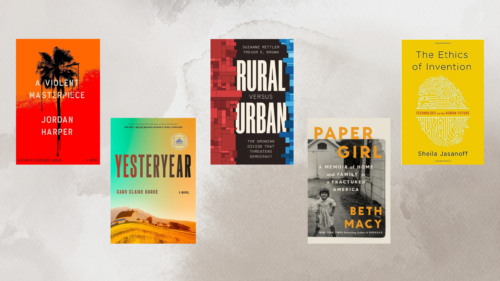
At a time of sharp political divides and rapidly changing technological innovation, Archon Fung, co-director of the Program on Democracy and the Informed Public, shares a curated list of summer must-reads to help make sense of cultural divides, emerging technologies, and the systemic shifts reshaping our world.
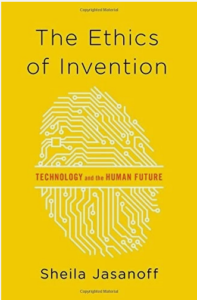
Sheila Jasanoff
Many wonder whether society should have acted sooner to blunt the worst effects of social media on mental health, misinformation, and democracy itself. Looking forward, we face similar dilemmas about whether we should allow a handful of multi-billionaires to shape society through the artificial intelligence they create. My colleague Sheila Jasanoff’s brilliant book about technology, society, and democracy provides wonderful grounding for those reflections. Jasanoff reflects upon recent technologies, such as industrial chemistry, GMO foods, and upgrading humans through IVF, and explains how the characteristic mistakes we make, such as falling into technological determinism, lead to misunderstanding their risks, exacerbating social inequalities, and the failure of democratic supervision.
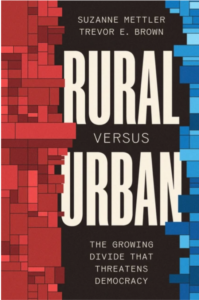
Suzanne Mettler and Trevor Brown
As much as any other dimension, American politics is polarized around the urban-rural divide. It’s hard for Democrats to win in rural places and for Republicans to win in metropolitan areas. Mettler and Brown show that this is a fairly recent phenomenon, explain how we got here, and suggest ways to move toward a less divided America. Surprisingly, they argue that rural and metropolitan dwellers agree on many of the most important policy questions; it’s the Democrats themselves that rural people don’t like.
This is partially due to a decades-long policy shift where the Democratic Party largely abandoned rural areas. Consider the shift from the pivotal roles of West Virginia and Appalachia in the political histories of John F. Kennedy and Robert Kennedy to the Clinton-through-Obama focus on free trade and globalization that left many rural communities behind. Mettler and Brown write, “Our interviews revealed a recurring theme: that rural people saw urban people, highly associated with the Democratic Party, as an overbearing elite.”
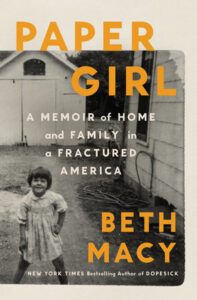
Beth Macy
Beth Macy is the outstanding journalist who wrote “Dopesick,” which was made into a Hulu miniseries starring Michael Keaton. “Paper Girl” is an autobiographical homecoming book in which she rediscovers her hometown of Urbana, Ohio. The book’s central question is: What would the author’s life look like if she had been born four decades later, in the 2000s rather than the 1960s? In the decades between, Urbana de-industrialized, the middle class disappeared because jobs vanished, educational opportunity withered, and the opioid crisis hit. While Macy’s upbringing was far from an idyllic “Leave it to Beaver” middle-class Americana, dedicated teachers, a solid public school system, and higher education opportunities afforded by programs like the Pell Grant enabled her to fulfill her potential. Returning home, the young people she meets also have tough family circumstances, but the additional barriers and lost opportunities leave them with few paths to success, or maybe even escape, in today’s rural America.
Macy is also currently the Democratic candidate for Virginia’s 6th district, which Donald Trump carried by 24 points in 2024.
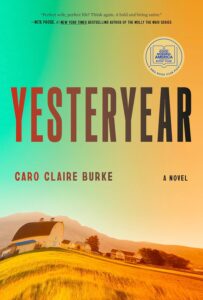
Caro Claire Burke
I’m glad this book has hit the best-seller lists and is getting a lot of attention. If you’re reading these book recommendations, you’re probably familiar with part of the plot line. A “trad-wife” social media influencer gets transported to 1855 (the era of the OG trad-wife?). No spoilers, but I thought the book was a wild ride through contemporary life on social media, changing pathways for ambition, feminism, and mental health.
Jordan Harper
As the title suggests, you shouldn’t read this book if you don’t like violent imagery or plot lines. On the other hand, if you are a fan of gritty noir, especially its Los Angeles variants, this book is for you. It’s a wonderfully written novel — no AI here. It is updated to account for YouTube citizen-journalism, the proliferation of private militaries and security forces, Hollywood power and powerlessness amplified by our gilded-age-on-steroids times, and stranger-than-Pizzagate, Epstein-class sex trafficking realities.