The Ash Center’s Reimagining Democracy Program recently announced its expanded Sports, Democracy and Civic Health initiative, which brings together scholars, sports leaders, civic organizations, and others to examine how sports can strengthen democratic life. Led by Tova Wang, Director of Research Projects in Democratic Practice, the initiative builds on more than five years of work exploring how sports and fandom can foster trust, reduce polarization, and encourage civic participation. One area of focus is how shared allegiance to a team can create a sense of belonging that extends beyond the game itself.
As part of that work, we recently spoke with Griffin Colaizzi, a research fellow at More in Common, a nonpartisan nonprofit that studies the forces driving Americans apart and identifies opportunities to bring them together around shared challenges. Colaizzi and his colleagues are participants in the Sports, Democracy and Civic Health initiative and will be contributing a chapter on sports and democracy to an upcoming book by Wang. Our conversation examines the findings and implications of the organization’s new report, “Sports Fandom: A Pathway to Community Belonging.”
Conducted in partnership with FOX Sports, the report draws on a survey of 5,572 U.S. adults. Respondents were grouped according to how closely they follow sports, from non-fans to highly engaged fans. The findings suggest that more avid sports fans are more likely to trust their local governments, help their neighbors, feel that they belong in their local communities, and work with others to improve those communities — all while providing a rare opportunity for Americans to connect across political differences.
More in Common will discuss the report’s findings during an upcoming webinar on October 8, 2026, from 2:00 to 3:00 p.m. EST. You can register for “Sports Fandom: A Pathway to Community Belonging. What a National Survey Reveals about Fans, Belonging, and Community Connection” here.
Q: What motivated More in Common to study sports fandom and community belonging at this moment?
Griffin Colaizzi: Sports is one of the few places left where Americans still regularly come together over something fun. At the same time, the U.S. feels increasingly fractured. Political institutions are viewed with skepticism, partisan divides feel stronger than ever, and loneliness seems to be rising. In a country as big and diverse as ours, doing things together really matters, and it’s getting harder to do. Last year, in our report “Fans, Politics and The Power of Sports,” we found that passionate sports fans are more civically engaged, more supportive of democratic norms, and more willing to connect across political divides. They also reported a stronger sense of belonging in their communities. This year, we wanted to follow that thread by exploring the relationship between sports fandom and community belonging.
Q: What was the most surprising finding from your study?
Colaizzi: I think the most surprising finding for me was that the fan bases of many major sports leagues are generally split across Democrats, Republicans, and Independents. This finding kind of runs counter to some cultural narratives that try to sort certain sports into left or right. It was really cool to see data back up the fact that the crowd at a football game, college basketball game, or even an MMA fight is more or less representative of America.
Q: The study found that more avid sports fans tend to be more engaged in their communities and more open to working across political differences. Why do you think sports fans are more engaged in these ways?
Colaizzi: I think a big part of it is that sports fandom naturally brings people into contact with each other. If you’re a sports fan watching the home team at local bar or public space, you’re likely to be around people from your community. And some of them may vote differently than you. But when you know someone first as a fellow fan, it’s easier to see them as a whole person beyond their politics. It’s hard to hate the person you just high-fived after a touchdown.
At More in Common, we talk a lot about perception gaps. That’s the idea that Americans tend to badly misjudge what people on the other side actually think and feel. These sort of caricatures of the other side are easy to believe when you don’t know or interact with anyone on the opposite side. But I think it gets much harder to sustain once you do, even if you’re never directly talking about politics with them. Our study also found that watching sports more often with other people is associated with stronger feelings of belonging in the community. If you feel like you’re part of a community, you’re probably more likely to invest in that community by getting involved, helping out your neighbors, and volunteering.
Q: Do you think sports fandom itself is the important factor, or is it about the experience of repeatedly gathering with others around a shared interest?
Colaizzi: That’s partly an open empirical question that I’m eager to explore in future work. What I can say though is that sports have some unique attributes that make it easy for people to repeatedly gather together. For one, there are a lot of sports and there are a lot of sports fans. Chances are you can find other people that are into the same sports you are, regardless of where you live. Sports fandom also comes with a visual cue. When you see a stranger in your team’s jersey, you immediately have something to talk about.
Sports schedules in general also provide an easy, consistent reason to repeatedly gather with others. That makes forming rituals, traditions, and shared experiences somewhat built into the sports fandom experience. Those shared experiences can also be pretty emotionally intense in the best ways. I can’t think of many other shared interests that lead to jumping up and down in excitement, yelling at the TV, high-fiving strangers, or uniting entire cities the way the Knicks did this June. So while I do think repeatedly gathering with others around a shared interest is a key factor, sports fandom itself may be especially well positioned to facilitate a unique kind of connection.
Q: You found that the most common reason less avid fans and non-fans do not attend sports gatherings is that they have no one to go with. What could help make these spaces more welcoming and accessible?
Colaizzi: I think the spaces themselves can be surprisingly welcoming, but people need an invitation in. It can be intimidating to go to a sports bar or other public viewing space alone and that’s where I think more passionate fans kind of have a responsibility to spread the fun of fandom. In our study, about half of the most passionate fans hosted others to watch sports at least once a month and were far more likely to watch sports at bars, restaurants, or a friend’s house regularly than less passionate fans. So the call to action so to speak is for those fans to bring along a coworker, a neighbor, or a friend who doesn’t follow the game as closely.
I think once someone has been invited in, going back gets a lot easier. And for those who are more outgoing, you can also just show up. My colleague Daniel Yudkin, who runs the Beacon Project (check it out!) at More in Common, decided to become a Saints fan this season. He’s been documenting it on Instagram, and it has kind of blown up. He’s received nothing but super positive responses from hardcore Saints fans welcoming him to the club. It’s been really fun to follow from afar and see how warmly a fan base can greet someone who just decided to show up.
Q: How can sports organizations ensure that the sense of belonging fostered through fandom extends beyond the fan base and reaches people who may feel disconnected from sports?
Colaizzi: I’d start local. Teams can partner with local groups on outreach, youth programs, and service days, so the team has a presence in the neighborhood beyond game day. Town identity mattered in our study. Both fans and non-fans feel a stronger sense of belonging in their local community when they see sports as important to their town’s identity. A team that’s part of its town’s identity has a way in with people who may never watch a game.
Q: Of all the findings in the report, which do you think are most important to amplify? And why?
Colaizzi: The most important finding — and my favorite — is that watching sports frequently with others is associated with higher feelings of belonging in your local community. This finding holds wherever people watch, whether it’s at bar, at a stadium, or at a friend’s house. This is also true no matter how big of a fan you are. All levels of fans and even non-fans tend to report higher levels of belonging in association with watching sports frequently with other people.
What I think is important about this finding is its accessibility. It would be one thing if we found that watching sports with others is only beneficial if it’s at a stadium every Sunday, but that’s not the case. If you want to start watching sports with other people, it doesn’t matter where you do it and it doesn’t matter if you know the third string QB’s college stats or if you just learned how to pronounce the starting QBs last name. The main thing is watching with others frequently.
Q: What specific actions could a professional sports team take to strengthen community connection and civic participation?
Colaizzi: On the community side, it looks a lot like what I described earlier. Teams should partner with local groups, invest in youth programs, and become a positive presence in the community beyond game day and in the offseason. Knowing the pro team in your city cares about the community can go a long way.
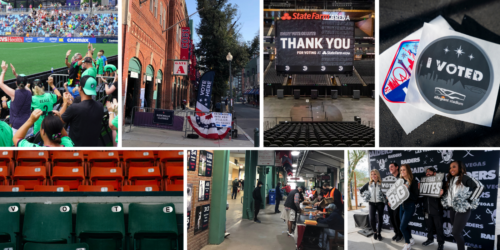
On civic participation, I’d encourage teams to keep a light touch. Part of what makes fandom special is that it’s fun and a break from politics. In our study, about eight in 10 of the most avid fans say sports is one of the few places they can enjoy something alongside people they disagree with politically. That bridge-building happens indirectly, which makes it easier and a lot more fun, and teams should try to protect that. A more direct option though is using stadiums and arenas as polling places. Tova Wang’s research here at the Ash Center has shown how well this works, and I’m grateful to Tova for sharing that work with us. Our study supports her research by showing the idea has broad support. At least 70% of people in every fan group support it, including non-fans.
Griffin Colaizzi is a research fellow at More in Common and a PhD candidate at Northeastern University. His research at More in Common investigates how sports fandom relates to community belonging, civic engagement, and social connection. His doctoral work examines how psychological factors, including empathy and moral obligation, can encourage sustainable and prosocial behaviors.