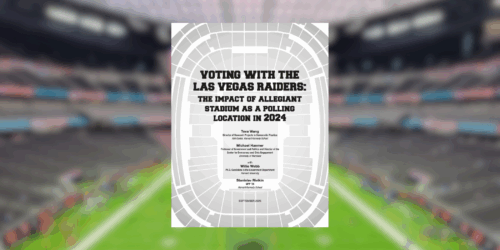
Voting with the Las Vegas Raiders: The Impact of Allegiant Stadium as a Polling Location in 2024
Sports facilities are uniquely positioned to provide an enjoyable voting experience and strengthen civic engagement. A new report by Tova Wang, Director of Research Projects in Democratic Practice, explores the impact of stadium voting in 2024 at Allegiant Stadium, drawing widespread, bipartisan support from voters and election officials and strengthening the relationship between the Las Vegas Raiders and the surrounding community.
In the 2024 general election, Allegiant Stadium drew over 4,200 voters to cast their ballots on Election Day, demonstrating the unique position of stadium facilities to provide an enjoyable voting experience and strengthen civic engagement. Voters at Allegiant Stadium were younger and more likely to be first-time voters compared to other polling locations in Clark County, with the experience drawing widespread, bipartisan support from voters, election officials, and the Las Vegas Raiders. This report explores the benefits of stadium voting by harnessing the power of sports to shape the fan-voter experience.
Tova Wang is the Director of Research Projects in Democratic Practice at the Ash Center for Democratic Governance and Innovation.
The views expressed in this article are those of the author alone and do not necessarily represent the positions of the Ash Center or its affiliates.
Terms of Engagement: Should Voting Be Mandatory in the U.S.?
On this week’s episode of “Terms of Engagement,” Miles Rapoport, former Senior Practice Fellow in American Democracy at the Ash Center, joins cohosts Archon Fung and Stephen Richer to discuss universal voting in the United States.
High voter turnout is often celebrated as a sign of a healthy democracy, with election officials viewing strong participation as evidence of public engagement and political legitimacy. On Terms of Engagement, Professor Jason Brennan joins cohosts Archon Fung and Stephen Richer to examine whether higher turnout actually strengthens democracy.
We Surveyed 50,674 Americans. This Is What Brings Them Together.
In this opinion piece, Audrey Feldman, Todd Rogers and Ben Valenta — participants in the Sports, Democracy and Civic Health project — describe their findings showing that shared fandom can soften partisan animosity and make political opponents more willing to connect.
Improving the Pipeline of Election Officials Strengthening Recruitment, Retention, and Professional Development in U.S. Election Administration
This paper by members of the Ash Center’s Executive Session on Elections and Election Administration, Tina Barton, Judd Choate, Ruth Greenwood, Elizabeth Linos, Veniece Miller and Tammy Patrick, presents a comprehensive pipeline strategy to recruit, support, and retain election administrators—by reducing barriers to entry, strengthening professional networks, improving workplace support and using workforce data to address burnout and prevent attrition.
We Surveyed 50,674 Americans. This Is What Brings Them Together.
In this opinion piece, Audrey Feldman, Todd Rogers and Ben Valenta — participants in the Sports, Democracy and Civic Health project — describe their findings showing that shared fandom can soften partisan animosity and make political opponents more willing to connect.
How Americans Navigate Voting Information Ahead of the 2026 Midterm Elections
The Shorenstein Center’s 2026 Voting Information Trends project—developed in collaboration with the National Internet Observatory at Northeastern University, the Ash Center for Democratic Governance and Innovation’s Program on Democracy and the Informed Public, and The Civic Health and Institutions Project—provides new insights into the voter information landscape in the United States ahead of the 2026 midterm elections.
Among the resources, an interactive dashboard maps where Americans are finding voting information and learning about key aspects of the voting process—from sourcing polling locations to voter registration. Also included are a series of trends reports gauging perceptions of voting in the lead up to the 2026 midterm elections.