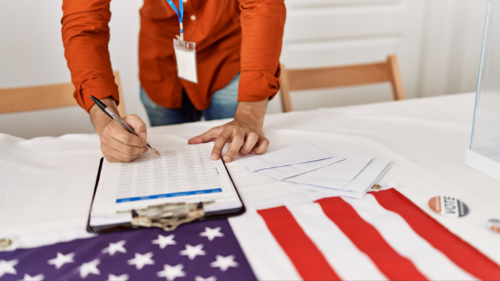
Propelled by the surprise outcome of the last presidential election, we are in the midst of a major shift in the attitudes of American youth toward political engagement. Sixty-four percent of youth surveyed by the Institute of Politics at Harvard Kennedy School are fearful about the future of American democracy. Young people are marching, petitioning politicians, and planning to head to the polls this November. And they aren’t just doing it for the ‘gram.
Millennials have been pilloried as being more interested in Snapchat than the political process, but Ashley Spillane, the 2018 Roy and Lila Ash Fellow in Democracy, argues that narrative couldn’t be further from the truth. Spillane, who most recently served as the president of youth advocacy organization Rock the Vote, says, “Four years ago we weren’t having an authentic conversation about young people, with young people, driven by young people. Not just soliciting their vote, not a campaign just trying to get them to turn out or an issue-specific initiative, but a real conversation about the power young people have and the ways in which they can deploy that power.”
Spillane, a passionate advocate for youth participation in politics, dedicated herself in recent years to helping America’s youngest voters get excited about casting a ballot. At Rock the Vote, she was responsible for launching a number of influential communications campaigns featuring celebrities like Lil Jon and Lena Dunham, which demystified the registration and voting process. Despite frequent collaborations with famous musicians and actors, “frankly, the most exhilarating part of the job was meeting with young people and getting them excited to participate,” reflects Spillane.
The key to connecting with millennials, Spillane says, is to create a culture of participation. “Voting should be a part of the story we tell about power, possibility, and opportunity in America. We can help young people understand how things will be in their communities, states, and this country if we’re honest about what’s broken, what they have the power to fix, and how much time it’s going to take to fix it,” she explains. To do that, you need to meet people where they are. For millennials, yes, that means social media, but it’s also the Video Game Voters Network, helping gamers be their own advocates for the video game industry; youth-focused fashion brands; and even the dating app Tinder.
Yet for all of her work on running youth engagement campaigns, Spillane was looking for an opportunity to more formally learn about leadership and organizing techniques. “I started running organizations when I was 26 and took over Rock the Vote when I was 30. I learned a lot of skills on the job, but always wished for the chance to pause and reflect on my experiences. Coming to HKS [Harvard Kennedy School] gave me the opportunity to do just that,” she says.
At HKS, Spillane found opportunities to be intellectually challenged and experiment with new skills. Professor Khalil Gibran Muhammad’s class on race and inequality in America was, Spillane says, an, “invaluable experience to learn and engage in open dialogue with the foremost expert on racism in America at a pivotal point in the fight against racism in America.” And Jeffrey Seglin’s course on column writing was a “collaborative and collegial space to experiment with writing.” In addition, Spillane, also an adviser to the Institute of Politics, saw opportunities to practice leadership skills and continue her work engaging young voters and mentoring undergraduate students.
Outside of the classroom, Spillane was actively involved in bringing cultural actors and academics together at the School. In the fall, she facilitated a conversation with Golden State Warriors’ Draymond Green about athlete activists. And, in the spring, she brought leaders from MTV, Chicago Votes, Tumblr, and Patagonia to campus for a conversation about voter participation; and, she moderated a conversation with Lesley McSpadden, the mother of Michael Brown, and documentary filmmaker Jason Pollock.
“My year at HKS has given me confidence in my abilities,” reflects Spillane. “There are things I still don’t know, but I have the skills, network and resources to go out and find the answers to questions that I have. And I’m not afraid to do that.”
Spillane will return to Washington, DC this summer as the president of Impactual LLC, a consulting firm that advises corporations, philanthropists, and nonprofits that want to support social impact work. Her work there will span a range of civic participation programs, from voter registration initiatives to anti-hate campaigns and democratic system reform. “There is a need for people who can lend support and creativity to organizations and individuals who want to try new, ambitious, bold things to make the world better. And I’m happy to be that person,” says Spillane.