

Policy Brief
Why Collective Behavior Change Requires a Civic Culture Approach
A new policy brief explores how civic culture can reshape social norms, encourage collective action, and drive lasting behavioral change.

Commentary
This overview maps the technology policy themes from the 2026 US midterm elections, drawing on local ballot measures and proposals from newly elected officials.
By:

Technology policy is rarely a salient issue for voters. The 2026 US midterms were different–in an election defined by affordability, concerns about rising electricity bills, data centers, and AI’s effects on jobs made AI a far more tangible issue, and local ballot questions and campaigns for elected officials reflected that growing public concern. Building on the Field Report: How AI Is Being Used in the 2026 Midterms, this piece provides a brief synopsis of the technology policy issues on the ballot, what newly elected officials have proposed, and what to watch next.
Data centers were the headline issue on the ballot. On November 3, 40 of the 41 local data center measures that passed across 10 states favored limited development. Most of these measures were not close, as the side favoring limited development won more than 70% of the vote in 30 of the 41 measures. The language in these measures took many forms: megawatt caps (typically stating over 25 megawatts), temporary moratoriums, rezoning referendums, advisory questions, and outright bans. Notably, every one of these decisions was made locally; no state put a data center, AI, or privacy measure before voters. In a meaningful exercise of civic power, communities themselves are deciding the shape of AI’s physical footprint.
Beyond data centers, the most notable local technology-related measures addressed license plate readers (York, Maine), Flock cameras (League City, Texas), and rules on surveillance technology (Pflugerville, Texas).
The data center backlash showed up in candidate races as well. NBC’s exit polling found that over half of voters considered AI and data centers a “crucial” or “major factor” in their vote for Congress. A recent Navigator research report found that “AI saw the most significant growth of any issue tested this year.” Most notably, data centers were central in high-profile races including:
Tech money also played a major role this cycle. As of late September, AI-focused super PACs aligned with OpenAI and Anthropic spent $55.7 million, mostly during the primaries. Megadonors poured billions into races this cycle, and several of the largest came from the technology industry, including Elon Musk, Marc Andreessen, Greg Brockman, and Reid Hoffman. This level of spending signals that the AI industry will be an active and well-resourced player as newly elected officials begin to shape technology policy.
Several newly elected officials included technology policy proposals in their campaigns and targeted the technology industry in their midterm victory speeches. The key themes across newly elected officials’ positions include:
Some of the most detailed proposals on AI came from new members of Congress:
Several newly elected attorneys general also included AI as a key issue in their campaigns. Michigan’s Eli Savit pledged to issue a suite of rules on AI misuse within his first 100 days, and Texas’s Nathan Johnson promised, within his first 30 days, a comprehensive audit of where state law falls short in protecting consumers, workers, and markets from AI.
In the near term, states are likely to continue moving on data center permitting, utility rates, tax incentives, and other actions; attorneys general will continue to take enforcement actions, particularly around chatbots and minors; and Congress is likely to start with oversight hearings and investigations into AI companies. Companies are already beginning to respond to the changing technology policy landscape–recently, OpenAI released a new policy document related to data centers (now labeled “compute campuses”).
There will also be a lot to learn about how AI shaped the election itself. In a report released before the election, the National Conference on Citizenship found that by mid-October one in four adults reported using an AI chatbot to learn about candidates. Early evidence from Caucus AI suggests that AI chatbots generally maintained a neutral tone and rarely told users who to vote for, but were also easy to influence as the chatbots would quickly cite new websites and present claims from attack sites as what unnamed ‘critics’ say. AI companies’ policies for handling election queries vary widely, as researchers at Princeton’s Center for Information Technology Policy have documented. Understanding how AI shaped election behaviors will be an important area of inquiry.
Campaigns also leveraged AI tools for content creation, data hygiene, and streamlining operational tasks. Now, in post-mortem discussions, they are evaluating the efficacy of AI use in campaigns, balancing the use of these new technologies with regulation, and will be looking into expanding the use of AI for more effective governance and government service delivery on behalf of newly elected officials and incumbents.
In this cycle, voters made clear that they want a say in decisions about technology, and in dozens of communities they made those decisions themselves. How newly elected officials respond will shape how AI’s next chapter is written with, and for, the public.
The author would like to thank Hillary Lehr, Darshan Goux, Paulo Carvão, Nick Pyati, and Felix Chen for their contributions to this piece.
Sarah Hubbard is the Associate Director for Technology & Democracy at the Allen Lab for Democracy Renovation.
The views expressed in this article are those of the author alone and do not necessarily represent the positions of the Ash Center or its affiliates.
Policy Brief
A new policy brief explores how civic culture can reshape social norms, encourage collective action, and drive lasting behavioral change.
Commentary
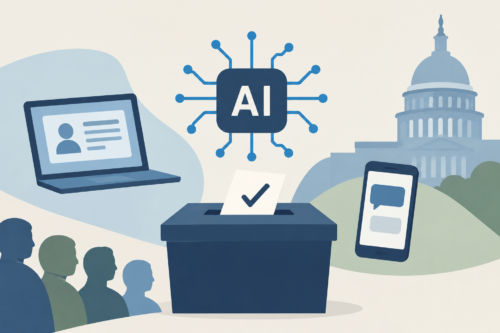
Allen Lab Policy Fellow Hillary Lehr provides a late-October 2026 snapshot of the multiple ways that AI and the midterms are intersecting, including campaign use cases, policy issues, and voters’ use of LLMs.

Additional Resource
Q+A
Ahead of Veterans Day, the Ash Center spoke with the leadership team at Vet the Vote about how their nonpartisan coalition empowers veterans and military families to continue serving their country as trusted poll workers.
Commentary
Allen Lab Policy Fellow Hillary Lehr provides a late-October 2026 snapshot of the multiple ways that AI and the midterms are intersecting, including campaign use cases, policy issues, and voters’ use of LLMs.

Feature
Amid rising threats, harassment, and political polarization, panelists at a recent Ash Center webinar discussed how law enforcement and election officials can collaborate to protect voters and election workers while safeguarding public trust.