The Allen Lab for Democracy Renovation’s Technology and Democracy workstream aims to ensure that emerging technologies are developed and governed in support of the public benefit.
The Allen Lab for Democracy Renovation’s Technology and Democracy workstream is focused on developing democracy-supportive technology policies, harnessing the opportunities for emerging technologies to improve governance, fostering professional norms that lead to technology development supportive of human pluralism, and building a robust pipeline of experts who can bridge ethical and technical considerations within policy and industry spaces. We pursue this work through foundational analysis and theory, field-building, and policy development.
The Landscape of Digital Civic Infrastructure in Massachusetts
Allen Lab for Democracy Renovation authors offer the first comprehensive analysis of how Massachusetts municipalities are using technology to support civic engagement, government decision-making, and public service delivery.
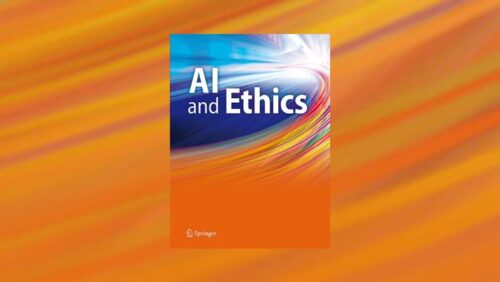
Crocodile tears: Can the ethical-moral intelligence of AI models be trusted?
Allen Lab authors Sarah Hubbard, David Kidd, and Andrei Stupu introduce an ethical-moral intelligence framework for evaluating AI models across dimensions of moral expertise, sensitivity, coherence, and transparency in their recently published paper, Crocodile Tears: Can the Ethical-Moral Intelligence of AI Models Be Trusted? in Springer AI & Ethics.
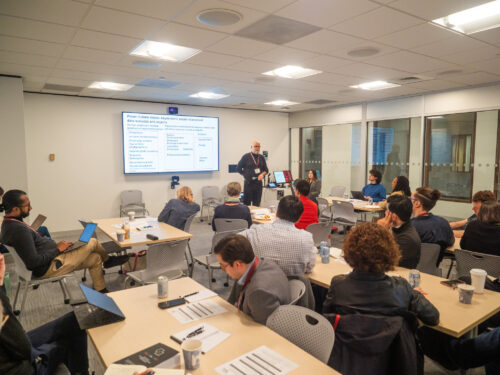
Earlier this year, the Allen Lab for Democracy Renovation hosted a convening on the Political Economy of AI. This collection of essays from leading scholars and experts raise critical questions surrounding power, governance, and democracy as they consider how technology can better serve the public interest.
This policy primer from the Allen Lab for Democracy Renovation is intended to introduce the ideas and conversations around how public AI alternatives could foster an ecosystem that prioritizes the public interest while offering a counterbalance to corporate concentration.
This policy primer from the Allen Lab for Democracy Renovation is intended to introduce the ideas and conversations around reform of Section 230 of the Communications Decency Act and how it could remake the social media ecosystem.
A Roadmap for Governing AI: Technology Governance and Power-Sharing Liberalism
This paper aims to provide a roadmap for governing AI. In contrast to the reigning paradigms, we argue that AI governance should be not merely a reactive, punitive, status-quo-defending enterprise, but rather the expression of an expansive, proactive vision for technology—to advance human flourishing.
GETTING-Plurality Research Network
At the center of our work is our multidisciplinary research network. The Governance of Emerging Technology and Tech Innovations for Next-Gen Governance (GETTING-Plurality) is a research network linking philosophers, social scientists, computer scientists, legal scholars, and technologists. This unique collaborative unites tech ethics initiatives at Harvard University with external impact partners across higher education and the tech industry, bringing philosophers and ethicists to the table for every project.
Our network seeks to advance understanding of how to shape, guide, govern, and deploy technological development in support of democracy, collective intelligence, and other public goods. Our focus is on how to do so, given the plural nature of human intelligence. We connect theory with practice to ensure that academic insights inform real-world policy and industry standards.
Conference on the Political Economy of AI Podcast Episodes
Check out the podcast episodes from the Allen Lab for Democracy Renovation’s Conference on the Political Economy of AI to glean insights from each panel.
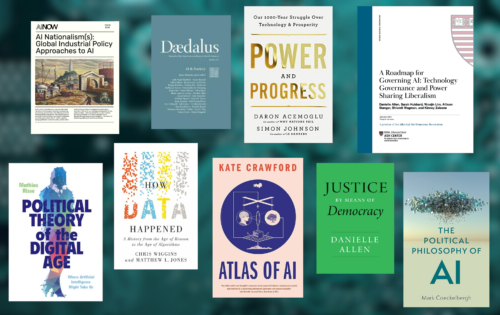
This list, curated by the GETTING-Plurality Research Network at the Allen Lab for Democracy Renovation, highlights a mix of foundational texts and new thinking on the timely issue of how AI will impact democracy, especially as we head into election season.
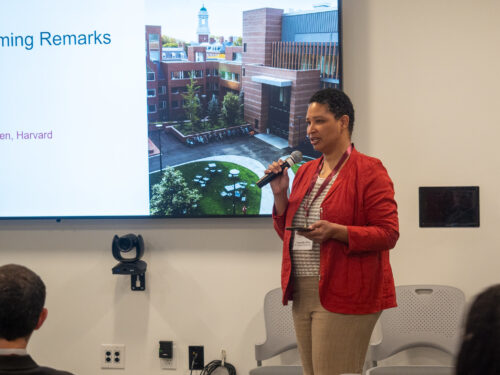
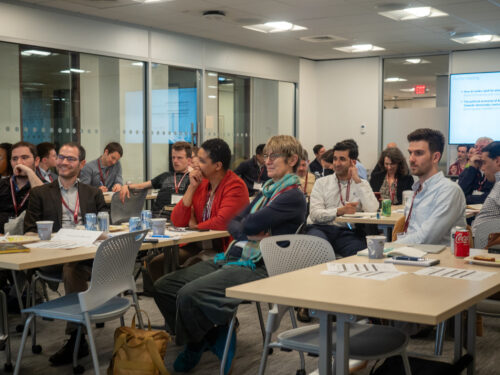
Experts gathered at the Allen Lab conference to examine the incentives and structures of AI development, as well as to discuss the past, present, and potential future of steering AI towards better serving the public interest.
From misinformation to AI panic, experts joined the Allen Lab’s GETTING-Plurality event to discuss the threats the burgeoning technology poses to democracy.
The GETTING-Plurality Research Network at the Ash Center’s Allen Lab and Connection Science at MIT Media Lab hosted a webinar event focused on “AI and the 2024 Elections”. In this session, we hear from Danielle Allen, Harvard University; Sandy Pentland, Massachusetts Institute of Technology; and Nate Persily, Stanford University. Each presenter gives a lightning talk, followed by audience Q&A.
GETTING-Plurality Conference on the Political Economy of Artificial Intelligence
The Political Economy of AI Conference was convened by the GETTING-Plurality Research Network, a project of the Allen Lab for Democracy Renovation, housed at the Harvard Kennedy School’s Ash Center for Democratic Governance and Innovation.
Terra Incognita: The Governance of Artificial Intelligence in Global Perspective
GETTING-Plurality Research Network members Allison Stanger and Woojin Lim, along with other authors, published “Terra Incognita: The Governance of Artificial Intelligence in Global Perspective” in the Annual Review of Political Science.
Hearing on “Where Are We Now: Section 230 of the Communications Decency Act of 1996”
Allen Lab Senior Fellow, Allison Stanger, provided testimony for The Subcommittee on Communications and Technology of the Committee on Energy and Commerce hearing on “Where Are We Now: Section 230 of the Communications Decency Act of 1996”.
The GETTING-Plurality Research Network at the Ash Center’s Allen Lab and Connection Science at MIT Media Lab hosted a webinar event focused on “AI and the Future of Privacy”. In this session, we hear from Bruce Schneier, security technologist, and Faculty Affiliate at the Ash Center; Sarah Roth-Gaudette, Executive Director of Fight for the Future; and Tobin South, MIT Ph.D. Candidate and Fulbright Scholar. Each presenter gives a lightning talk, followed by audience Q&A.
Democracy as Approximation: A Primer for “AI for Democracy” Innovators
This essay was adopted from a presentation given by Aviv Ovadya at the Second Interdisciplinary Workshop on Reimagining Democracy held on the campus of Harvard Kennedy School in December 2023.
GETTING-Plurality — “A Roadmap for Governing AI: Technology Governance and Power-Sharing Liberalism”
This GETTING-Plurality Research workshop session features Danielle Allen, James Bryant Conant University Professor at Harvard University, Director of the Allen Lab, and presenting author of “A Roadmap for Governing AI: Technology Governance and Power-Sharing Liberalism.” Allen was joined in conversation by commentator Rob Reich, McGregor-Girand Professor of Social Ethics of Science and Technology, Stanford University.
Abstract: As perhaps the most consequential technology of our time, Generative Foundation Models (GFMs) present unprecedented challenges for democratic institutions. By allowing deception and de-contextualized information sharing at a previously unimaginable scale and pace, GFMs could undermine the foundations of democracy. At the same time, the investment scale required to develop the models and the race dynamics around that development threaten to enable concentrations of democratically unaccountable power (both public and private). This essay examines the twin threats of collapse and singularity occasioned by the rise of GFMs.