

Commentary
What the 2026 Midterm Results Mean for Technology Policy
This overview maps the technology policy themes from the 2026 US midterm elections, drawing on local ballot measures and proposals from newly elected officials.

Policy Brief
This policy brief examines how states can strengthen partnerships between postsecondary institutions and state election officials to build sustainable civic infrastructure.
By:

Colleges and universities play an important role in preparing students for democratic participation, yet efforts to advance civic education and student voter engagement often remain fragmented, under-resourced, and dependent on individual campus leaders. While state election officials and postsecondary institutions share an interest in supporting informed civic participation, the structures needed to coordinate and sustain meaningful collaboration are often under resourced and limited, particularly across the full diversity of postsecondary institutions, including regional public universities, community colleges, and small private colleges.
To explore opportunities for strengthening these relationships, a series of facilitated convenings brought together a cross-ideological group of higher education leaders, election officials, and civic engagement practitioners. Drawing on participants’ experiences, perspectives, and recommendations, alongside research and policy analysis, these convenings led to the development of the Postsecondary Civic Liaison Network framework. The resulting nonpartisan, state-adaptable model identifies four interconnected priorities for building more coordinated and sustainable partnerships: access to trusted election information, institutional capacity building, student leadership and pathways, and local civic learning.
As the United States commemorates its 250th anniversary, this work invites renewed consideration of postsecondary education’s role in supporting democratic life. By moving beyond episodic voter engagement initiatives toward sustained institutional partnerships, Postsecondary Civic Liaison Networks offer a practical approach to strengthening the civic infrastructure connecting campuses, students, and local communities. The report outlines recommendations for state-level policy, governance, and institutional coordination, with particular attention to how election officials, postsecondary leaders, and students can establish and sustain these networks. The report also offers practical guidance for state election officials, higher education leaders, and civic organizations interested in exploring and adapting the framework.
To read the full paper, scroll up and click “Download the PDF” to the right of your screen.
Alex Kappus, Ph.D., served as a 2025–2026 Fellow with the Democratic Knowledge Project at the Harvard Graduate School of Education, affiliated with the Allen Lab for Democracy Renovation. Kappus currently serves as Senior Director for Client Success at Carnegie Higher Education, where he advises colleges and universities on institutional strategy, student success, and organizational change
The views expressed in this article are those of the author alone and do not necessarily represent the positions of the Ash Center or its affiliates.
Commentary
This overview maps the technology policy themes from the 2026 US midterm elections, drawing on local ballot measures and proposals from newly elected officials.

Policy Brief
A new policy brief explores how civic culture can reshape social norms, encourage collective action, and drive lasting behavioral change.
Commentary
Allen Lab Policy Fellow Hillary Lehr provides a late-October 2026 snapshot of the multiple ways that AI and the midterms are intersecting, including campaign use cases, policy issues, and voters’ use of LLMs.
Commentary
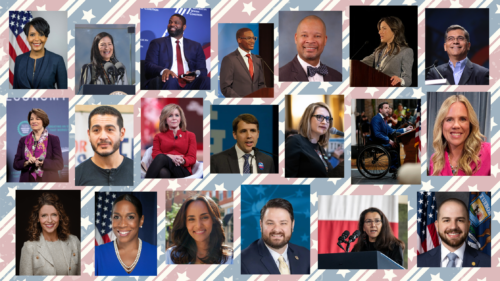
Election night 2026 produced a remarkable roll call of historic firsts. From the first Black woman elected governor of a U.S. state to the first Muslim elected to the Senate, voters broke barriers across state and party lines.
Policy Brief
A new policy brief explores how civic culture can reshape social norms, encourage collective action, and drive lasting behavioral change.

Additional Resource