

Additional Resource

Commentary
Allen Lab Policy Fellow Hillary Lehr provides a late-October 2026 snapshot of the multiple ways that AI and the midterms are intersecting, including campaign use cases, policy issues, and voters’ use of LLMs.
By:
Technology has always intersected with and transformed elections, from radio to television to the internet and social media. Now, AI is transforming election campaigns in new and complex ways.
This field report compiles report-backs and perspectives from political practitioners shared in the final weeks of the 2026 U.S. midterms. This post will map the wide array of ways AI and the midterms are intersecting, then dive into three areas: campaign use cases, policy issues, and voters’ use of LLMs providing a late-October 2026 snapshot.
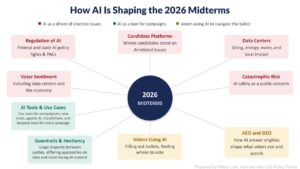
When thinking about AI in the 2026 midterms, it helps to distinguish between the politics of AI and AI in politics.
The politics of AI has quickly become a significant electoral issue. New Pew research finds 60% of Americans are uncomfortable with a new data center near them. Data centers, a physical, localized lightning rod of AI’s opportunity and intrusiveness, is where AI tension is surfacing across the country. That tension is shaping the platforms candidates of both major parties are running on. In the months leading up to Election Day, public concern has grown not only around job security and disruption, but around broader economic uncertainty and catastrophic risk. Together, these issues are shaping voter sentiment in ways candidates have to respond to.
Meanwhile, there is AI in politics. Campaigns are experimenting with AI in novel and interesting ways this cycle. While the public’s taste and tolerance for generative AI content in campaigns is still being shaped, many practitioners describe using generative AI in their work this cycle as ‘the wild west’ with few rules or norms to work off of. There is legislative action in a patchwork of states, which we’ll dive into below, and a great deal of learning underway into the efficacy of AI adoption for content generation, data refinement, and internal workflow use cases.
Alongside emerging use of disclosed and undisclosed AI-generated content, from text and images to audio, translation, and video, there is broader concern about undisclosed deepfakes realistic enough to deceive the public. As of late October, there are no standout stories of deepfakes significantly misleading a particular segment of voters. The broader effects of deepfakes combined with algorithmically driven polarization on social media are not yet known nor is the extent to which extreme targeting using advanced data segmentation, psychographics and individual-level personalization (often described as ‘Cambridge Analytica 2.0’ by practitioners) may or may not be in play.
Some of the most helpful applications of AI in the midterms involve applying AI to solve existing operational or informational pain points in campaign operations. Political tech practitioners have built several tools that help campaigners monitor the conversations happening in different corners of the internet, which helps campaigns refine their media and messaging approaches.
Higher Ground Institute (HGI), a think tank and experimentation hub for political tech practitioners on the American left, hosts monthly AI Open Mics where practitioners share new ways they are experimenting with AI in their workflows. Some involve novel uses of major LLMs like ChatGPT and Claude, including agentic use cases that automate reporting, improve data hygiene, and power more responsive dashboards for thoughtful, strategic voter outreach. In other cases, campaigns and organizations are using bespoke, vibe-coded tools to solve specific, local pain points, such as making it easier for volunteer canvassers to create more efficient door-knocking routes in multi-story building such as apartment complexes, voice dictate notes, or update data based on conversations at the door.
The ability of non-developer campaign practitioners to build their own tech solutions is an extraordinary advancement. It also raises issues of data integration, security, and shelf life, including whether these solutions can be shared with other campaigns after Election Day.
There is also a measurable gap in AI adoption between the American right and left. The American Association of Political Consultants (AAPC) has surveyed its members on AI adoption for the past three years and found a 20-percentage-point gap between the two. When it comes to AI-generated content put in front of voters, Republican candidates have experimented much more in the 2026 cycle.
“I’d describe two layers of AI usage on the American Right this cycle, each along its own spectrum of sophistication. First is the workflow usage – drafting copy, pulling research, cleaning up data, and some automation – and second is the production usage – creating videos, graphics, websites, apps – where it actually encounters voters. Safe to say most everyone is in the first bucket to some degree with all of the tools we use, but the second bucket is where there’s hesitation and uncertainty based on policies, regulations, laws, platforms, client expectations, and voter sentiment.”
Eric Wilson, Founder, Center for Campaign Innovation
“Both the left and the right are operating in the same quickly evolving technological landscape – and finding ways to reach voters within that. Over the past 10 years, the right has been quicker to adopt new technologies. This trend continues with AI. The right is quick to try things and scale what works while the left is more hesitant. In this case, both sides are still experimenting while voters are still deciding what they are comfortable with. This cycle is about AI experimentation – and both the right and the left are navigating the uses that suit them best as part of that moment.”
Betsy Hoover, Founding Partner, Higher Ground Labs
Conversations with practitioners on the left surface challenging questions around values alignment. Concerns range from skepticism of Big Tech, to job loss and the effects of automation on workers, to the environmental impact of data centers. Because of these perceived values conflicts, adoption on the left has been slower and more hesitant. Still, strong use cases are emerging from early adopters on both sides, showing AI’s potential to make campaigns more effective, more efficient, and more fulfilling for voters.
Here is a rundown of all the use cases presented at Higher Ground Institute’s monthly Open Mic series.
In a federally unregulated landscape, three factors are shaping how campaigns and organizations use AI:
The American Association of Political Consultants is a bipartisan association that is tracking state legislation and offers research and guidance to members around ethical usage of AI in campaigns. Julie Sweet, director of advocacy at AAPC, shared the following insights:
“Thirty-two states have passed laws on AI-generated election content, and they define it about ten different ways, so campaigns get a different compliance answer in every state for the same ad. Most of these laws regulate the tool rather than the deception. Courts have struck down or limited them in California, Hawaii, Vermont, and Montana. Labels don’t help much either. In the AAPC Foundation’s randomized trial, they barely improved viewers’ ability to spot AI and lowered an ad’s credibility even when no AI was used, a cost that falls on the honest speaker.
After the election, the debate should move from the tool to the deception. AAPC’s Meaningful Disclosure framework asks whether content is standing in as evidence: argument needs no label, content that could pass for a record should be labeled a dramatization, and fabricated proof shouldn’t run at all.”
Julie Sweet, director of advocacy at AAPC
Campaigns aren’t the only ones experimenting. Voters are also using chatbots as they fill out their ballots, asking for election-critical information like where, when, and how to vote, and using them to decipher what’s on their ballots. When LLM users request election critical information such as the address and hours of their local polling place, the chatbots are designed to direct users to the Democracy Works website for up to date, verified data. However, the 2026 midterms will be the first test run in which a sizable portion of the electorate will use chatbots while filling out their ballot.
“A year ago, everyone was focused on content creation and the role deepfakes might play in 2024 – and while we’ve seen a lot of AI-generated content this cycle, the real story this cycle hasn’t been what campaigns are saying with AI, but what AI is saying about campaigns, and how people are using LLMs to learn about campaign issues, ballot measures, and candidates. Figuring out what chatbots say about issues, candidates, and races, and how to influence those responses, is an entire discipline that didn’t exist eighteen months ago.”
Kate Gage, Executive Director, Higher Ground Institute
Voter use of LLMs has become a top AI-related issue, especially on the left, this cycle. Media attention on the voter use of LLMs increased in October. Proponents argue that the scraping and filtering function of LLMs can act as an encylopedia-like antidote to the disinformation that spreads widely on social media platforms. But because models are not transparent about how they ingest and prioritize different types of content (and from where), demand has grown in the political community for strategy, research, and solutions around generative engine optimization (GEO). GEO is similar to search engine optimization, but focused on getting targeted content to appear in chatbot outputs.
New polling from AAPC suggests that one in five voters expects to interact with an LLM as they fill out their ballot in the 2026 midterms. The picture is further complicated by major search engines, which now return AI-generated answers to many queries. That means voters get ambient LLM exposure even through a traditional Google search, rather than only a list of links from which to choose their own sources.
A number of startups have emerged in 2026 to help campaigns address this strategically and monitor how major LLM outputs change over time. Caucus.ai and CampSight by Run for Something help campaigns see how queries about their candidate show up across models and suggest formats or places to publish that can improve those outputs.
Vulnerability to incorrect, obsolete, or targeted misinformation ingestion by LLMs is being monitored, but whether and how it plays out is another unknown and is definitely something to watch after Election Day. It will also be interesting to see whether today’s largely skeptical public sentiment toward AI reduces voters’ use of LLMs to complete their ballots in 2026, or simply deepens their distrust of AI-generated output. AAPC survey data from September found that voters currently trust LLM search results less than social media. Given the lack of content moderation on social media, that is surprising. It is also a strong signal of how skeptical the public is of AI right now, a skepticism that extends to its potential impact on democracy.
Andrew Hall, Davies Family Professor of Political Economy at Stanford Graduate School of Business and a Senior Fellow at the Hoover Institution who recently joined Anthropic, posted on October 15th that voter use of LLMs is still a relatively low percentage of total conversations with Claude. Given that these are percentages from a random sample, researchers do not yet have a numeric sense of how many people may be engaging in these conversations. Further, as more voters receive, complete and cast their ballots in October and November, these numbers are very likely to increase from the September 21-27, 2026 snapshot shared here:
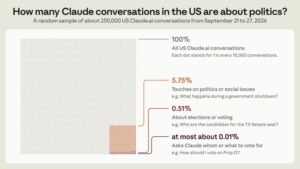
“How many Claude conversations…?” Andrew Hall, Anthropic
Voter use of LLMs can be viewed as an early test run for AI-assisted democracy. While there will be inaccuracies to spot, learnings to share, and improvements to integrate in future cycles, there is reason to be optimistic about long term potential to enhance the voter experience. It’s hard to imagine LLM outputs being cumulatively worse than algorithmically driven misinformation on social media. Much of the public’s distrust of LLMs may be a hangover from the largely unregulated social media era and the damage it did to democracy, despite real differences in how AI platforms approach misinformation and self-regulation.
Whether that changes depends on several things: greater transparency from the platforms, public opinion settling as AI becomes more integrated into everyday life, and whether the worst outcomes, or real benefits, materialize. All of these will shape how much voters trust and use LLMs as they fill out their ballots, and whether that turns out to be a net win or loss for democracy.
Between now and Election Day, we are learning everything we can about:
The candidates who adopt new technologies in ways that strengthen their relationships with voters and enhance their ability to deliver in office will define the strongest examples of AI-enhanced democracy.
Hillary Lehr is a Policy Fellow at the Allen Lab for Democracy Renovation. She serves as a Managing Director at Higher Ground Labs.
AI tools were used in the production of this piece, including voice dictation and transcript processing, draft editing, and refinement. All analysis, insights, and editorial judgments reflect the author’s own synthesis and ideas.
The views expressed in this article are those of the author alone and do not necessarily represent the positions of the Ash Center or its affiliates.
Additional Resource

Commentary
Engaged California is the nation’s first state-run deliberation program, and a new law aims to make it last.

Additional Resource
In a recent guest essay for The New York Times, Allen Lab Democracy Stack Fellow Beth Noveck argues for putting A.I. behind every public servant.

Feature
Amid rising threats, harassment, and political polarization, panelists at a recent Ash Center webinar discussed how law enforcement and election officials can collaborate to protect voters and election workers while safeguarding public trust.
Commentary
Engaged California is the nation’s first state-run deliberation program, and a new law aims to make it last.
Additional Resource
In a recent guest essay for The New York Times, Allen Lab Democracy Stack Fellow Beth Noveck argues for putting A.I. behind every public servant.