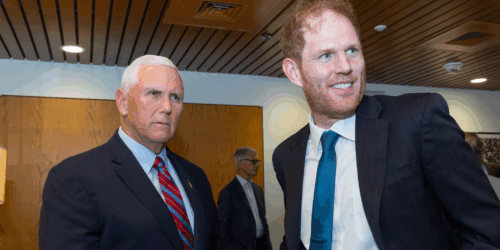
When former Vice President Mike Pence visited Harvard’s Institute of Politics for a discussion on “The Future of Conservatism and American Democracy,” he was introduced not just by a moderator, but by a longtime friend and admirer — Ash Center Senior Fellow Stephen Richer. A former Republican officeholder, Richer has often cited Pence as a personal role model for integrity and constitutional fidelity. Their friendship added a layer of warmth and sincerity to an evening that balanced deep ideological reflection with a spirit of civility and mutual respect.
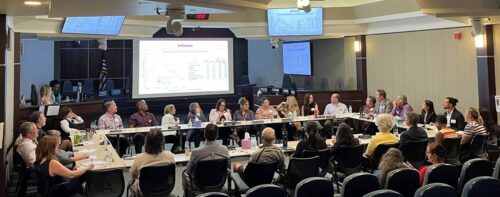
Former Vice President Mike Pence appeared at Harvard’s Institute of Politics for a one-hour conversation, moderated by Harvard Kennedy School professor Archon Fung, on “The Future of Conservatism and American Democracy.”
During the forum, Pence and Fung covered a variety of topics, including contrasted his vision of a “limited government conservatism”, called for renewed civility in public discourse, defended continued U.S. support for Ukraine, and urged a principled handling of antisemitism issues involving Harvard.
Below is commentary by Ash Center Senior Fellow Stephen Richer, who is a friend of Vice President Pence and introduced him at Harvard.
In the wake of the assassination of Charlie Kirk, Utah Governor Spencer Cox has implored political leaders to “disagree better” — a cause he’s championed for years.
I think Governor Cox would be proud of the Ash Center’s recent event with former Vice President Mike Pence.
I introduced the Vice President as a “one of my heroes.” I said that throughout my time as an elected Republican officeholder, “more than anyone in the United States, Mike Pence had shown me the path that I chose to walk – a path that I hoped to be of truth, integrity, and Constitutional fidelity.”
I mean it. And I will likely feel this way for the rest of my life.
Nevertheless, I disagreed with some of the Vice President’s remarks on Tuesday night.
I’m less confident than Vice President Pence that the 2026 elections will be free from federal disruption. I’m less optimistic about the future of the country’s constitutional democracy. And I also don’t think the Republican Party will revert to Reagan Republicanism by 2028.
I daresay my disagreements with the Vice President pale in comparison to the disagreements of some other attendees that night. Together with Ash Center Director Professor Archon Fung, Pence discussed religion in politics, environmentalism, and the role of the bureaucracy — topics that animate listeners at any university. And Pence even ventured into President Trump’s ongoing fight with Harvard.
Despite those touchy topics, the mood of the event couldn’t be characterized as anything other than positive. Nobody shouted. Nobody booed. Nobody heckled. Nobody attempted to veto, cancel, or intimidate.
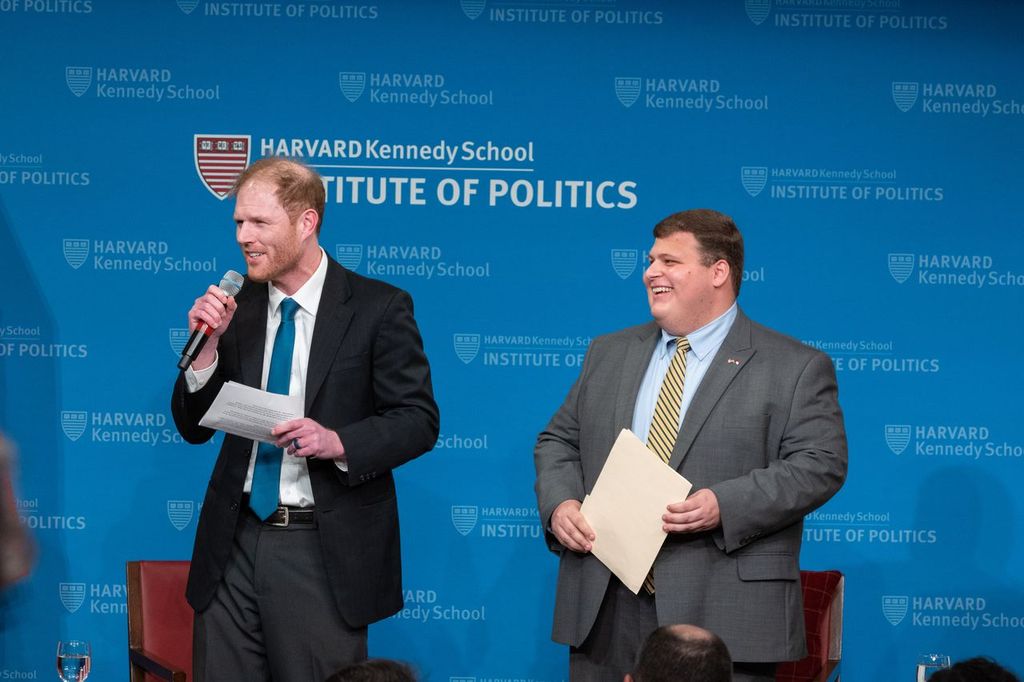
Richer and a Harvard undergraduate introducing Vice President Pence. Courtesy: Martha Stewart
Students asked articulate, intelligent, respectful questions. They stayed after the event for over an hour in order to shake hands with the former Vice President or to take a selfie.
Pence didn’t back down from any of the ardently conservative positions he has held for many years. He didn’t, for example, sugarcoat that he thinks modern-day environmentalists have correctly diagnosed a scientific phenomenon (the earth is warming), but that they’re way off on their prescription (e.g. The Paris Agreement).
But nor did he purposefully antagonize or insult opposing viewpoints. He told us that he learned from one of his favorite colleagues in Congress, Democrat John Lewis, to “disagree without being disagreeable.”
In closing the event, Professor Fung said, “I’d like everyone to take a minute to reflect on the conversation that we just had, and what we accomplished here together … we had a conversation across very different political views, and as [the Vice President said], the thing that’s important is civility and learning and exchange. I think people walk away with very different views, but hopefully a deeper understanding of each other, maybe a sharper understanding of where we differ, but maybe also clearer insight on where we agree, and hopefully a few people learned something as well. And I really deeply believe that …. exercising those muscles … is perhaps the most important source of our democratic flourishing.”
I don’t know if Professor Fung or Vice President Pence have ever fallen short on “disagreeing without being disagreeable.”
I know I have. Too many times as a politician.
But this event served as a model of a better way forward.
Stephen Richer, Senior Practice Fellow in American Democracy, is the former elected Maricopa County Recorder, responsible for voter registration, early voting administration, and public recordings in Maricopa County, Arizona, the fourth largest county in the United States.
The views expressed in this article are those of the author alone and do not necessarily represent the positions of the Ash Center or its affiliates.
Terms of Engagement: Should Voting Be Mandatory in the U.S.?
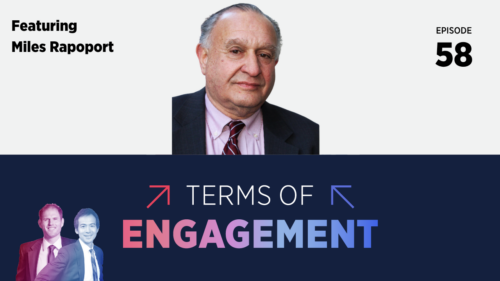
On this week’s episode of “Terms of Engagement,” Miles Rapoport, former Senior Practice Fellow in American Democracy at the Ash Center, joins cohosts Archon Fung and Stephen Richer to discuss universal voting in the United States.
High voter turnout is often celebrated as a sign of a healthy democracy, with election officials viewing strong participation as evidence of public engagement and political legitimacy. On Terms of Engagement, Professor Jason Brennan joins cohosts Archon Fung and Stephen Richer to examine whether higher turnout actually strengthens democracy.
We Surveyed 50,674 Americans. This Is What Brings Them Together.
In this opinion piece, Audrey Feldman, Todd Rogers and Ben Valenta — participants in the Sports, Democracy and Civic Health project — describe their findings showing that shared fandom can soften partisan animosity and make political opponents more willing to connect.
Allen Lab launches new Digital Civic Infrastructure Initiative to help governments strengthen democracy through technology
The new initiative combines municipal partnerships, digital tools, and research to help communities improve transparency, civic participation, and public service delivery.
Allen Lab Fellow Spotlight: City Charters Are Deliberative Democracy’s Friends
Allen Lab Fellow Tyler Fisher examines the untapped potential of city charters as a vehicle for deliberative democracy, arguing that advocates should work to embed tools like citizen assemblies, participatory budgeting, and town meetings directly into the governing architecture of cities, institutionalizing deliberative democracy one municipality at a time.