
Archon Fung
Director, Ash Center for Democratic Governance and Innovation;
Co-Director of the Program on Democracy and the Informed Public;
Winthrop Laflin McCormack Professor of Citizenship and Self-Government


Exploring how people find, understand, and act on information, and how actionable information empowers the public and moves institutions to reduce risks, improve performance, and become more accountable
Democracy and the Informed Public, Transparency for Development (T4D), Transparency Policy Project
Democracy depends on people having information they can trust and act on and institutions that respond to those actions. Every day, people rely on information to protect their health and safety, claim their rights, and meet their responsibilities as citizens, workers, and consumers. Too often, though, that information is hidden, outdated, confusing, or out of reach. How do people decide what information (and sources of information) to trust? What conditions lead people to act on information? How is AI reshaping the information landscape both for users and disclosers of information? And how can mandatory disclosure and other transparency policies lead to improvement in—rather than undermine—social welfare?
For more than two decades, Ash Center scholars have studied how information is produced, shared, and used, and how people can act on it to make governments and companies more responsive. Research by the Transparency Policy Project examined mandatory disclosure policies from nutrition labels, drinking water reports, terrorism alerts, and mortgage disclosure. Transparency for Development investigated community-led accountability efforts in Indonesia, Tanzania, and beyond. The Program on Democracy and the Informed Public now builds and expands on those foundations in the current and future information-laden world.
The body of research and commentary below reflects scholarship from the Program on Democracy and the Informed Public and its predecessors as well as other Ash fellows and faculty. We encourage you to explore and learn more about our work.
Director, Ash Center for Democratic Governance and Innovation;
Co-Director of the Program on Democracy and the Informed Public;
Winthrop Laflin McCormack Professor of Citizenship and Self-Government

Visiting Professor of Public Policy at the Harvard Kennedy School;
Co-Director of the Program on Democracy and the Informed Public;
Samuel F. and Rose B. Gingold Chair in Human Development and Professor of Economics,
School of Social Sciences and Social Policy, Brandeis University

Ash Center Senior Fellow

Lombard Director of the Shorenstein Center;
Edward R. Murrow Professor of the Practice of Press, Politics and Public Policy

Program Director
Additional Resource
The Shorenstein Center’s 2026 Voting Information Trends project—developed in collaboration with the National Internet Observatory at Northeastern University, the Ash Center for Democratic Governance and Innovation’s Program on Democracy and the Informed Public, and The Civic Health and Institutions Project—provides new insights into the voter information landscape in the United States ahead of the 2026 midterm elections.
Among the resources, an interactive dashboard maps where Americans are finding voting information and learning about key aspects of the voting process—from sourcing polling locations to voter registration. Also included are a series of trends reports gauging perceptions of voting in the lead up to the 2026 midterm elections.

Video
In this webinar moderated by Tova Wang, director of democratic research projects at the Ash Center, panelists Julia Angwin, Amanda Yarnell, Tommy Gong, and Brianna Wiggity Weck explore how election officials can leverage social media’s reach to improve public awareness around voter registration, voting, and election integrity. The discussion builds on the Ash Center paper, “Building Capacity to Use Social Media: How Election Officials Can Leverage Content Creation to Provide Accurate Voter Information,” which outlines frameworks for collaboration between election officials and digital content creators.

Policy Brief
Technology has enriched the lives of Americans with novel communication choices. It has also made it more difficult to reach everyone in emergencies. In a new policy brief, Mary W. Graham, senior fellow at the Ash Center for Democratic Governance and Innovation, explores this new paradox of the digital transition.
Additional Resource
The Shorenstein Center’s 2026 Voting Information Trends project—developed in collaboration with the National Internet Observatory at Northeastern University, the Ash Center for Democratic Governance and Innovation’s Program on Democracy and the Informed Public, and The Civic Health and Institutions Project—provides new insights into the voter information landscape in the United States ahead of the 2026 midterm elections.
Among the resources, an interactive dashboard maps where Americans are finding voting information and learning about key aspects of the voting process—from sourcing polling locations to voter registration. Also included are a series of trends reports gauging perceptions of voting in the lead up to the 2026 midterm elections.
Video
In this webinar moderated by Tova Wang, director of democratic research projects at the Ash Center, panelists Julia Angwin, Amanda Yarnell, Tommy Gong, and Brianna Wiggity Weck explore how election officials can leverage social media’s reach to improve public awareness around voter registration, voting, and election integrity. The discussion builds on the Ash Center paper, “Building Capacity to Use Social Media: How Election Officials Can Leverage Content Creation to Provide Accurate Voter Information,” which outlines frameworks for collaboration between election officials and digital content creators.

Paper
As traditional news declines, content creators play a growing role as information sources. This paper proposes frameworks for effective collaboration between creators and election officials and offers recommendations for officials to develop their own social media content.

Case Study
Since 1910, the theory has held: force candidates and donors into the light, and corruption shrinks. Congress kept building on that idea for a hundred years — new disclosure mandates in the 1970s, tighter rules in 2002 — until a single Supreme Court case blew a hole in it. Today, PACs with names like “Best of America” and “Ready to Win” can legally hide the identities of the people actually writing the checks. Even the committee tasked with policing all of it couldn’t agree on basic rules for internet ads until December 2022, and still has none for ads generated by artificial intelligence.

Article
In a landmark 2013 Science piece, David Weil, Mary Graham, and Archon Fung coin “targeted transparency”: the idea that governments can hit big policy goals — safer cars, healthier menus, cleaner factories — simply by forcing companies to disclose the right information at the right moment. It’s worked before (think fuel-economy stickers), but the authors warn it can just as easily backfire into empty paperwork. So when does sunlight actually change behavior, and when is it just noise?

Article
A letter grade in a restaurant window changed diners’ behavior overnight. A federally mandated water-quality report, mailed quarterly, mostly ends up in the trash. David Weil digs into why some transparency policies reshape behavior and others just generate paperwork — and into the cases where governments have good reason to keep the curtain closed.
FOIA “doesn’t work very well for anyone,” write Archon Fung, Mary Graham, and David Weil — so instead of waiting on records requests, why not just publish everything? Their memo to federal policymakers lays out concrete fixes, from stimulus-spending dashboards to an eight-point test for whether a disclosure law will actually work.

Case Study
After a wave of fatal Firestone tire blowouts and SUV rollovers in 2000, Congress did something the auto industry had blocked for twenty years: forced automakers to publish a simple star rating for how likely each new model was to flip. Within five years, nearly every car on the lot had climbed to four or five stars — proof the system worked, or proof the stars stopped meaning much of anything?

Case Study
The rules requiring public companies to open their books trace back to a “modest first installment” cobbled together in 1933, after the market lost 83 percent of its value. Every decade or so since, a new scandal has forced Congress to patch the system again: conglomerate collapses in the 1960s, brokerage failures in the 1970s, Enron in 2001. Now regulators are trying to force the same disclosure logic onto something far harder to standardize than a balance sheet: a company’s carbon footprint.

Case Study
For nearly a decade, Americans lived with a five-color scale meant to tell them how worried to be about terrorism — yet polls found most people had no idea what color the country was even on, and a psychologist warned the system was turning citizens into “worriers, not warriors.” Archon Fung, Mary Graham, and David Weil trace how a transparency tool designed to guide action ended up guiding almost nothing at all.

Case Study
Megan Kanka’s death in 1994 led to a wave of disclosure laws requiring states to publish the whereabouts of released sex offenders — and Washington State built one of the most aggressive versions, giving the public near-unlimited online access to names, photos, and addresses. But Archon Fung, Mary Graham, and David Weil found a wrinkle that disclosure advocates rarely mention: by one national estimate, roughly a quarter of offenders simply don’t register at all.

Case Study
In 1975, Congress forced banks to disclose, address by address, who got mortgages and who got turned away — a narrow bill that squeaked through the Senate by two votes. Fifty years, a savings-and-loan crisis, a subprime meltdown, and a new federal bureau later, regulators are still uncovering redlining, except now it’s harder to see: branches quietly placed outside Black neighborhoods, bias buried inside lending algorithms. The agency built to police all of it has spent much of the last decade fighting for its own survival in court.

Case Study
After a 1983 federal report warned that American schools were falling behind, states rushed to publish school report cards, betting that transparency would push parents toward better schools and administrators toward better results. But by 1999, researchers found barely half of teachers and less than a third of parents had actually looked at one — and when No Child Left Behind forced every state to disclose more data in 2001, confusion multiplied just as fast as disclosure did, with some states juggling more than one report card per school. Two decades and a pandemic later, 45 states still publish their report cards in English only.

Case Study
No treaty created it. No government voted it into being. Yet by 2005, a board of accountants headquartered in London — funded partly by the same “big four” firms whose clients it regulates — had convinced the European Union to make its rules binding law for seven thousand companies, with the US, Russia, and India weighing whether to follow. Businesses were already complaining the standards made their accounts “unreadable and irrelevant.” Enforcement was left entirely to the same national governments that had just given up control.

Policy Brief
A color-coded terror alert system nobody understood. A calorie-labeling bill Congress kept burying. Archon Fung, Mary Graham, David Weil, and Elena Fagotto lay out exactly why some disclosure laws save lives and others just generate paperwork — and which future is winning.
Book
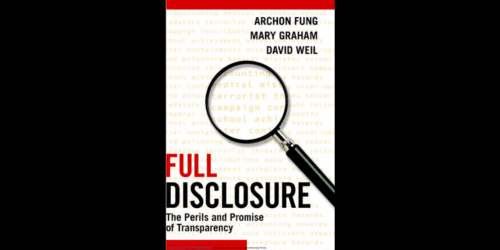
Full Disclosure explores how transparency policies, like corporate disclosures and nutritional labels, can empower citizens and improve governance, but often fall short due to incomplete or irrelevant information, offering insights into making them more effective.

Policy Brief
Nutritional labels told dieters to cut calories — so they skipped the fat warning that actually mattered. Archon Fung, Mary Graham, David Weil, and Elena Fagotto studied 15 disclosure laws and found the same pattern again and again: giving people facts doesn’t guarantee they’ll use them the way policymakers intended.

Paper
Restaurant letter grades changed how Los Angeles ate almost overnight. So why did mandatory hospital error reporting go nowhere, even as the death toll climbed past 44,000 a year? Archon Fung, David Weil, Mary Graham, and Elena Fagotto dig into what separates a transparency policy that reshapes an industry from one that just sits on a shelf.

Paper
Enron’s collapse rewrote financial disclosure rules. SUV rollovers rewrote auto safety labels. But not every transparency law ages well — some quietly degrade into empty paperwork exercises. Archon Fung, Mary Graham, and David Weil trace what separates a disclosure system built to last from one built to fail.

Paper
Medical mistakes, tainted tap water, junk food, toxic factories — four of the government’s most ambitious disclosure programs tackled four completely different problems. Mary Graham found they broke down in strikingly similar ways, and the lessons could shape every transparency law that comes after them.

Article
Lead in faucets, carcinogens in Liquid Paper, dolphins in tuna nets: none of it changed until the companies faced public exposure instead of a lawsuit. Mary Graham calls it “regulation by shaming” — but she also finds it can backfire, distorting what the public thinks is actually dangerous.

Article
Trust between citizens and the institutions that govern them is essential for effective policy, especially in public health. However, against a backdrop of escalating political polarization and rising levels of misinformation, there has been a stark decline in public confidence in government and health institutions.

Article

Occasional Paper
A community scorecard program in Indonesia and Tanzania showed no measurable health improvements — but an adapted version in Ghana, Malawi, and Sierra Leone showed promise. The difference? Whether local officials were in the room.

Paper

Paper
Instead of telling communities how to fix their maternal health systems, community partner organizations shared information on local conditions and encouraged communities design their own action plans — no prescribed targets, no required tactics. The result: 1,139 separate actions, from road repairs to ambulance funds to confronting health officials directly.

Additional Resource
To find mothers who’d recently given birth across rural Indonesia, researchers assumed a door-to-door household census would beat asking a few knowledgeable locals where to look. So they tested both, side by side, in the same villages. Jessica Creighton and Wayan Suriastini ran the comparison — and the “thorough” method missed far more respondents than anyone expected.

Paper

Article
Archon Fung and Elena Fogotto describe a new Commonwealth Fund–supported project examining whether smartphones, apps, and wearables can create a better model of transparency: one where patients not only access information but generate and share their own health data through platforms like Smart Patients and patient-powered research networks. The project will study these platforms’ features, how they empower patients, and whether their benefits reach all users or mainly the tech-savvy.

Occasional Paper
The Transparency for Development (T4D) study was designed to answer the question of whether a community-led transparency and accountability program can improve health outcomes and community empowerment, and, if so, how and in what contexts. To answer this question, researchers and civil society organization partners began by co-designing a program that would activate community participation to address myriad barriers to proper maternal and newborn care, with the ultimate goal of improving maternal and newborn health outcomes. This report presents the design of the program that was then implemented in 200 villages in Tanzania and Indonesia and studied using a mixed methods impact evaluation. In addition to detailing the program, the report outlines how we got there—describing a number of principles that informed some distinguishing features of the program, as well as an iterative design process that defined other features through trial and error.

Paper
The growth of experimentation has brought randomized controlled trials (RCTs) into evaluations of complex interventions in policy areas like health care or education, which often occur at the group or society level, at a large scale, and the implementation of which can take myriad forms. For precisely evaluating the benefits of complex programs, RCTs remain the gold standard, frequently used when, for example, a health or education program is under consideration for scaling, is already being done at large scale but is of uncertain benefit, or is almost perfected save for a very specific design question. But often large-scale randomized controlled trials of complex interventions are not the best choice. When, for whatever reason, evaluation of a complex intervention is important but small-scale experimentation is more appropriate than a full RCT, how might further refinement of that intervention be most rigorously and reliably evaluated? This paper describes one approach to such an evaluation.

Paper
Ahead of launching their community scorecard intervention in 200 villages, the Transparency for Development team surveyed households in Indonesia and Tanzania. This report details the demographics, health conditions, and empowerment levels of the communities included in the sample prior to the intervention. One interesting finding is although respondents rated their local health providers as fairly responsive, very few viewed local government as responsive.

Article
The FDA’s new nutrition labels will more clearly show added sugar, calorie counts, and realistic serving sizes, and are being praised by health advocates as key to fighting obesity. However, Elena Fagotto argues these improved labels may not actually help the people who need them most.

Article
Transparency isn’t magic: menu calorie counts and credit card disclosures actually change behavior, but sex offender registries and privacy policies often backfire or go ignored — the difference is whether people have real choices and the information is presented simply, argue Elena Fagotto and Archon Fung.

Article
In this study, Archon Fung and Stephen Kosack assess the current state of transparency initiatives across the globe. Honing in on interventions with a focus on “transparency for accountability”—which show mixed results—they develop a framework of five “worlds” that helps account for the variation in outcomes.

Case Study
For fifty years, global disease surveillance ran on an honor system: countries reported outbreaks to the WHO when they chose to, and reputation and trade concerns usually won out over early warning. That system quietly died in 2003, when cell phone messages out of Guangdong Province forced the world — and eventually Beijing itself — to confront a SARS outbreak the government hadn’t disclosed. Two decades, a rewritten rulebook, and a COVID death toll past six million later, the question isn’t whether informal networks can out-pace governments. It’s whether anyone funds the basic reporting systems meant to catch the next one before it spreads.

Case Study
In 1997, a local news crew snuck cameras into restaurant kitchens and found rats, roaches, and food left to rot at room temperature. Within a month, Los Angeles County had passed an ordinance forcing every restaurant to post a letter grade — A, B, or C — right in its window. Revenue at A-graded restaurants jumped nearly 6 percent while C-graded ones lost customers, and hospitalizations for foodborne illness fell by double digits. But one researcher later found the grades didn’t always mean what diners thought they meant.

Case Study
After cryptosporidium-contaminated water killed more than fifty people in Milwaukee in 1993, Congress required water utilities to mail customers an annual report on what’s in their tap water. Three decades, a Flint, and a Newark later, the reports still don’t catch the thing that matters most: lead leaching from century-old pipes between the treatment plant and the faucet, invisible to any test performed at the source. A 2018 study found tens of millions of Americans drinking from systems that violated federal standards — many without ever being told.

Case Study
When Congress mandated nutrition labels in 1990, it was hailed as the biggest change in food policy in fifty years — standardized facts on every can and package, for the first time letting shoppers compare what they were actually eating. But the label that promised transparency also carved out exemptions covering nearly half of what Americans buy, and the science it reported lagged years, sometimes decades, behind what scientists already knew. Now online grocery and delivery apps are opening a new gap.

Article
Big brands keep the reputation and the profits — so who’s actually on the hook when labor laws get broken? David Weil’s “fissured workplace” theory has an answer, and it’s not the one regulators have been using.

Article
Wouldn’t it make sense to find out—before applying for a job in a dangerous industry—which firms have a safe track record and which don’t? The Obama administration thought so and proposed an online system for accessing workplace safety data. The Trump administration disagreed, delaying it indefinitely—a decision that raises injury risk for thousands of workers.
David Michaels and David Weil argue that OSHA-driven transparency can push dangerous employers to improve: making injury data public would likely “nudge” them into better protecting their workers.

Article
A new OSHA rule, taking effect in 2017, will require large employers and those in high-risk industries to electronically report injury and illness data. Elena Fagotto argues the added transparency will help employers benchmark safety performance and let OSHA target its limited inspection resources more effectively.

Case Study
After two years of Senate hearings exposed bribery and racketeering inside major labor unions, Congress passed a law forcing them to disclose their finances to the 13 million workers they represented. But for decades, getting that information meant a trip to a Labor Department reading room or a mailed request with a per-page fee — and in a typical year, barely eight thousand people bothered to ask. It took a Republican administration four decades later, not union members themselves, to finally force the disclosures that mattered.

Case Study
After a wave of plant closings in the 1970s and ’80s, Congress settled on a modest compromise: companies above a certain size would have to warn workers and communities sixty days before a mass layoff. But the definitions of “mass layoff” and “covered employer” were carved so narrowly — and enforcement left so entirely to workers suing in federal court rather than any government agency — that researchers found the law barely touches most permanent layoffs. Even 9/11 and the offshoring wave of the mid-2000s, each triggering congressional hearings about expanding the rule, changed nothing.

Case Study
A 1972 survey found a quarter of U.S. workers were exposed to one or more of nearly 8,000 workplace hazards — often without employers or employees even knowing it. The fix that emerged was a cascading disclosure chain: manufacturers tell employers, employers tell workers. Decades, lawsuits, and one UN standard later, hazard communication still ranks among OSHA’s most violated rules. So does all that paperwork actually keep anyone safer?
Policy Brief
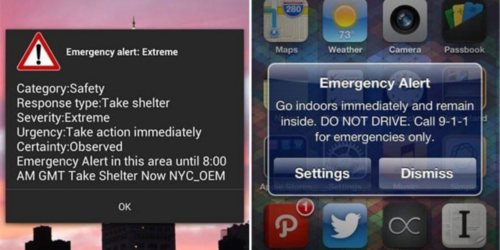
Technology has enriched the lives of Americans with novel communication choices. It has also made it more difficult to reach everyone in emergencies. In a new policy brief, Mary W. Graham, senior fellow at the Ash Center for Democratic Governance and Innovation, explores this new paradox of the digital transition.
Commentary
In this paper, Mary W. Graham, Ash Center Senior Fellow and longtime co-director of the Center’s former Transparency Policy Project, explores the unintended information inequities that weaken the nation’s vital health and safety alerts. By examining three policies — wildfire alerts, drinking water reports, and auto safety recalls — she suggests common sources of inequality problems and steps policy makers are taking to remedy them.

Article
Cap-and-trade bills can take years to pass — but a disclosure rule could pass tomorrow. Elena Fagotto and Mary Graham point to a 1984 chemical disaster that led to mandatory US toxic-emissions reporting and cut pollution nearly in half within a decade. Could the same trick work on greenhouse gases?

Policy Brief
Congress was debating climate bills that wouldn’t take effect for half a decade — meanwhile emissions kept climbing. Mary Graham and Elena Fagotto had a faster fix: make every factory and product disclose its greenhouse gas emissions now. It had already worked once before, after a very different disaster.

Article
A last-minute rider that even the EPA and environmental groups shrugged off turned into one of the most quietly powerful pollution laws in US history. Mary Graham and Catherine Miller revisit the Toxics Release Inventory’s famous 46 percent decline — and find the real story is a lot messier than the headline number suggests.
Case Study
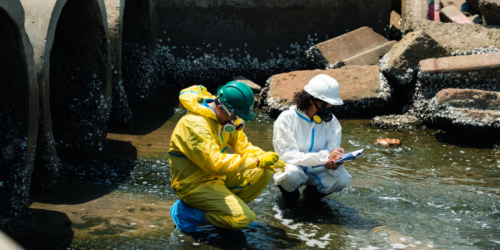
After the 1984 Bhopal gas leak killed thousands, Congress forced American factories to report, chemical by chemical, exactly how much toxic pollution they released into the air, water, and ground. The agency meant to run it initially saw the whole thing as paperwork. Within a decade, the numbers alone had pushed companies to voluntarily cut their toxic releases almost in half — without a single new regulation telling them to.
Case Study
A 1972 survey found a quarter of U.S. workers were exposed to one or more of nearly 8,000 workplace hazards — often without employers or employees even knowing it. The fix that emerged was a cascading disclosure chain: manufacturers tell employers, employers tell workers. Decades, lawsuits, and one UN standard later, hazard communication still ranks among OSHA’s most violated rules. So does all that paperwork actually keep anyone safer?
Case Study
The rules requiring public companies to open their books trace back to a “modest first installment” cobbled together in 1933, after the market lost 83 percent of its value. Every decade or so since, a new scandal has forced Congress to patch the system again: conglomerate collapses in the 1960s, brokerage failures in the 1970s, Enron in 2001. Now regulators are trying to force the same disclosure logic onto something far harder to standardize than a balance sheet: a company’s carbon footprint.

Case Study
In 1999, a landmark national report called for a simple fix: make hospitals publicly disclose their serious errors, the way New York already did for cardiac surgery. Bill Clinton backed it, half the country heard about it within weeks, and then doctors, hospitals, trial lawyers, and consumer groups spent two decades fighting over the details. By 2017, researchers could show that some hospitals killed patients at thirteen times the rate of others — but the data came with one catch that made it useless to the people who needed it most.
Case Study
For nearly a decade, Americans lived with a five-color scale meant to tell them how worried to be about terrorism — yet polls found most people had no idea what color the country was even on, and a psychologist warned the system was turning citizens into “worriers, not warriors.” Archon Fung, Mary Graham, and David Weil trace how a transparency tool designed to guide action ended up guiding almost nothing at all.
Case Study
Megan Kanka’s death in 1994 led to a wave of disclosure laws requiring states to publish the whereabouts of released sex offenders — and Washington State built one of the most aggressive versions, giving the public near-unlimited online access to names, photos, and addresses. But Archon Fung, Mary Graham, and David Weil found a wrinkle that disclosure advocates rarely mention: by one national estimate, roughly a quarter of offenders simply don’t register at all.
Case Study
In 1975, Congress forced banks to disclose, address by address, who got mortgages and who got turned away — a narrow bill that squeaked through the Senate by two votes. Fifty years, a savings-and-loan crisis, a subprime meltdown, and a new federal bureau later, regulators are still uncovering redlining, except now it’s harder to see: branches quietly placed outside Black neighborhoods, bias buried inside lending algorithms. The agency built to police all of it has spent much of the last decade fighting for its own survival in court.
Case Study
Since 1910, the theory has held: force candidates and donors into the light, and corruption shrinks. Congress kept building on that idea for a hundred years — new disclosure mandates in the 1970s, tighter rules in 2002 — until a single Supreme Court case blew a hole in it. Today, PACs with names like “Best of America” and “Ready to Win” can legally hide the identities of the people actually writing the checks. Even the committee tasked with policing all of it couldn’t agree on basic rules for internet ads until December 2022, and still has none for ads generated by artificial intelligence.
Case Study
After two years of Senate hearings exposed bribery and racketeering inside major labor unions, Congress passed a law forcing them to disclose their finances to the 13 million workers they represented. But for decades, getting that information meant a trip to a Labor Department reading room or a mailed request with a per-page fee — and in a typical year, barely eight thousand people bothered to ask. It took a Republican administration four decades later, not union members themselves, to finally force the disclosures that mattered.
Case Study
In 1997, a local news crew snuck cameras into restaurant kitchens and found rats, roaches, and food left to rot at room temperature. Within a month, Los Angeles County had passed an ordinance forcing every restaurant to post a letter grade — A, B, or C — right in its window. Revenue at A-graded restaurants jumped nearly 6 percent while C-graded ones lost customers, and hospitalizations for foodborne illness fell by double digits. But one researcher later found the grades didn’t always mean what diners thought they meant.
Case Study
For fifty years, global disease surveillance ran on an honor system: countries reported outbreaks to the WHO when they chose to, and reputation and trade concerns usually won out over early warning. That system quietly died in 2003, when cell phone messages out of Guangdong Province forced the world — and eventually Beijing itself — to confront a SARS outbreak the government hadn’t disclosed. Two decades, a rewritten rulebook, and a COVID death toll past six million later, the question isn’t whether informal networks can out-pace governments. It’s whether anyone funds the basic reporting systems meant to catch the next one before it spreads.
Article
Cap-and-trade bills can take years to pass — but a disclosure rule could pass tomorrow. Elena Fagotto and Mary Graham point to a 1984 chemical disaster that led to mandatory US toxic-emissions reporting and cut pollution nearly in half within a decade. Could the same trick work on greenhouse gases?
Case Study
After a wave of plant closings in the 1970s and ’80s, Congress settled on a modest compromise: companies above a certain size would have to warn workers and communities sixty days before a mass layoff. But the definitions of “mass layoff” and “covered employer” were carved so narrowly — and enforcement left so entirely to workers suing in federal court rather than any government agency — that researchers found the law barely touches most permanent layoffs. Even 9/11 and the offshoring wave of the mid-2000s, each triggering congressional hearings about expanding the rule, changed nothing.
Case Study
After a 1983 federal report warned that American schools were falling behind, states rushed to publish school report cards, betting that transparency would push parents toward better schools and administrators toward better results. But by 1999, researchers found barely half of teachers and less than a third of parents had actually looked at one — and when No Child Left Behind forced every state to disclose more data in 2001, confusion multiplied just as fast as disclosure did, with some states juggling more than one report card per school. Two decades and a pandemic later, 45 states still publish their report cards in English only.

Case Study
When genetically modified crops hit the market in the mid-1990s, Europe erupted — boycotts, “Frankenfood” headlines, Prince Charles weighing in — while American shoppers kept eating GMO corn and soy without a second thought. The transatlantic divide got so sharp that African nations facing famine turned away U.S. food aid rather than risk losing European export markets. Two decades later, Congress finally passed a national labeling law in 2016 — but only to kill off a patchwork of state rules, with no hearings, no debate, and a loophole letting up to 5 percent of a product be unlabeled GMO material.