Digital identity is how people establish who they are online: from logging into a bank account or Facebook profile, to applying for government services. As the internet continues to be flooded with AI bots and content, the need for human verification continues to grow. However, demanding personal information for every action online can expose the very people that digital civic spaces, such as community forums or open-source projects, should protect.
I worked on the planning and development of Taiwan’s Digital Identity Wallet at Taiwan’s Ministry of Digital Affairs (moda) and have been deeply involved in Taiwan’s civic technology community. My research as a 2025–26 Policy Fellow at the Allen Lab investigated the role of digital identity as a component of digital civic infrastructure. This piece explores the different use cases for digital identity and a case study about how Taiwan is experimenting with putting privacy-preserving digital identity methods into practice.
Digital identity systems are usually designed around the needs of service providers; the government delivers a service and the citizen receives it. It is surprisingly rare to begin with the citizen as a participant in public life. The Allen Lab’s framework for digital civic infrastructure (DCI) demonstrates the role of technology to enhance democratic participation across the dimensions: Connect, Learn, Act. Digital identity has a different role in each.
In Connect, identity supports continuity and community trust. Who is who? Who can serve as a moderator? Who has contributed over time? In these contexts, legal names are not always essential. In open-source communities, such as g0v in Taiwan, people can build trust under pseudonyms. In Learn, much information should be available without identification. People can read public records without signing in and join discussions with few barriers. The greatest political pressure falls on the Act dimension. Once a system asks whether someone is eligible, has already voted, meets an age threshold, or can be held responsible for an outcome, identity ceases to be a login detail. It becomes a condition of public action.
These different demands may help explain why gathering people online can be easier than building durable civic organizations online that can maintain membership, make decisions together, and sustain collective action over time. A community deciding who may vote, or managing shared resources, needs ways to recognize eligible members without making their legal names public. My hypothesis is that secure, privacy-preserving identity infrastructure can help support this continuity. Done well, it lets people participate verifiably without exposing more of themselves than necessary. Done badly, it forces them to surrender excessive personal information or excludes them altogether.
Digital identity has many different needs
There are very different use cases and needs for digital identity, for example, a taxpayer and whistleblower both need to verifiably prove who they are, but have very different constraints. Instead of only defining digital identity as a login method, I propose to think of identity as a civic proof. The question changes from “Who are you?” to “What does this action you are trying to take online require you to prove?”. There are four different types of civic proofs within the umbrella of digital identity:
- Legal identity: Where tax filings, statutory benefits, or legally binding documents require legal identification, the proof must rest on an identity recognized by law. It needs a traceable basis and a means of revocation.
- Attribute proof: Entering an age-restricted space or establishing residency may require only a particular fact: “I am at least eighteen” or “I live in this jurisdiction.” Neither requires disclosing a full identity.
- Uniqueness proof: One person, one vote—or one person, one account—requires a way to prevent duplicate participation and resist Sybil attacks, in which one actor creates many identities. Participation can remain pseudonymous, provided the proof actually establishes uniqueness within the relevant system.
- Pseudonymous participation: Whistleblowing, sensitive consultations, and political dissent need room for people to participate without routinely exposing their identities, while retaining appropriate procedures for reviewing conduct afterward.
Often, civic action does not require a full legal identity. For example, in open-source communities such as g0v in Taiwan, people can build trust and contribute under pseudonyms, while public information can remain accessible without requiring identification. Even when a civic organization needs to determine who may vote or manage shared resources, it may only need to verify eligibility without disclosing members’ legal names. Demanding it in every case makes excessive disclosure a routine condition of participation, creating opportunities for surveillance, control, and intimidation. Unless we separate these different needs and types of civic proofs, debates about digital identity will keep talking past one another.
Who should issue digital identity?
One key aspect of digital identity is to establish who is entitled to issue these credentials. Recent advances in technology and cryptography have now shifted the balance of power so that credentials can be held by a user, presented, and verified by the system. Issuers of digital identity typically include:
- Public services: States and legally recognized institutions still provide most high-assurance foundations for identity.
- Private services: Platform identity providers such as Google or Microsoft enable users to sign in to other services with an existing account. Banks and financial institutions also verify customers’ identities through know-your-customer (KYC) procedures. Some also issue digital identity credentials that other services accept, as participating banks do through Sweden’s BankID.
Over the past decade, the institutional foundations for issuing trusted credentials have remained relatively stable: governments and recognized institutions continue to vouch for identities or qualifications. However, more recent innovations have occurred in how people hold credentials, authorize sharing, and present proofs.
Digital identity wallets, drawing on the ideal of self-sovereign identity (SSI), aim to give people greater control over interactions which involve verifying their identity. People can hold credentials from different issuers and choose when to present them to a service. The issuer still vouches for the underlying claim; greater user control does not mean that people can declare their own legal eligibility.
Selective disclosure and zero-knowledge proofs can further reduce what people must reveal, allowing them to prove only what a particular action requires. The W3C’s Verifiable Credentials Data Model v2.0 provides a standard framework for credentials and presentations, while its Digital Credentials API, still a working draft, is developing browser-mediated credential exchange. These developments can make authorization easier and disclosure more limited, although privacy depends on the cryptography and implementation. They open up new civic uses for established credentials, giving people more control over when, with whom, and how much information they share.
Resisting manipulation: a case study from Taiwan
Taiwan presents a compelling example of how a country is actually implementing these emerging frameworks for privacy-preserving digital identity in practice.
PTT, Taiwan’s long-running nonprofit, online bulletin board, has been in use for over thirty years. In election years, it becomes a battleground for coordinated manipulation. Operators create multiple accounts, flood discussions, and try to steer public opinion. Responsibility for moderation is spread across volunteers, who struggle to keep up. Requiring every account to be tied to a real identity might seem the obvious response. But pseudonymous posting is woven into PTT’s culture. Collecting its users’ identity records would also leave the platform responsible for a valuable target for attackers due to Taiwan’s geopolitical situation with China.
Taiwan’s National Security Bureau has reported China-linked influence operations using inauthentic accounts and AI-generated material to undermine confidence in Taiwan’s democracy. In this setting, a database connecting political speech to legal identities could, if breached, expose participants to targeted intimidation. Protecting civic discussion therefore requires attention both to coordinated manipulation and to the risks created by collecting identity data.
With Taiwan’s 2026 local elections approaching, PTT’s administrators and cryptography developers are working on another approach. A user would utilize a government-issued Citizen Digital Certificate, including its mobile counterpart, to generate a zero-knowledge proof on their own device and obtain a “blue check.” The aim is for PTT to verify that the user holds an eligible Taiwanese credential without receiving the name, national ID number, or other personal details contained in it. The platform would not need to build a database of those identity records simply to check eligibility.

Taiwan’s Citizen Digital Certificate. Source: Ministry of the Interior, Taiwan.
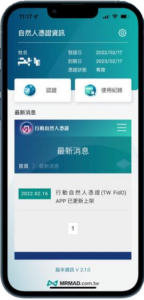
Taiwan’s mobile Citizen Digital Certificate. Source: Ministry of the Interior, Taiwan.
A zero-knowledge proof allows a user to demonstrate that a specific claim is true without handing over the private information used to establish it. Here, the claim is “I hold an eligible, government-issued credential.” The device produces a mathematical proof that the platform can check, while keeping the credential’s identifying details private. It is more than covering up fields on a document: the platform can verify that the required condition holds without seeing the underlying personal record. Additional safeguards and moderation are still needed to prevent duplicate participation, account compromise, or coordinated activity.
This civic experiment sits within a longer debate about state-issued identity. In 2020, the government planned to replace national identity cards with a chip-based New eID. Security researchers and human rights groups objected to the inadequate legal basis and unresolved security risks. In January 2021, the Executive Yuan put the plan on hold, making further implementation conditional on a stronger legal framework. The longstanding Citizen Digital Certificate system, operated through the Ministry of the Interior Certificate Authority (MOICA), continued to serve its conventional role.
Taiwan opened a new digital identity wallet sandbox in 2025. Rather than creating another national identity card, TW DIW lets government and private organizations issue digital credentials that people hold and selectively present. PTT’s proposed blue check uses the Citizen Digital Certificate as its foundation and adds zero-knowledge proofs. It shares the wallet’s ambition to give people more control over disclosure, without being a TW DIW implementation.
The state issues the underlying credential, but civic developers build the proof and the platform’s verification process. So while government credentials remain an important source of trust, civic technology can put that trust to work for a community’s own needs, and privacy-preserving cryptography is becoming practical enough to use outside a research setting.
How to maintain accountability with pseudonymous identity
If no one discloses a real name on an online platform, who answers when something goes wrong? We often think of accountability as attaching a name to a decision, which means whoever signs off must bear the consequences. But identifying a natural person and establishing a process that requires an actor to explain their conduct, face review, and accept consequences are separable tasks. Accountability does not need to start with disclosing a legal name to a platform or the public.
In my experience of platform governance, attacks by anonymous accounts often provoke calls for real-name verification. Requiring everyone to identify themselves in response can also harm whistleblowers, dissenters, and journalists protecting themselves or their sources. Civic action and association need services that can limit abuse while preserving privacy and room for anonymity.
Mark Bovens defines accountability as a relationship between an actor and a forum. The actor must explain and defend what they have done, the forum can question that account and reach a judgment, and the actor may face consequences. His framework invites a further question: can those relationships work without the disclosure of legal identity? In platform governance, some accountability functions may operate through a pseudonym if conduct can be reliably attributed to an account, its controller can receive notice and respond, and the platform can impose effective sanctions through a fair process. Real-name registration is one possible institutional choice, but the need for accountability alone does not make it a necessary condition for every form of participation.
Cryptography offers ways to address these concerns, for example, the zero-knowledge credential project being developed with PTT highlighted above is designed to let a user prove possession of an eligible credential without disclosing identity attributes such as a legal name. These types of privacy-preserving credentials can reduce services’ dependence on identity data, allow eligibility checks, enforcement, and identity disclosure to be designed for their separate purposes, and subject platforms and credential issuers to public scrutiny.
This is not meant to excuse unlawful conduct or make anonymity an absolute right. Cryptography, accountability theory, and constitutional law address different questions respectively; what is technically possible, how institutions require people to answer for their conduct, and which freedoms the law protects. Taken together, they support a narrower claim: universal real-name identification is not the only conceivable way to protect participation while providing accountability.
A pro-social vision for digital identity
Digital identity goes beyond only login, verification, and fraud prevention– institutions can do more than prevent harm, they can expand people’s ability to take part in public decisions. When designing a digital identity system to support this idea, builders may want to reflect on the following questions: Who is excluded? Does it protect personal data alone, or people’s capacity for civic action? Can a single actor control critical infrastructure such as the wallet, operating system, browser, or trust list? What place do civic communities have in its governance? Do people’s concerns receive a response?
Moving from this narrow definition of digital identity to a more pro-active vision of different civic proofs for different digital identity use cases means redistributing power within identity system providers. The state can provide a trusted basis for eligibility, and platforms can check necessary conditions. Neither should have full control and citizens should have a real say in deciding which actions require which civic proof and which spaces must preserve anonymity.
The public value of digital identity must ultimately be measured by what citizens can do: speak safely, associate on their own terms, and sustain collective action. The state may issue credentials. It should not have the sole authority to define the boundaries of public life.
References and further reading
This essay develops an argument first presented at the Allen Lab Fellow Meeting on April 17, 2026: From State-Issued Credentials to Citizens Proving Themselves.
Self-sovereign identity: Frederico Schardong and Ricardo Custódio, “Self-Sovereign Identity: A Systematic Review, Mapping and Taxonomy,” Sensors 22(15), 5641 (2022). Peer-reviewed review; open author manuscript.
ZKP explanations and applications: Ethereum Foundation PSE, “zkID” (privacy-preserving digital identity infrastructure); Semaphore, “Semaphore: Anonymous interactions” (proving group membership without revealing which member is participating).
Zero-knowledge proofs: MIT CSAIL, “Zero-Knowledge Proofs,” with the foundational reference to Shafi Goldwasser, Silvio Micali, and Charles Rackoff, “The Knowledge Complexity of Interactive Proof Systems,” SIAM Journal on Computing 18(1), 186–208 (1989).
Credential standards: W3C, Verifiable Credentials Data Model v2.0 (Recommendation, 2025), especially §5.7 and §8.9 on zero-knowledge proofs and data minimization; Digital Credentials (Working Draft, 2026). A credential format or wallet does not itself guarantee selective disclosure or unlinkability.
PTT case study: Vivian Jeng, “零知識行動自然人憑證開發 — 故事篇.” Developer account of the PTT collaboration and intended design; this is not an independent deployment or effectiveness evaluation.
Taiwan–China context: Associated Press, “Taiwan says China is redoubling efforts to undermine democracy with disinformation” (2025), reporting the National Security Bureau’s assessment; and “China issues warrants for alleged Taiwanese hackers and bans a business for pro-independence links” (2025).
Yen-Lin (mashbean) Huang is a former Policy Fellow at Harvard Kennedy School’s Allen Lab for Democracy Renovation. He previously served as a decentralization architect at Taiwan’s Ministry of Digital Affairs, where he helped develop the Taiwan Digital Identity Wallet.
The views expressed in this article are those of the author alone and do not necessarily represent the positions of the Ash Center or its affiliates.