Commentary
California Writes Public Deliberation Into Law
Engaged California is the nation’s first state-run deliberation program, and a new law aims to make it last.
Read the latest news, commentary, and analysis from the Ash Center.
Commentary
Engaged California is the nation’s first state-run deliberation program, and a new law aims to make it last.
Newest
Video
Harvard Kennedy School’s Ash Center and the Harvard Project on American Indian Economic Development hosted a diverse panel of Congressional and tribal leaders to look ahead and discuss how Congress might come together on a bipartisan basis to enhance support for Indian Country’s pandemic recovery efforts.
Video
The Ash Center hosted a discussion with three leading U.S. election practitioners – one litigator, one election official, and one national grassroots organizing leader – as we asked each of them a series of questions about their greatest fears around the voting process, their work to achieve a fully inclusive and well-administered election, and their ideas for the future of U.S. democracy.
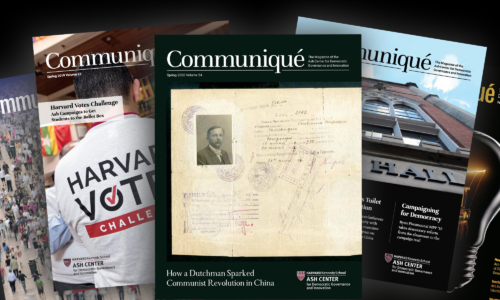
Communique Magazine
This issue, our first-ever digital-only magazine, explores how the Ash Center has responded to both the COVID-19 pandemic and consequential presidential election. We feature the democracy programs work on increasing voter participation and a report recommending universal civic duty voting. We highlight Director Tony Saich’s latest book on a Dutch Communist named Henk Sneevliet and his role in sparking the communist revolution in China, and we also detail the stories of Ash Center students, alumni and fellows around the globe.
Video
The Electoral College is the system by which Americans elect their president every four years. When American voters go to the polls for a presidential election, they are actually voting for a slate of electors who have pledged to support a specific candidate. These electors cast their own votes, and the winner is elected to the presidency. Two hundred years ago, the Framers incorporated the Electoral College into the United States Constitution, and to this day it remains one of the most controversial aspects of that document. But despite numerous attempts to reform or even abolish it, the Electoral College remains the mechanism by which Americans choose their president every four years. So why is it still around? Alex Keyssar, Matthew W. Stirling, Jr. Professor of History and Social Policy at Harvard Kennedy School, explores this subject in his latest book, “Why Do We Still Have The Electoral College?”
The answer is not as straight forward as one might think, and in this video Professor Keyssar discusses the myriad reasons that we still follow with what he calls, “a process that does not conform to democratic principles the nation has publicly championed.”
Behind the Book is a collaboration between the Office of Communications and Public Affairs and Library and Knowledge Services at Harvard Kennedy School.
Video
The Ash Center hosted a timely discussion with leading practitioners who are effectively integrating digital strategies with authentic power-building while navigating a never-before-seen civic environment.
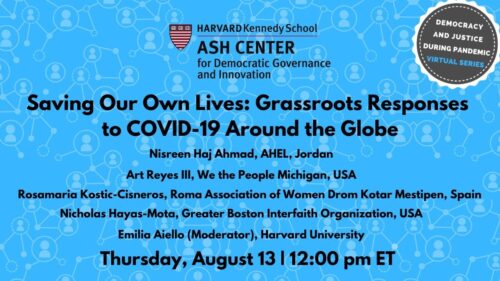
Video
To what extent have these organizations proven better equipped to deal with the pandemic response, and what are the challenges that these associations face when organizing in the age of COVID-19? In addition, how can they seize this moment to turn their organizing into power and influence in political and economic life?
Video
The Ash Center and the Center for Public Leadership recognized Civic Health Month and hosted a discussion on how healthcare workers are deepening civic engagement through voter empowerment, including how high levels of civic engagement can drive more equitable health outcomes.

Feature
The Great American Outdoors Act—the biggest land conservation legislation in decades—recently passed with huge bipartisan majorities in both chambers of Congress
Media Release